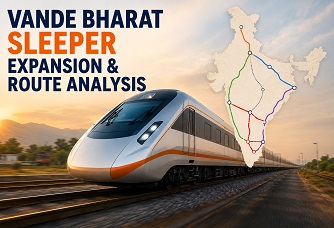
On January 17, 2026, Prime Minister Narendra Modi flagged off India’s first Vande Bharat Sleeper train from Howrah Junction, marking far more than a ceremonial railway inauguration. It signalled the beginning of the end for the decades-old Rajdhani-era model of overnight travel in India — and the birth of a new benchmark for what passengers on long-distance routes can expect.
Four months on, the data from India’s eastern corridor is in, and the verdict from passengers is resoundingly positive. With ergonomic berths, automatic doors, Kavach safety systems, improved onboard catering, and significantly reduced travel times, the Howrah–Kamakhya service has delivered a premium “airline-on-rails” experience at fares far more accessible than air travel. Early occupancy rates have been exceptionally strong, with tickets selling out rapidly.
What lies ahead, however, is even more ambitious: a nationwide expansion to some of India’s most-travelled overnight corridors. From the Deccan Plateau to the Indo-Gangetic Plains, Indian Railways aims to roll out multiple Vande Bharat Sleeper services by the end of 2026, targeting high-demand routes like Delhi–Howrah, Mumbai–Bengaluru, and others. This shift promises to transform long-distance rail travel across the country.
Also Read: Vande Bharat Booking & Passenger Experience
The Howrah–Kamakhya Vande Bharat Sleeper (train numbers 27575/27576), operated by Northeast Frontier Railway (NFR), covers 968 km in approximately 14 hours, cutting travel time by nearly three hours compared with the existing express services on the same corridor. Running six days a week, the train halts at 13 stations, threading through New Jalpaiguri, the gateway to Darjeeling's famous tea gardens, before pushing through the lush Assam plains to Guwahati's Kamakhya Junction.
The inaugural commercial run on January 23, 2026 drew an extraordinary response: all berths were sold out within hours of reservation windows opening. Railway Ministry officials confirmed that the swift sell-out reflected genuine pent-up demand rather than novelty-driven curiosity, with repeat bookings in subsequent weeks maintaining near-full occupancy on most runs. Per-journey ridership stands at around 823 passengers one way, and early feedback has consistently praised the smoother ride, quieter coaches, and dramatically improved sanitation compared with legacy overnight trains.
The on-board experience itself is a considerable step up from what Indian rail passengers have historically accepted. The 16-coach rake features three classes — AC First (1A), AC 2-Tier (2A), and AC 3-Tier (3A) — each with wide berths, roller blinds, individual reading lights, and electric outlets at every berth. The train's bio-vacuum toilet technology, aircraft-grade in design, has drawn particular praise from travellers fatigued by the state of conventional train lavatories.
First AC passengers are treated to a first for Indian semi-high-speed rail: dedicated shower cubicles with hot water, alongside improved ambient lighting and centrally controlled air-conditioning. On-board catering is available throughout the journey, with pantry cars serving both regional and standard railway menus.
Ticket pricing on the Howrah–Kamakhya route follows a fixed per-kilometre model: ₹2.4 per km for 3AC, ₹3.1 per km for 2AC, and ₹3.8 per km for First AC, with a minimum chargeable distance of 400 km regardless of actual journey length. For the full 968 km route, this translates to approximately ₹2,400 for 3AC, ₹3,100 for 2AC, and ₹3,800 for First AC, before the addition of 5% GST, reservation fees, and superfast charges.
These rates sit roughly 10–15% above comparable Rajdhani Express classes on the same corridor, a premium that Indian Railways has explicitly justified on the basis of speed, comfort, and the train's no-RAC, no-waitlist booking policy. Unlike any other express service in India, the Vande Bharat Sleeper issues only confirmed tickets. If the train is full, passengers simply cannot book — a policy designed to guarantee the quality of the travel experience and protect punctuality.
For the majority of regular AC travellers, the premium remains within reach, and early booking patterns suggest passengers are willing to pay it.
Also Read: Vande Bharat 2026: Redefining Rail Safety and Engineering Standards
The Rajdhani Express, introduced in 1969 as a locomotive-hauled flag-bearer connecting Delhi with major metros, has served as the gold standard for overnight rail travel for over five decades. The Vande Bharat Sleeper challenges that legacy on almost every dimension.
Speed: While the Vande Bharat Sleeper's design speed reaches 180 km/h — confirmed during December 2025 trials under the Commission of Railway Safety, it currently operates at up to 130 km/h for safety reasons on most routes. That still comfortably outpaces the Rajdhani Express, which averages 80–90 km/h. The result is a 15–20% reduction in journey time on comparable corridors.
Technology: The Vande Bharat Sleeper is self-propelled, an Electric Multiple Unit (EMU) where power is distributed across axles, as opposed to the Rajdhani's single locomotive-hauled configuration. This architecture allows rapid acceleration (0 to 100 km/h in 52 seconds) and more precise braking. Every rake is equipped with Kavach 4.0, the latest version of India's indigenous Automatic Train Protection system, which uses RFID-based logic to prevent Signal Passing at Danger (SPAD) events. Semi-permanent couplers additionally reduce the jerk and sway that has long plagued overnight passengers.
Safety Standards: The trainset adheres to EN 45545 HL3 fire-safety standards, with fire-resistant materials in all non-metallic components and "fire barrier" end-wall doors designed to contain compartment fires for at least 15 minutes. The Rajdhani's older rolling stock carries no equivalent certification.
Hygiene and Comfort: Bio-vacuum toilets, sensor-based taps, odour-control technology, CCTV coverage, automatic doors, and infotainment systems with on-board Wi-Fi place the Vande Bharat Sleeper in a different category from the Rajdhani's infrastructure — most of which was designed in a different era.
Booking: The Rajdhani allows RAC and waitlisted tickets, meaning passengers may travel on a shared berth or face last-minute cancellations. The Vande Bharat Sleeper's confirmed-only policy eliminates that uncertainty entirely.
The conclusion for most passengers planning long-distance overnight journeys is increasingly clear: for those who can secure a confirmed ticket, the Vande Bharat Sleeper is simply a superior product.
Railway planners have been open about their strategy: identify 1,000–1,500 km corridors with sufficient overnight demand, proven infrastructure, and maintenance turnaround feasibility. The Howrah–Kamakhya route, at 968 km and 14 hours, is described internally as the "natural sweet spot" — long enough to justify sleeper berths, short enough to fit cleanly into an overnight window.
Production is ramping up. The third and fourth Vande Bharat Sleeper rakes were scheduled for rollout by March 2026, with Indian Railways targeting a delivery rate of one rake per month for the next six units through August 2026. With a growing fleet, the question of route allocation is no longer theoretical.
Bengaluru–Mumbai CSMT is the most advanced proposal. The 1,125 km corridor has already been approved, with South Western Railway (SWR) as the operating zone. A journey time of approximately 16 hours is projected, with a maximum permissible speed of 130 km/h. The approval date of April 5, 2026 places the launch in likely late 2026 or early 2027.
Pune–Hyderabad and Hyderabad–Bengaluru are among the Deccan corridors generating strong interest. Both cities are separated by distances of 560–700 km, sitting at the shorter end of the sleeper sweet spot; planners are likely evaluating whether demand justifies a dedicated sleeper rake or whether a shared service across a longer corridor — such as Pune–Hyderabad–Bangalore — makes more operational sense.
Hyderabad–Chennai and Chennai–Bengaluru represent high-demand South Indian corridors where the current overnight options are heavily subscribed. The Chennai–Bengaluru distance of around 350 km sits below the Vande Bharat Sleeper's minimum chargeable threshold, making it more suited to the Chair Car variant; but Hyderabad–Chennai (around 700 km) fits the sleeper profile comfortably.
Delhi–Varanasi holds symbolic significance: it was on this very axis that the original Vande Bharat Chair Car service debuted in 2019. Railway Board officials have signalled that once two or three sleeper rakes are in sustained regular service, a high-visibility Delhi route will follow. Delhi–Varanasi at approximately 800 km is an ideal test.
Delhi–Amritsar has already received a ministerial announcement: Union Minister of State for Railways Ravneet Bittu confirmed in February 2026 that an exclusive Vande Bharat Sleeper service via Chandigarh, Ludhiana, and Jalandhar is planned for launch by winter 2026.
Mumbai–Pune is a shorter corridor at around 190 km — too short for sleeper class alone, but it is under active discussion as part of an extended route, potentially as the Pune end of the Mumbai–Bengaluru service.
Longer-term proposals under active Railway Board consideration include Delhi–Pune, Delhi–Bengaluru, Ahmedabad–Kolkata, and Mumbai–Kolkata — corridors ranging from 1,200 to 2,000 km that would push the Vande Bharat Sleeper beyond its current operational envelope and potentially require overnight scheduling across two nights.
Also Read: Is Digital Lifeline of India at Risk? The Undersea Cable Chokepoints
The broader implication of the Vande Bharat Sleeper programme is a systemic shift in how India thinks about premium overnight rail. For decades, the Rajdhani Express defined the ceiling of what rail travel could offer. That ceiling is being lifted.
The no-RAC policy alone is transformative. Millions of Indian rail passengers have experienced the anxiety of booking a waitlisted ticket and hoping for confirmation, or the indignity of an RAC berth shared with a stranger. The Vande Bharat Sleeper's guarantee of either a confirmed seat or no booking eliminates that entirely, nudging the product closer to the certainty of airline ticketing.
For now, the Howrah–Kamakhya corridor carries the weight of proof-of-concept. By most early measures, it is delivering. If fleet expansion proceeds as scheduled through August 2026, and if South India's high-demand corridors come online in 2027, the Vande Bharat Sleeper may well do what railway planners once only promised: make overnight rail travel in India genuinely aspirational again.
.jpg "AR Enterprises: Building The Supply Networks Behind India's Construction Growth")
.jpg "Industrial Packers: Engineering Industrial Packaging for India's Manufacturing Future")





We use cookies to ensure you get the best experience on our website. Read more...