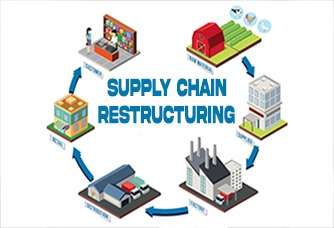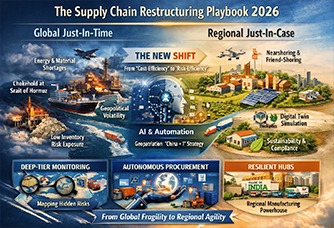
In 2026, the convergence of the West Asia war, a severe energy crisis, and the near-halt of the Strait of Hormuz has turned the "Just-in-Time" (JIT) model into a major strategic liability. Today, Supply Chain Restructuring is a must to stay competitive. It is evident that the global supply chain landscape is undergoing a fundamental transformation, moving from the efficiency-first "Global/Just-in-Time" (JIT) model to a resilience-focused "Regional/Just-in-Case" (JIC) approach.
This shift is critical because modern supply chains are no longer just operational networks; they have become geopolitical flashpoints - representing a transition from hyper-optimized, low-inventory global networks to localized, buffer-heavy systems designed to withstand systemic shocks.
As the world's most vital energy artery, the strait of Hormuz carries roughly 25 percent of global seaborne oil and 20 percent of LNG. The ongoing war has kept the strait in a "Chokehold" with daily ship transits plunged by 95 percent (from 129 per day to just 6) due to hostilities and Iranian-imposed tolls.
S. Jaishankar (External Affairs Minister) warns against over-reliance on single sources, advising that "excessive dependence on [one] supply chain could be detrimental to India’s national interest."
This article has been meticulously crafted to help master 2026 supply chain restructuring with our expert playbook. Transition from fragile Just-in-Time (JIT) to resilient Just-in-Case (JIC) models using Agentic AI, deep-tier visibility, and regionalized hubs.
Under a JIT model, even a 12-day closure can trigger a "total systemic collapse." This is because businesses lack the inventory to wait out such blockades. Understanding the importance of this, the JIC approach will focus on inventory buffering by maintaining months of stock instead of days; thereby allowing companies to continue operations while awaiting safe passage or alternate routes.
Rising fuel prices immediately spike logistics and manufacturing costs, which JIT systems, due to its thin margins, cannot easily absorb. Acting as a regional energy sovereignty, JIC encourages regionalizing supply chains to reduce the "miles traveled" for goods, thereby lowering exposure to high global freight and fuel costs.
Furthermore, this is not just limited to energy. Currently, the conflict has expanded beyond energy into a "multi-commodity industrial corridor" crisis.
The world is witnessing critical material shortages as West Asia provides 68.5 percent of the world's limestone, 62 percent of its gypsum, and roughly 43 percent of seaborne urea exports (essential for fertilizers).
A disruption in fertilizer shipments directly threatens upcoming crop cycles (e.g., India's Kharif season). Regionalizing these supplies or keeping "Just-in-Case" stockpiles is now a matter of national food security.
From "Cost-Efficiency" to "Risk-Efficiency," the "old rules" of seeking the lowest cost globally no longer apply. So to say, 88 percent of businesses plan to reconfigure their chains in 2026, with 46 percent focusing on geographic diversification to avoid relying on a single, high-risk region.
Anticipatory strategy have become imperative, wherein, companies are moving from reactive management to strategic scenario planning, assuming 30-, 60-, or 90-day disruptions as a baseline rather than an exception
For years, supply chains operated on "just-in-time" principles to minimize storage costs and optimize cash flow. However, geopolitical shifts, trade tariffs, and climate events have made this model fragile.
So to say, the era of absolute lean manufacturing—defined by minimal inventory and just-in-time (JIT) delivery—is being re-evaluated. The "Just-in-Case" (JIC) pivot represents a shift from prioritizing low costs to ensuring operational continuity in a volatile, post-globalized landscape.
By 2026, building resilience through strategic inventory management is not just a defensive tactic, but a key competitive advantage that balances working capital with the high costs of supply chain disruption.
The JIC approach involves proactive risk mitigation by stocking safety buffers for:
Critical Components: High-risk or long-lead-time components are needed with respect to availability to prevent total production stoppage.
Unpredictable Demand: Buffers against sudden, unexpected spikes in customer demand must be kept in mind.
Regionalized Supply: Inventory located in regional "nearshore" hubs rather than awaiting long-distance shipping.
It is also noteworthy to note that shifting to JIC requires tying up more working capital in inventory, which directly impacts corporate finance. Executive leaders must re-balance this formula:
Cost of Stockouts vs. Holding Costs: The financial impact of a stopped production line now far outweighs the carrying cost of inventory. JIC reduces stockout risks and avoids the "panic buying" that drives up expenses.
Strategic Stockpiling as a Hedge: Purchasing in bulk (JIC) acts as a hedge against rising raw material costs and inflation in 2026.
Inventory Visibility: Utilizing AI-driven analytics allows companies to maintain a lower level of "safe" safety stock, optimizing capital while still ensuring resilience.
While having said that, a credible report states that instead of abandoning lean, companies are embracing a hybrid model, applying JIT to fast-moving, predictable items and JIC to critical, fragile items.
Transition from "Pilot Purgatory" to Scaling AI: After years of experimentation, AI is finally moving into scaled deployment today. This year (2026) itself saw 86 percent of organizations plan to scale AI, and the 40 percent of enterprise applications is said to embed AI agents to handle routine procurement tasks (such as sourcing and contract review) with minimal human intervention.
Structural Geopolitical Risk: Geopolitical tensions and tariffs have moved from temporary disruptions to permanent policy, forcing a permanent redesign of supply networks. 73 percent of UK firms expect intensified risk in 2026, pushing companies toward "friend-shoring".
Mandatory Sustainability & Compliance: New regulations, such as the EU Digital Product Passport (DPP), make sustainability a requirement rather than a competitive edge. This necessitates tracking embedded carbon and ensuring ethical sourcing, which is easier with regionalized, transparent networks.
Workforce Shortages: Structural labor shortages in logistics and warehousing are driving a mandatory shift toward automation, with 45 percent of supply chain leaders planning to purchase automation equipment to complement human talent.
To successfully shift from Lean to Resilient, executives are employing the following strategies:
AI-Powered Demand Planning: Leveraging AI to improve forecasting reduces the amount of excess inventory required, making JIC more cost-effective.
Multi-Tier Visibility: Implementing tools that map sub-tier suppliers (Tier 2 and 3) helps identify where critical buffers are necessary.
Regionalization and Nearshoring: Moving inventory closer to the end market—nearshoring—reduces the lead time required for safety stock replenishment.
Supplier Collaboration: Establishing partnerships that share demand data to allow suppliers to manage the buffer inventory, reducing the direct working capital burden on the manufacturer.
By 2026, the goal is not to eliminate inventory but to have the right inventory at the right time, turning supply chain resilience into a "Total Value" proposition rather than merely a cost center.
India has seen one of the most dramatic growth when it comes to supply chain management and the market as a whole. According to McKinsey & Company, India has overtaken China with 40 percent share of the US smartphone supply chain. Now, India accounts for approximately 40 per cent of the smartphone supply to the United States that was formerly fulfilled by Chinese manufacturers.
Today, we are witnessing a significant pivot in American trade strategy, wherein, Washington has actively diversified its import sources. To be precise, the United States has successfully reallocated more than USD 80 billion in trade value which was previously sourced from China. This showcases a replacement of roughly two-thirds of those specific goods.
While various regions have stepped in to fill the void, India and the ASEAN bloc have emerged as the most significant beneficiaries of this realignment.
However, the growing demand also means that India must meet the global supply chain benchmarks. But for this to happen, supply chain restructuring is of utmost priority. Or rather to say it has become the imperative need of the hour - making a much-needed shift from a focus on cost-driven efficiency to a model which is prioritized by resilience, automation, and regionalization.
Kumar Mangalam Birla (Aditya Birla Group) asserts that a "decadal reshaping" is underway, moving away from global fragility. He notes, "We wouldn't look at a company or a business where you source in one corner of the world and sell in another corner of the world... [Globalization needs] a very sharp dimension of regionalization to it."
The convergence of persistent geopolitical volatility, advanced agentic AI capabilities, and strict sustainability regulations is forcing organizations to pivot from pilot projects to fully integrated, autonomous, and regionalized supply chains.
“Geopatriation" or "friend-shoring" is showcasing an upward trajectory with organizations moving critical data and operations to secure, local regions.
Power-of-Two Networks: For instance, companies are building regional hubs in North America, Europe, and Southeast Asia to move production closer to demand and reduce dependence on a single global source.
Logistics Control Towers: Regionalized hubs can be managed through "control towers" that leverage real-time data to handle logistics bottlenecks and improve resilience.
Shortened Supply Lines: Regionalization also allows for prompt, more predictable deliveries to meet consumer demand while reducing exposure to international transit disruptions at the same time.
The procurement is shifting from "advisory" AI to Agentic AI, which can act autonomously within pre-set, governed parameters. Understanding the competency of teams across departments, Anand Mahindra from Mahindra Group emphasizes in connecting supply chain innovation to human capital, stating that "innovation is developed by teams with skills" and that investing in people is the key to managing such complex systems.
Touchless Operations: Autonomous agents are expected to handle up to 60–70 percent of end-to-end transactional procurement. This will include aspects such as issuing RFPs, evaluating supplier responses, and managing contract renewals.
Predictive Risk Monitoring: AI agents are replacing annual audits today by scanning for supplier financial, geopolitical, and ESG risks all round the clock.
Zero-Click Intelligence: Procurement teams are expected to increasingly rely on AI-generated summaries to make faster, data-driven decisions.
As these trends converge, procurement teams are transforming from cost-control units into strategic partners:
AI Risk Management: Spending on AI risk management is rising (up by 37 percent) to ensure transparency, compliance, and reliability.
Total Value Over Cost: Leading organizations are focusing on total value (profitability, risk reduction, speed) rather than only unit cost.
Strategic Supplier Partnerships: Suppliers are now treated as innovation partners rather than just vendors, with deeper integration for co-innovation.
2026 represents the moment where the cost of inaction—brittle, opaque networks—becomes too high, and the technology to build superior, resilient systems finally matures, making autonomous and regionalized strategies the new standard.
By 2026, deep-tier visibility—mapping beyond Tier 1 to Tier 2 and Tier 3 suppliers—is no longer a competitive advantage but a necessity, as over 50 percent of disruptions originate from these hidden, lower-tier dependencies. Restructuring for 2026 resilience requires moving from annual supplier audits to continuous, AI-powered monitoring of the entire supplier network to uncover single-point failures in raw materials and sub-components.
Lower-tier mapping identifies "hidden" bottlenecks where multiple Tier 1 suppliers rely on the same Tier 2 or Tier 3 source, creating a high-impact, single-point dependency.
Direct Engagement & Digital Tools: Utilize mapping software and demand that Tier 1 suppliers disclose their key sources (Tier 2/3).
Ingredient Tracking: Request Bills of Materials (BOMs) to identify specific, critical inputs—like rare earth metals or specialized semiconductors—sourced from a single location or supplier.
Automated Monitoring: By 2026, over 50 percent of large enterprises are said to utilize real-time visibility platforms to receive alerts on shipping delays or geopolitical risks affecting Tier 2 suppliers, rather than relying on historical, manual reports.
Geographic Concentration: Multiple sub-suppliers located in the same country or region exposed to identical climate, political, or trade risks.
Single-Source Components: A single supplier providing a critical, hard-to-replace component.
Supplier Financial Health: Low-tier suppliers lacking the financial strength to survive market volatility.
Multi-sourcing is not just about having a backup; it is a mathematical approach to optimizing risk against total cost. If a primary supplier has a probability of disruption and a secondary supplier has assumed independence, the probability of both failing simultaneously is
By adding a secondary, independent supplier, the chance of a total supply shutdown decreases exponentially.
The most crucial metric in 2026 is mapping the Time to Recover (TTR) of a sub-supplier, compared to the Time to Survive (TTS) of the organization. If TTR > TTS, multi-sourcing is required.
Fostering optimal allocation modeling, modern procurement uses weighted sum methods to balance multiple objectives simultaneously.
Nearshoring and Friend-shoring: Moving manufacturing closer to the end consumer (e.g., US companies moving production from Asia to Mexico) to slash lead times from weeks to days.
Decentralized Manufacturing: Utilizing micro-factories and 3D printing to produce goods locally, reducing the need for massive, centralized hubs that require transcontinental shipping.
Digital Twin Logistics: Using AI to simulate regional disruptions, allowing companies to pivot between local suppliers instantly when a specific region faces a climate or political event.
In this new model, the "Global" entity acts as the connective tissue—managing data, brand, and IP—while the physical execution is handled by autonomous regional nodes.
Major industries like automotive and electronics are leading the transition toward multi-regional networks. This showcases the move away from centralized global models to protect against rising geopolitical tensions and climate-driven logistics failures. Electronics companies, traditionally dependent on East Asian manufacturing, are now creating parallel supply chains to de-risk their operations.
India now contributes roughly 14–15% of iPhone output, with facilities near Chennai serving as a regional powerhouse.
Furthermore, to speak of another instance, a major electronics firm used digital optimization models to assess sites based on geopolitical trade risk and carbon footprint. By relocating production closer to customers, they reduced their average freight haul length by 50 percent and cut carbon emissions by 15 percent.
This allows companies to choose the best configuration (e.g., 70 percent primary, 30 percent backup) to maximize reliability without overspending. Contingency "Shadow" Suppliers is another model where rather than just maintaining two active suppliers, which can increase complexity, 2026 strategies involve maintaining a pre-qualified "shadow" supplier in a different region that can ramp up within hours, not weeks.
Prioritize Deep-Tier Mapping: Focus efforts on high-value, sole-sourced, or specialized components.
Implement Real-Time Risk Monitoring: Shift from manual to AI-driven supplier risk tools.
Establish Strategic Redundancy: Qualify secondary suppliers located in different regions (e.g., diversifying a single-source Tier 2 in Asia with a partner in a different continent or closer to a new nearshore site)
Now let’s delve into the nitty-gritty of integrating advanced technologies. To take from an instance, Agentic AI is transforming procurement from a reactive administrative function into a self-healing, autonomous system. In the 2026 supply chain landscape, these "agents" don't just suggest actions—they execute them.
Here is how autonomous agents drive resilience through spot-buying and negotiation:
When a primary supplier fails due to a geopolitical or climate event, the "time-to-recovery" is often delayed by manual sourcing. Agentic AI eliminates this lag:
Instant Market Scanning: Agents continuously monitor global marketplaces and Tier-2/3 databases. The moment a disruption is flagged, the agent identifies alternative suppliers with available capacity that meet pre-set ESG and quality standards.
Dynamic Bidding: Instead of a human sending ten emails, an agent initiates parallel "micro-tenders." It manages the RFQ (Request for Quote) process in real-time, comparing landed costs, lead times, and risk scores simultaneously.
Execution: Agents can autonomously execute low-to-medium value "spot buys" to keep production lines moving, ensuring that the premium paid for speed is within pre-authorized financial guardrails.
Beyond simple transactions, 2026-era agents use Large Language Models (LLMs) specialized in legal and commercial logic to negotiate terms:
Game Theory Optimization: Agents use "principled negotiation" frameworks to find the Best Alternative to a Negotiated Agreement (BATNA). They can trade off price for better "force majeure" clauses or faster delivery windows based on the current urgency.
Real-time Risk Clause Insertion: During a crisis, an agent doesn't just negotiate price; it insists on transparency requirements or "right to sub-source" clauses that a human might overlook in the heat of a disruption.
Closing the Loop: Once terms are met, the agent generates the contract, aligns it with corporate compliance, and pushes it to the ERP system for immediate PO issuance.
Agentic AI moves procurement from "detect and respond" to "predict and prevent":
Supplier Health Monitoring: Agents "crawl" unconventional data—local news in native languages, port congestion data, and satellite imagery—to sense a supplier's distress weeks before a formal notification arrives.
Autonomous Diversification: If an agent detects a rising risk concentration in a specific region (e.g., a "nearshore" hub becoming over-saturated), it can initiate the onboarding process for a supplier in a different "friend-shoring" geography without human prompting.
By 2026, the competitive advantage shifts to firms that treat procurement agents as a digital workforce. This reduces "tail spend" leakage and ensures that when the next "black swan" event hits, your supply chain begins its recovery in seconds, not weeks.
In the 2026 restructuring landscape, Digital Twins serve as the "flight simulator" for supply chain executives. While standard analytics look at the past, a Digital Twin is a dynamic, virtual replica of your end-to-end network that synchronizes real-time data from IoT, ERP, and logistics platforms to mirror and optimize current operations.
For a supply chain undergoing restructuring to improve regional agility, the focus shifts from cost-optimization to systemic elasticity—specifically proving that the new model can handle extreme volatility, such as a 30% demand surge.
The primary goal of stress-testing with a Digital Twin is to discover the "breaking points" of a regionalized network before they manifest in reality.
Proving Throughput (The 30% Spike): Executives use these tools to run "What-If" scenarios specifically targeting demand volatility. By simulating a 30% spike, the twin identifies exactly which node (a regional distribution center, a Tier-2 supplier, or a local transport route) will bottleneck first.
Design of Experiments (DoE): Modern twins embed DoE frameworks to systematically explore thousands of variable combinations—such as labor availability, lead time, and port capacity—to establish data-backed "decision boundaries" for regional operations.
Measuring Time-to-Recovery (TTR): Beyond just predicting failures, twins calculate the Mean Time to Recovery. In 2026, a resilient restructured chain must prove it can return to stable operations within 24–48 hours of a major shock.
When selecting a technology enabler for regional stress-testing, platforms like AnyLogistix, Coupa, and Llamasoft (now Coupa) are central. They offer:
Strategic vs. Operational Twins: Strategic twins act as "virtual laboratories" for long-term network redesign, while operational twins (or "Control Towers") monitor and adjust flows in real-time to maintain service levels during spikes.
Multi-Agent Coordination: Advanced platforms like NVIDIA Omniverse allow for store-level and warehouse-level simulations, modeling how thousands of robotic agents and workers will interact during peak demand to ensure 99 percent uptime.
Predictive Sensitivity: These platforms can identify that a 10 percent shift in fuel costs or a 15 percent labor shortage in a specific region will erode margins by a precise percentage, allowing for preemptive resource reallocation.
The Innovation: Developed a proprietary technology stack that treats logistics as a platform rather than a pipeline. They use AI-powered route optimization and dynamic network planning to handle over 2 million shipments daily.
Win-Win: Businesses get end-to-end visibility and reduced return rates (from 38% to 16% in some cases). Consumers receive packages faster and more reliably across nearly every pin code in India.
The Innovation: Eliminated middlemen by connecting farmers directly with retailers and restaurants using an integrated supply chain platform. They use demand forecasting to move perishables from farm to store in under 12 hours.
Win-Win: Farmers earn nearly 20% more for their produce by avoiding commission agents, while consumers get fresher, higher-quality vegetables at stable prices.
The Innovation: Built an asset-light "virtual" network that stitches together underutilised local capacity—like spare space in kirana stores or idle local trucks—instead of building expensive warehouses.
Win-Win: FMCG brands can reach remote villages (over 80,000 to date) without massive infrastructure costs. Rural consumers get access to the same diverse product ranges as urban dwellers at fair prices.
Locus.sh: The AI Decision Engine
The Innovation: Provides a SaaS platform that automates complex supply chain decisions like last-mile dispatching and route planning. Their patented geocoding converts fuzzy Indian addresses into precise coordinates.
Win-Win: Organizations like Tata Croma and BigBasket reduce fuel costs and logistics overhead by up to 20%. Consumers enjoy more precise "preferred time" delivery slots and higher on-time fulfillment rates.
The Innovation: Created a digital marketplace that connects shippers with over 700,000 truckers. It uses telematics and GPS tracking to solve the fragmentation of the Indian trucking industry.
Win-Win: Fleet operators reduce "empty miles" (idle time), while companies gain real-time transparency and cost efficiency for bulk freight movements.
Simulation turns "regional agility" from a buzzword into a measurable science. By 2026, companies using digital twins achieve up to 95 percent prediction accuracy and can reduce disruption-related losses by an average of 25 percent through proactive contingency planning
Indian startups are restructuring the supply chain by moving away from traditional, manual models toward digitised, asset-light, and AI-driven networks. These innovations typically focus on solving "untraceable" legs of the journey, such as rural penetration and messy last-mile delivery.
Going forward, the long-term outlook for 2026 exects a "hardened" global manufacturing core, characterized by shorter, more agile, and highly automated value chains. Organizations are shifting from defensive, reactive tactics to proactive, cognitive systems that can automatically detect and respond to disruptions
In line with this, supply chain restructuring in India is undergoing a massive transformation, wherein, it is shifting from traditional cost-focused models to resilient, technology-enabled, and sustainable networks.
Driven by the "China + 1" strategy, geopolitical shifts, and government initiatives like “Make in India” and “PM Gati Shakti” India is emerging as a premier global manufacturing and sourcing hub. The future path is somewhat clear and involves accelerating the adoption of digital technologies, improving logistics infrastructure to lower costs, and achieving significant ESG compliance by 2030.
We use cookies to ensure you get the best experience on our website. Read more...