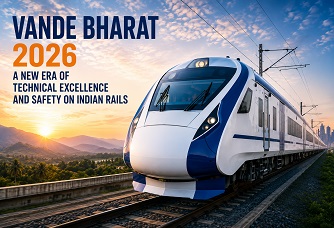
India's flagship semi-high-speed train programme is entering one of its most transformative phases. In 2026, the Vande Bharat Express is no longer just a symbol of domestic manufacturing pride; it is rapidly evolving into a benchmark for modern rail safety, smart technology, and passenger-first engineering. The programme, backed by the Pradhan Mantri Gati Shakti Yojana, is also strengthening India's indigenous automatic train protection system ecosystem.
The programme, which began at the Integral Coach Factory, has now expanded production to the Rail Coach Factory Kapurthala and the Modern Coach Factory in Raebareli, reflecting the scale at which India is advancing its railway manufacturing capability. Each new generation of trainsets rolls out with measurably refined engineering, and 2026 has delivered some of the most significant upgrades to date.
On the safety front, the milestones are remarkable. Indian Railways successfully conducted high-speed trials of its indigenous Kavach automatic train protection system at 160 km/h on the Dadri-Tundla section using a 20-coach Vande Bharat rake, evaluating speed supervision and automatic braking intervention under real operating conditions. In a record-setting achievement, Kavach Version 4.0 was installed across 472.3 route kilometres in a single day in January 2026 — the highest ever recorded — bringing total coverage to over 1,300 route kilometres across five railway zones.
Meanwhile, the Vande Bharat Sleeper variant is introducing a new tier of maintenance intelligence. Northeast Frontier Railway has deployed a smart Air Spring Monitoring System, a Portable Vibration Monitoring System for real-time diagnostics, and an indigenously engineered External Pit Power Supply and Pre-cooling System — tools that are setting new global benchmarks in predictive maintenance and crew safety.
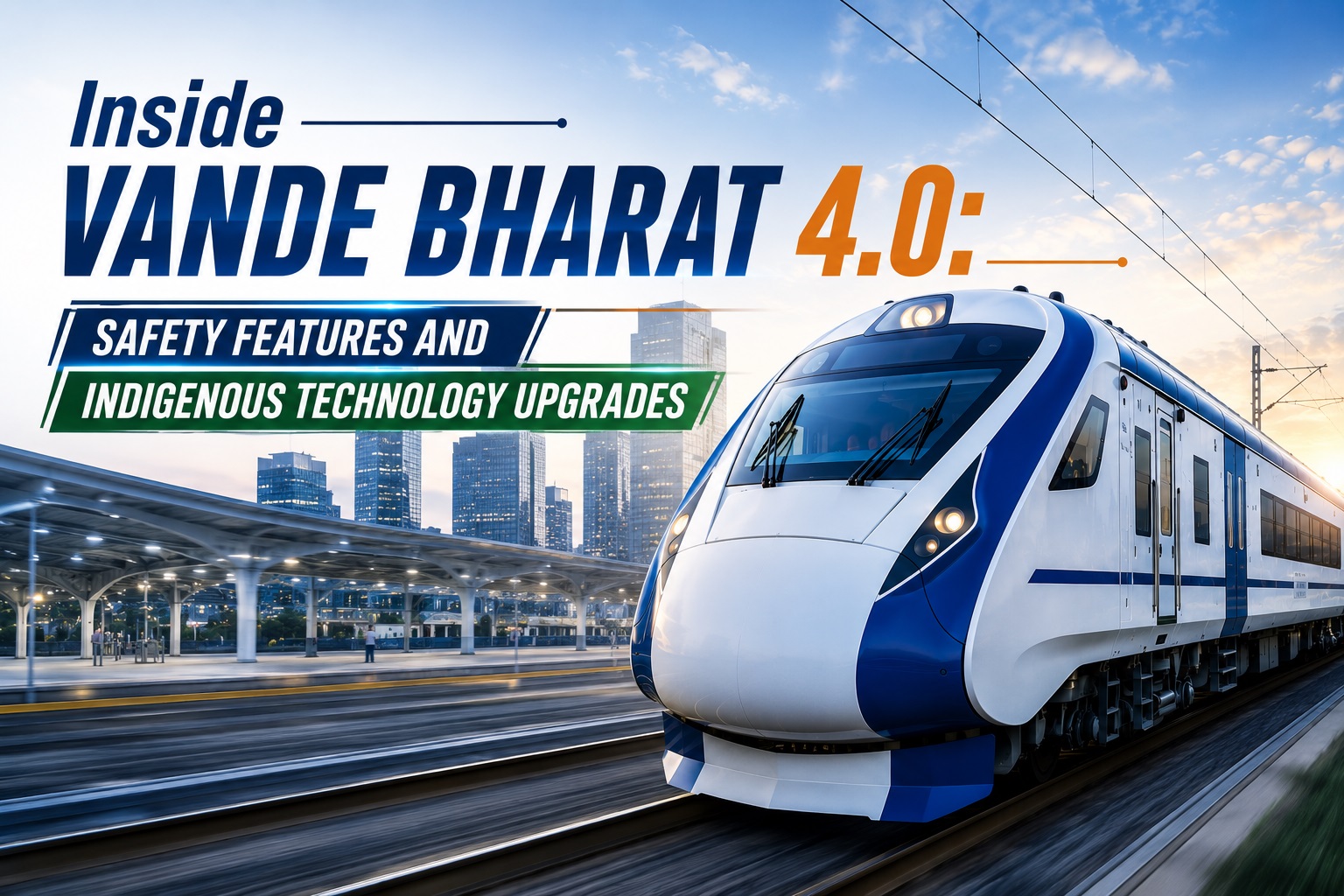 When Indian Railways launched the first Vande Bharat Express in 2019, it was a statement of intent, a self-propelled, semi-high-speed train built indigenously. Five years and several iterations later, the platform is maturing rapidly.
Vande Bharat 3.0, currently the workhorse of India's premium inter-city network, can accelerate from 0 to 100 kmph in 52 seconds, generates lower noise and vibration than its predecessors, and runs on regenerative braking that feeds power back to the grid. But Vande Bharat 4.0, now in advanced planning, is designed to leapfrog these benchmarks entirely.
The most consequential difference is in the safety architecture. Where 3.0 relies on earlier Kavach integration and conventional brake supervision, 4.0 is envisaged to incorporate Kavach 5.0 — India's next-generation automatic train control and automatic train protection system, announced in April 2025.
Kavach 5.0 is specifically designed for denser suburban and semi-high-speed operations, enabling significantly reduced inter-train headway, which means more trains can safely share the same corridor. This is critical for high-demand routes like Delhi–Mumbai and Delhi–Howrah, where Mission Raftar is targeting operational speeds of 160 kmph and beyond.
"The integration of Kavach 5.0 into the Vande Bharat 4.0 platform marks a critical evolution in our indigenous safety and performance framework, ensuring that high speed is always balanced with absolute reliability," says Satish Kumar, Chairman and CEO of the Railway Board.
On the passenger experience side, Vande Bharat 4.0 is expected to bring enhanced seating with improved ergonomics, better-finished coach interiors, and an upgraded bio-vacuum toilet system. The version currently being prototyped for export markets will also need to meet international crashworthiness standards, pushing ICF and BEML to refine the semi-permanent coupler and anti-climber assemblies that are already present on the Sleeper variant.
Also Read: May Day 2026: Collaborative Automation Powering Indian Factory Workers
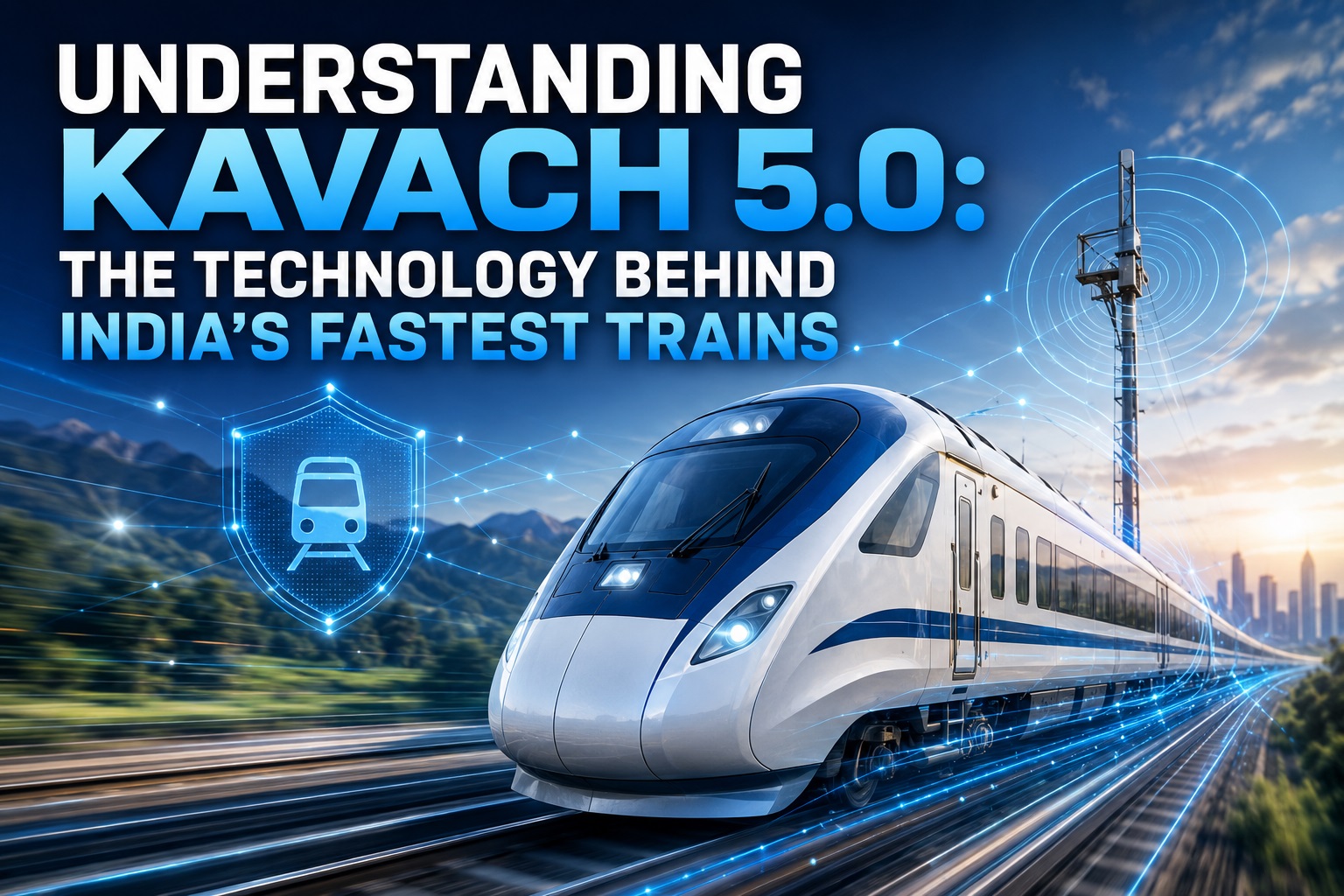 India's Kavach system — the name translates to "armour" — is the country's homegrown answer to European Train Control System standards.
Developed by the Research Design and Standards Organisation (RDSO) in collaboration with certified Indian vendors, Kavach is an automatic train protection system that operates continuously and autonomously, without depending on driver alertness.
It monitors speed against permissible limits, reads lineside signals, and applies brakes automatically if a driver fails to respond — particularly vital during fog, heavy rain, or high-speed operations where human reaction windows shrink to fractions of a second.
“Kavach 5.0 is a game-changing upgrade tailored for high-density suburban networks like Mumbai. By reducing the inter-train headway by nearly 30%, it will enable us to run 30% more trains safely and efficiently, transforming passenger experience while upholding the highest safety standards,” says Ashwini Vaishnaw, Union Railway Minister.
The system's credibility was established emphatically in February 2026, when Indian Railways conducted a trial of Kavach 4.0 at 160 kmph on the Dadri–Tundla section in Prayagraj division — a 167-kilometre stretch that forms part of the critical Delhi–Howrah corridor. A 20-coach Vande Bharat rake was used for the trial.
The North Central Railway confirmed that speed supervision and automatic braking intervention performed precisely at 160 kmph during the test speed train exercise, meeting all safety benchmarks. This is the kind of real-world proof that moves Kavach from a policy promise to an operational standard.
Kavach 5.0 adds a layer designed for frequency rather than just safety: it reduces inter-train headway, allowing more trains to operate on the same route without compromising safe braking distances. This matters enormously for urban and suburban sections where a single corridor may need to handle dozens of services per hour.
The system communicates via a combination of radio frequency identification tags embedded in the track, ultra-high frequency transmitters operating on dedicated uhf tag frequency, and a central rail monitoring system that creates a live digital picture of train positions across the network — effectively a vande bharat train tracking infrastructure built into the signalling layer itself and enabling accurate train live location visibility.
Kavach is also notable for its indigenous DNA. Every component — from the onboard logic unit to the trackside RFID tags — is manufactured within India, fitting squarely within the Pradhan Mantri Gati Shakti Yojana framework for integrated infrastructure development. The January 2026 milestone of installing Kavach 4.0 on 472.3 route kilometres in a single month — the highest ever recorded — shows that deployment has moved from pilot to industrial scale. An additional 2,667 route kilometres of sanctioned work is currently underway.
Also Read: Top Government Schemes for Manufacturing Startups in India 2026
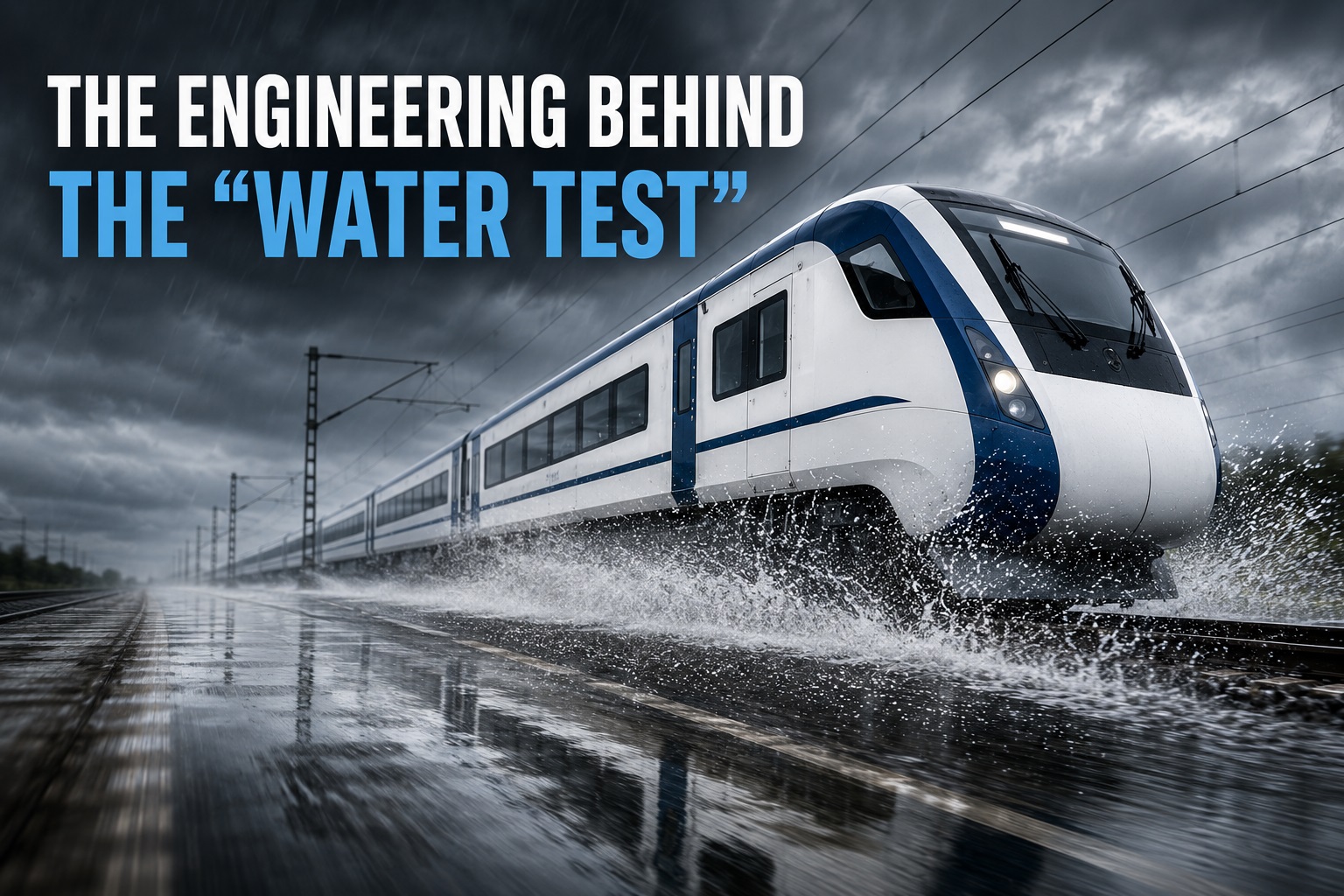 On December 30, 2025, Railway Minister Ashwini Vaishnaw posted a video that briefly captured the country's attention. It showed glasses of water, placed on a surface inside a moving coach, remaining perfectly still — not a ripple, not a drop spilled — as the train hurtled through the Kota–Nagda section of Rajasthan at 180 kmph.
This now-famous vande bharath water test was not a publicity stunt. It was a precision engineering demonstration, and it told engineers and railfans alike exactly what they needed to know: the ride quality of the Vande Bharat Sleeper is stable enough for overnight travel at semi-high speed.
Achieving this kind of stability at 180 kmph on a conventional broad-gauge track requires solving several overlapping engineering problems simultaneously.
The primary solution is an advanced air suspension system — a significant upgrade over the traditional coil and leaf spring assemblies used in older Indian rolling stock.
Air suspension automatically adjusts to load variations across the coach, maintaining a consistent ride height and absorbing vertical and lateral oscillations before they translate into passenger discomfort. In a sleeper configuration where passengers are horizontal and sensitive to even minor vibrations, this is not a luxury but a necessity.
The CRS trial on the Kota–Nagda section was comprehensive, not ceremonial. Engineers assessed ride stability, oscillation patterns, vibration behaviour across the coach floor, emergency braking distances, and full safety system functionality.
The Commissioner of Railway Safety declared the trial successful, clearing the path for commercial operation. The first Vande Bharat Sleeper service was inaugurated on January 17, 2026 by Prime Minister Narendra Modi, operating between Howrah and Kamakhya Junction (Guwahati).
"Vande Bharat Sleeper tested today by the Commissioner of Railway Safety. It ran at 180 kmph between Kota–Nagda section. Our own water test demonstrated the technological features of this new generation train,” says Ashwini Vaishnaw, Union Railway Minister.
The structural design of the Sleeper train also addresses inter-coach dynamics in a way that earlier Vande Bharat versions did not. The train features fully sealed wider Gangways — a detail that may seem cosmetic but carries real engineering significance.
Sealed Gangways eliminate the aerodynamic turbulence that occurs at inter-coach junctions at high speed, reducing oscillation transmitted between bogies as a train rounds curves or changes grade. They also substantially improve in-coach air quality and temperature regulation, prevent dust and noise ingress, and — critically for sleeper passengers — reduce sound levels in the transitional zones between coaches. For overnight journeys, quiet matters.
Additional safety systems embedded in the Sleeper platform include crashworthy semi-permanent couplers with anti-climbers (designed to prevent one coach from riding up over another in a collision), fire-barrier doors between coaches, aerosol-based fire detection and suppression systems in each coach, and UV-C-based air disinfection integrated into the air-conditioning units.
The BEML-manufactured 16-coach prototype includes 11 AC 3-tier coaches, four AC 2-tier coaches, and one AC First Class coach. ICF is developing a longer 24-coach version to serve routes where demand requires higher capacity.
Also Read: World Earth Day: A Wake-Up Call for Transparent ESG Practices
The Vande Bharat platform in 2026 is best understood not as a single train but as a technology programme. The Chair Car express already serves 164 routes with average occupancy exceeding 100 percent. The Sleeper variant has now passed its high-speed trials and entered passenger service.
Kavach 4.0 is being deployed at record pace, and Kavach 5.0 is waiting in the wings for Vande Bharat 4.0. A 4,500-strong Vande Bharat fleet by 2047 is the long-term vision under Viksit Bharat, supported by dedicated high-speed corridors designed for 350 kmph under the Pradhan Mantri Gati Shakti Yojana.
What makes this moment significant is the indigenous depth of the programme. RDSO designed Kavach. BEML assembled the Sleeper prototype. ICF engineers worked through multiple trial cycles to solve the air suspension system and sealed Gangways challenges that the vande bharath water test so elegantly summarised.
India is not importing a high-speed rail solution — it is building one, iterating it in public, and scaling it at a pace that would have seemed implausible a decade ago. For technology enthusiasts, railfans, and safety-conscious travellers, the most exciting thing about Vande Bharat in 2026 is not what it has already achieved. It is how clearly the roadmap to 350 kmph is now coming into view.
.jpg "AR Enterprises: Building The Supply Networks Behind India's Construction Growth")
.jpg "Industrial Packers: Engineering Industrial Packaging for India's Manufacturing Future")



We use cookies to ensure you get the best experience on our website. Read more...