.jpg "May Day 2026: Collaborative Automation Powering Indian Factory Workers")
Collaborative automation is reshaping how Indian factory workers operate in 2026, and the shift is evident from the moment you walk into a modern manufacturing unit.
Instead of rows of workers performing repetitive tasks in isolation, you now see people interacting with machines, guiding them, correcting them, and relying on them to handle the physically demanding parts of the job.
Collaborative automation is not pushing workers out of factories; it is changing what their work looks like and how much control they have over it.
This change carries weight because India’s manufacturing sector still relies heavily on human labor. Millions of workers depend on these jobs, and even small shifts in how work is structured can affect livelihoods at scale.
What is happening today is not just about efficiency or cost savings—it is about redefining the relationship between humans and machines in a way that improves both productivity and working conditions.
As Mukesh Ambani, Chairman and Managing Director of Reliance Industries said “It is not about replacing people. It is about raising standards and releasing our organisation’s collective potential.”
This article explores how collaborative automation is reshaping factory work in India, with a focus on human-robot collaboration in Industry 5.0 and the rise of cobots in MSMEs India in 2026. It looks at how 3D tasks (dirty, dangerous, dull) are being automated, how safety and dignity on the shop floor are improving, and why upskilling factory workers for AI is becoming essential. It also examines policy support, real-world case studies, and the challenges workers face as industries shift toward a more human-centric manufacturing model.
Also Read: Nano GCCs in Automotive Engineering: Building Lean R&D for 2026
Transition from Industry 4.0 to 5.0 (Human-centric)
The move from Industry 4.0 to Industry 5.0 marks a shift in thinking rather than just technology. Industry 4.0 introduced automation, data exchange, and connected systems, helping factories operate faster and more efficiently. However, it often treated workers as part of the system rather than the center of it.
Industry 5.0 changes that perspective. It integrates human needs into technological progress, emphasizing systems that support workers rather replacing them. This is where collaborative automation becomes important.
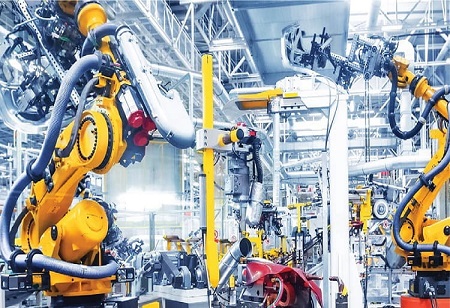
Cobots—collaborative robots—are designed specifically for shared environments. They take over the “3D tasks” automation India refers to: dirty, dangerous, and dull activities that have long defined factory work. These include lifting heavy components, working in hazardous environments, and performing repetitive motions that lead to fatigue over time.
By shifting these responsibilities to machines, factories are seeing a reduction in injuries and physical strain. Workers who once spent hours performing repetitive tasks can now supervise operations, handle exceptions, and ensure quality. This transformation supports the idea that technology should enhance human roles rather than replace them.
|
Aspect |
Industry 4.0 |
Industry 5.0 |
|
Focus |
Automation & efficiency |
Human-centric systems |
|
Worker Role |
Operator |
Supervisor & decision-maker |
|
Technology |
Isolated robots |
Collaborative automation |
|
Skill Requirement |
Task-specific |
Multi-skilled, AI-enabled |
|
Goal |
Productivity |
Productivity + worker well-being |
The change is also cultural. When workers feel safer and less exhausted, they are more engaged. This directly affects productivity, but more importantly, it changes how workers experience their jobs on a daily basis.
Anand Mahindra, Chairman, Mahindra Group says, “AI will increase the value of blue-collar jobs rather than eliminate them. As intelligent systems take over routine tasks, practical skills accelerated by AI will become premium assets.”
The Shift from Replacement to Augmentation (Experience & Expertise)
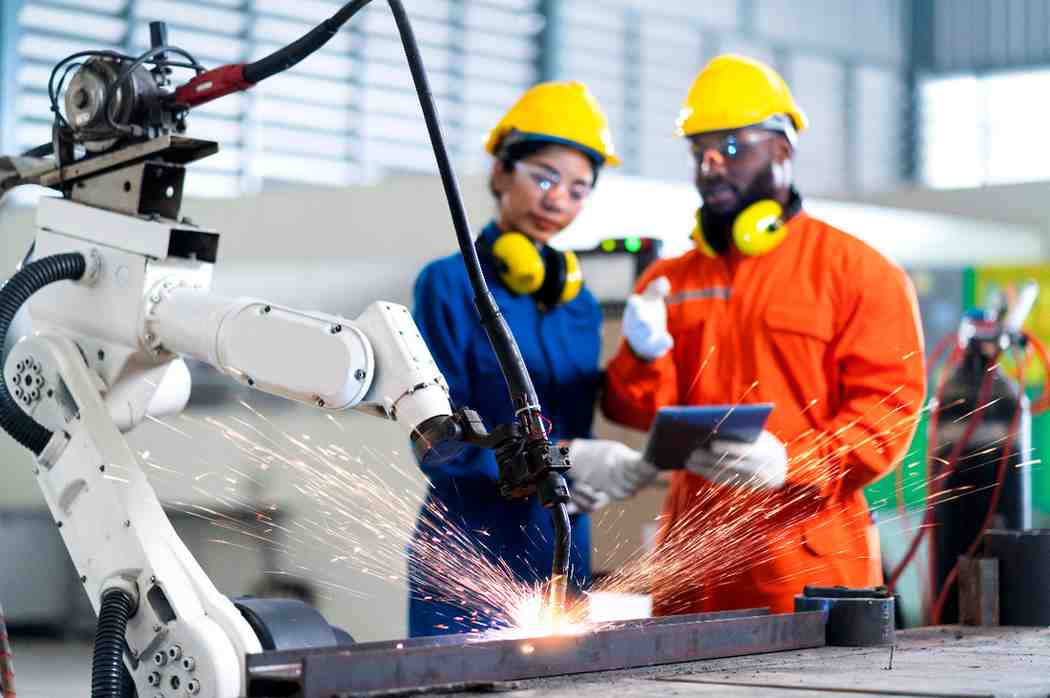 For decades, automation has been framed as a threat to employment. The assumption wassimple: machines would replace people. In practice, the shift has been more complex, especially in India’s manufacturing sector.
Collaborative automation introduces a model based on augmentation rather than replacement. Instead of removing workers from the process, it builds systems where human expertise and machine precision work together.
Traditional industrial robots are built for speed and repetition. They operate in controlled environments, often separated from workers by safety barriers. Their programming is rigid, and any change in task requires reconfiguration by specialists.
However, Cobots operate differently. They are designed to:
This flexibility makes them suitable for human-robot collaboration in Industry 5.0, where production environments often require adaptability rather than rigid automation.
Indian companies are actively building solutions around this model. Addverb Technologies has developed robotic systems that integrate with warehouse and manufacturing operations, enabling workers to interact with machines in real time. Similarly, GreyOrange focuses on automation solutions that allow humans and robots to coexist within the same operational space.
Aman Jain, Founder & CEO, Unbox Industry says, “Automation is not about replacing workers to save money. It is about reducing inefficiencies and safety risks, while allowing people to take on more meaningful and skilled roles. I witnessed laborers working near scorching furnaces and operating machines despite having already lost fingers to those exact same units. These grim conditions revealed that for many Indian factories, automation is treated as a last resort rather than a safety standard.”
A notable development in this area is the use of worker-generated data to train AI systems. In some facilities, workers wear head-mounted cameras that record how tasks are performed. These recordings are analyzed to teach machines how to replicate human actions and decisions.
This approach highlights a key shift: workers are not just using technology; they are shaping it. Their experience becomes a critical input in building intelligent systems, ensuring that automation reflects real-world conditions rather than theoretical models.

.jpg "AR Enterprises: Building The Supply Networks Behind India's Construction Growth")
.jpg "Industrial Packers: Engineering Industrial Packaging for India's Manufacturing Future")




We use cookies to ensure you get the best experience on our website. Read more...