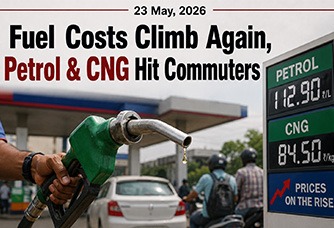
Fuel prices in India have been increased once again, with Oil Marketing Companies (OMCs) announcing fresh hikes on May 23, 2026. Petrol prices have gone up by ₹0.87 per liter, while diesel has increased by ₹0.91 per liter, adding further pressure on consumers already dealing with rising transportation and living costs.
Following the latest revision, fuel prices across major metro cities have moved closer to the ₹100 mark and beyond in several regions.
The latest hike has pushed petrol and diesel prices higher across Delhi, Mumbai, Kolkata, and Chennai. The revision marks one of multiple increases recorded this month, reflecting continued volatility in fuel pricing.
|
City |
Previous Price (₹/litre) |
Latest Price (₹/litre) |
Change |
|---|---|---|---|
|
Delhi |
98.64 |
99.51 |
+0.87 |
|
Mumbai |
107.59 |
108.49 |
+0.90 |
|
Kolkata |
109.70 |
110.64 |
+0.94 |
|
Chennai |
104.49 |
105.31 |
+0.82 |
|
Bangalore |
107.16 |
108.09 |
+0.93 |
|
City |
Previous Price (₹/litre) |
Latest Price (₹/litre) |
Change |
|---|---|---|---|
|
Delhi |
91.58 |
92.49 |
+0.91 |
|
Mumbai |
94.08 |
95.02 |
+0.94 |
|
Kolkata |
96.07 |
97.02 |
+0.95 |
|
Bangalore |
95.04 |
95.99 |
+0.95 |
|
Chennai |
96.11 |
96.98 |
+0.87 |
This marks the third fuel price hike in recent weeks, indicating continuously rising momentum in domestic fuel rates.
The rise in fuel prices is largely driven by global crude oil trends. International crude benchmarks have crossed the $100 per barrel mark amid geopolitical tensions in the Middle East and concerns over supply disruptions through key routes such as the Strait of Hormuz. Given that India imports nearly 85% of its crude oil needs, domestic prices remain highly sensitive to global market fluctuations.
In line with the broader fuel trend, Compressed Natural Gas (CNG) prices have also been increased, reducing its cost advantage over petrol and diesel.
CNG prices in Delhi-NCR have been raised by ₹1 per kg, marking the third hike within just 10 days.
|
Date |
Price (₹/kg) |
Change |
|---|---|---|
|
May 15 |
78.09 |
+2.00 |
|
May 18 |
80.09 |
+1.00 |
|
May 23 |
81.09 |
+1.00 |
Following the latest revision, CNG in Delhi now costs ₹81.09 per kg, while in Noida and Ghaziabad, prices have risen to ₹89.70 per kg.
The increase in CNG prices is also linked to rising global energy costs and supply uncertainties. Escalating tensions in the Middle East and disruptions in key global energy corridors have pushed crude oil prices from around $70 per barrel to over $100 per barrel in recent weeks, impacting both liquid fuels and natural gas pricing.
Frequent fuel price revisions highlight the gravity of the ongoing volatility in global energy markets. State-run oil marketing companies are reportedly under financial pressure, with estimated monthly losses nearing ₹1,000 crore due to selling fuel below market-linked rates.
Reports suggest that diesel is currently being sold at a loss of ₹25–₹30 per liter, while petrol losses range between ₹10–₹14 per liter. In comparison, private retailers such as Shell India are charging significantly higher prices in certain locations.
Amid rising prices, the Ministry of Petroleum and Natural Gas has assured that the country has adequate fuel supplies and has urged consumers to avoid panic buying.
While India has managed relatively moderate fuel price increases compared to several global markets, domestic fuel rates are expected to remain sensitive to international developments in the coming weeks.
The repeated fuel price hikes have triggered growing concern among consumers, especially within middle- and lower-income groups who are most sensitive to daily cost fluctuations. For many households, increased fuel expenses directly impact monthly budgets, transportation costs, and essential spending.
Auto drivers, delivery workers, and small business operators are among the worst affected, as fuel forms a significant portion of their operating costs. With both petrol and CNG becoming costlier, the expected relief from switching fuels is also diminishing.
At the same time, rising fuel costs are gradually influencing consumer behavior, with more buyers considering electric vehicles (EVs) as a long-term cost-saving alternative.
|
Year |
EV Sales (Units) |
Market Share |
|
FY2021 |
~1.4 lakh |
~1.3% |
|
FY2023 |
~10 lakh |
~4.7% |
|
FY2025 |
~18–20 lakh |
~6–7% |
|
FY2026* |
~22–25 lakh |
~7–9% |
*Estimated figures based on industry trends
While EV adoption is still evolving, the steady rise indicates a gradual shift in consumer preference, driven partly by fuel price volatility and lower running costs.
The government has acknowledged the impact of rising fuel prices and has taken steps to ensure supply stability across the country. The Ministry of Petroleum and Natural Gas has assured that there is no shortage of petrol, diesel, or CNG, urging citizens to avoid panic buying.
In the past, the government has intervened through excise duty cuts and price stabilization measures to provide relief to consumers. While no immediate tax revision has been announced, officials are closely monitoring global crude trends and domestic pricing pressures.
Additionally, the government continues to promote alternative energy solutions, including electric mobility, ethanol blending, and compressed bio-gas initiatives, as part of its long-term strategy to reduce dependence on imported fossil fuels.
Looking ahead, fuel prices in India are expected to remain closely linked to global crude oil movements. With geopolitical tensions still unresolved and crude prices hovering above $100 per barrel, short-term volatility is likely to continue.
However, if global supply conditions stabilize or diplomatic resolutions ease tensions, there could be some relief in fuel prices. On the domestic front, any government intervention—such as duty cuts or subsidies—could also influence price trends.
In the longer run, the current situation may accelerate India’s transition towards cleaner and more cost-efficient energy alternatives, including EVs and gas-based mobility solutions.







We use cookies to ensure you get the best experience on our website. Read more...