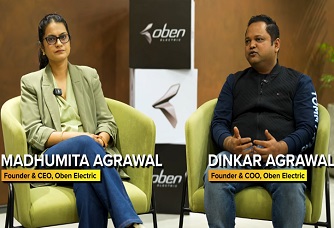
At the forefront of India’s evolving electric mobility landscape, Oben Electric is redefining how the industry approaches scale and strategy. Founded by Madhumita Agrawal (CEO) and Dinkar Agrawal (COO), the company offers a sharp lens into the country’s next phase of EV growth. They discuss how market realities beyond metros, in-house engineering, and a disciplined, phased scaling approach are shaping the future of electric motorcycles, while emphasizing the importance of product-market fit, affordability, and integrated distribution in driving mass adoption.
India’s electric mobility transition is often narrated through the rapid rise of electric scooters, urban adoption curves, and policy incentives. Yet, beneath this dominant narrative lies a structural truth that continues to define the country’s mobility DNA: India runs on motorcycles. For CXOs evaluating long-term bets in the EV ecosystem, this distinction is not merely academic—it is strategic.
The two-wheeler market in India is the largest in the world, and motorcycles form its backbone, particularly beyond metro cities. They are not aspirational purchases alone; they are deeply embedded in the economic and social fabric, enabling daily commutes, supporting gig work, and powering last-mile delivery networks. Against this backdrop, the early EV wave’s tilt toward scooters represents only a partial capture of the total opportunity.
A new generation of founders is now recalibrating this narrative by shifting focus toward electric motorcycles. Among them, Oben Electric has emerged as a case study in how market insight, engineering choices, and operational discipline can align to address a more expansive opportunity.
The answer lies in understanding the difference between visible momentum and underlying market reality. Scooters gained early EV traction due to their relatively simpler architecture, lower speed requirements, and alignment with urban commuting. However, motorcycles dominate overall volumes, particularly in Tier 2, Tier 3, and rural markets.
On one hand, scooters drive early adoption and visibility. On the other, motorcycles represent the scale lever that will ultimately determine the depth of EV penetration in India. Ignoring the latter risks building a business that is structurally constrained.
The strategic insight here is that India’s EV transition will not be linear. It will be layered—urban first, mass next. Companies that position themselves only for the first phase may struggle to adapt when the market expands into its larger, more complex segments.
One of the most critical differentiators is contextual design. Global EV trends—particularly from China, often serve as reference points, but direct replication rarely works. India’s climate, road infrastructure, and usage patterns impose unique demands on product engineering.
For instance, thermal conditions in India are significantly harsher, requiring battery systems that prioritize safety and longevity. This has led some players to adopt Lithium Iron Phosphate (LFP) chemistry despite its higher weight, trading off density for durability and stability.
Such decisions reflect a deeper strategic mindset: optimizing for lifecycle value rather than headline specifications. For CXOs, this highlights the importance of aligning product architecture with real-world usage rather than marketing benchmarks.
This philosophy is evident in the approach taken by Oben Electric, where engineering decisions are guided by Indian conditions rather than imported assumptions.
Also Read: How Advanced Sealing Solutions Boosting Ethane Pipeline Output
In traditional automotive manufacturing, supply chains are deeply entrenched and optimized over decades. In contrast, the EV ecosystem is still evolving, with fragmented supplier networks and varying levels of technological maturity. This creates both risk and opportunity.
Vertical integration allows companies to mitigate supply chain uncertainties while gaining tighter control over product quality and cost structures. By bringing critical components such as battery assembly, motor manufacturing, and software development in-house, companies can accelerate innovation cycles and respond more effectively to market feedback.
However, this approach is capital-intensive and operationally complex. It requires not just technical expertise but also disciplined execution across functions. The payoff, however, is significant, greater resilience, faster iteration, and the ability to differentiate at a product level.
The decision to vertically integrate should be viewed through a strategic lens rather than purely operational metrics. It is less about cost savings in the short term and more about building long-term capability.
The evolution of Oben Electric demonstrates how early investments in in-house R&D and manufacturing can create a foundation for both speed and scale.
One of the most common pitfalls in high-growth sectors is premature scaling. The pressure to capture market share often leads companies to expand aggressively before achieving product-market fit. In the EV space, this can be particularly damaging, as early defects can erode consumer trust in an already nascent category.
A more effective approach is phased validation. This involves launching limited units, gathering real-world data, and iterating based on customer feedback before moving to mass production. While this may delay initial scale, it significantly improves product reliability and customer satisfaction.
This disciplined approach has been central to the journey of Oben Electric, where early deployments were used as learning platforms rather than purely revenue-generating exercises.
The lesson is clear: in emerging markets, speed must be balanced with stability. Sustainable growth is built on validated foundations, not accelerated assumptions.
The Indian consumer is both value-conscious and performance-aware. Unlike early adopters in developed markets, who may prioritize sustainability as a primary driver, Indian buyers evaluate EVs through a multi-dimensional lens—cost, range, reliability, and design.
One of the most consistent insights is the demand for “the best of both worlds.” Customers expect electric vehicles to deliver strong range while maintaining usable speed and performance. Compromises on either front can significantly impact adoption.
Design is another critical factor. Motorcycles in India carry emotional weight—they are symbols of identity, aspiration, and pride. EV products that fail to capture this emotional dimension risk being perceived as utilitarian appliances rather than desirable vehicles.
This shift in consumer expectation underscores a broader transition in the EV market—from functional acceptance to experiential preference. As adoption deepens, differentiation will increasingly be driven by design, brand, and user experience.
Also Read: How Sustainability Became Core to Strategy in Heavy Industry
The sub-₹1 lakh motorcycle segment represents one of the largest opportunities in the Indian market. However, it is also one of the most challenging. Customers in this segment prioritize affordability and utility over performance, leaving little room for premium pricing.
To succeed here, companies must achieve a delicate balance between cost optimization and product integrity. This requires efficiencies across the entire value chain—from component sourcing to manufacturing processes.
The ability to deliver a compelling product at this price point is not just a technical challenge; it is a strategic one. It demands alignment between engineering, operations, and financial planning.
Efforts by Oben Electric to develop platforms targeting this segment reflect a recognition that long-term scale in India will be driven by mass-market adoption rather than niche premium offerings.
The implication is significant: winning the EV race in India will depend on the ability to democratize access without compromising sustainability of the business model.
While product innovation often takes center stage, distribution and service infrastructure play an equally important role in shaping customer trust. In a category as new as EVs, consumers seek reassurance—not just at the point of purchase but throughout the ownership lifecycle.
A robust distribution network ensures accessibility, while an integrated service ecosystem builds confidence. The absence of either can become a barrier to adoption, particularly in non-metro markets.
One effective strategy is to tightly link sales and service operations, ensuring that every retail touchpoint is supported by after-sales capabilities. This not only enhances customer experience but also provides valuable feedback loops for continuous improvement.
This highlights a critical shift: in the EV era, customer experience extends far beyond the product. It encompasses the entire ecosystem, from purchase to maintenance.
In the EV sector, manufacturing is no longer a backend function—it is a core strategic capability. The ability to produce consistent, high-quality vehicles at scale directly influences brand perception, cost efficiency, and operational resilience.
Modern EV manufacturing requires precision, process discipline, and integration with R&D. Facilities that combine these elements can achieve higher efficiency while maintaining flexibility to adapt to evolving designs.
Quality control systems, zero-defect processes, and real-time tracking mechanisms are becoming standard expectations rather than differentiators. Companies that invest early in these capabilities are better positioned to scale without compromising on quality.
Also Read: Optimizing Production Processes for Zero-Defect Auto Manufacturing
The next phase of India’s EV journey will be defined by expansion into deeper markets and broader segments. As infrastructure improves and costs decline, adoption will move beyond early adopters into mainstream consumers.
Motorcycles will play a central role in this transition, particularly in regions where they are the primary mode of transport. Companies that have already aligned their strategies with this reality will have a significant advantage.
At the same time, competition will intensify. Established automotive players, new-age startups, and global entrants will all vie for market share. Differentiation will increasingly depend on execution—how well companies can integrate product, process, and customer experience.
The trajectory of Oben Electric illustrates how a focused, market-driven approach can create a strong foundation in a competitive landscape.





We use cookies to ensure you get the best experience on our website. Read more...