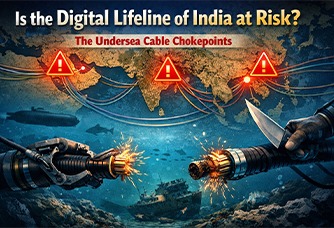
When we speak of national infrastructure, what mostly comes to our minds are highways, airports, power grids, and railways. However, this is true, but, just to an extent! There is one more critical infrastructure which is rarely discussed but quintessential for India’s economic growth and global competitiveness.
Submarine fiber optic cables - the thin but yet so important strands of cables are lying thousands of meters beneath the ocean and connecting the world with internet connectivity. Let's look into some of the hindrances that can lead to these undersea cable chokepoints and how the digital lifeline of India or in more simple term - Internet connectivity in India might be at risk.
But before delving into the nitty-gritty of the digital lifeline of India, let’s first understand the bigger picture at play. Over 97 percent of the global internet, including most of India's, flows through undersea cables near a war zone. Iran's latest threat has made everyone's problem.
These fiber-optic cables act as the backbone of global digital connectivity and its importance goes far beyond technology. They are vital for everything from financial transactions and defense to everyday communication. However, this ever-important infrastructure stands surprisingly vulnerable to damage, disruption, and cyber threats.
In this article, we will explore how undersea cable chokepoints like the Strait of Hormuz and Red Sea threaten India’s connectivity, UPI, AI, and digital economy:
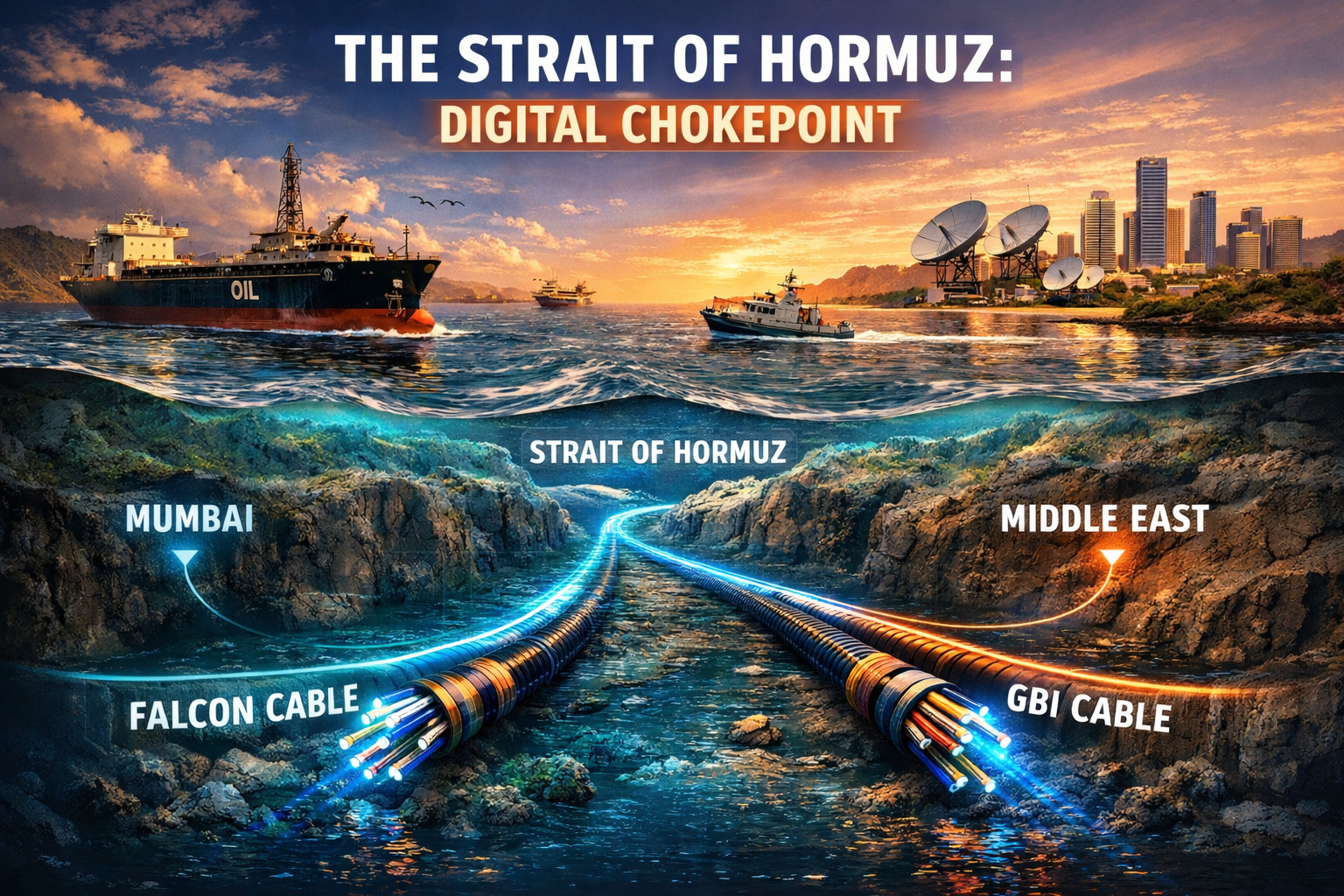
The Strait of Hormuz is famously known as an oil chokepoint, but it is equally a data chokepoint.
Cables like the FALCON and Gulf Bridge International (GBI) systems pass through these waters to connect Mumbai to the Middle East.
Regional conflicts in the Persian Gulf pose a direct threat to subsea infrastructure. During periods of high geopolitical tension, "gray zone" warfare—where infrastructure is targeted without a formal declaration of war—becomes a primary concern for India’s National Security Council.
A disruption here doesn't just affect internet browsing; it severs the digital link between India and its massive diaspora and energy partners in the GCC countries.
According to reports by CNN and Iranian state-linked media, Tehran is considering imposing fees on submarine communication cables passing beneath the Strait of Hormuz, a move that could affect global technology companies and disrupt international internet traffic.
Furthermore, the Red Sea is the world’s most critical digital corridor. Almost all internet traffic between Europe and Asia—including the majority of India’s westbound data—is funneled through the narrow Bab-el-Mandeb Strait and the Suez Canal. This is a geographic "pinch point." Because the Red Sea is relatively shallow, cables are not buried deep in the seabed, making them highly accessible and vulnerable.
If the Red Sea corridor is severed, India loses its lowest-latency route to London and Marseille, forcing data to reroute around the Cape of Good Hope (Africa). This significantly increases "ping" times, disrupting high-frequency trading, cloud-based banking, and real-time AI processing.
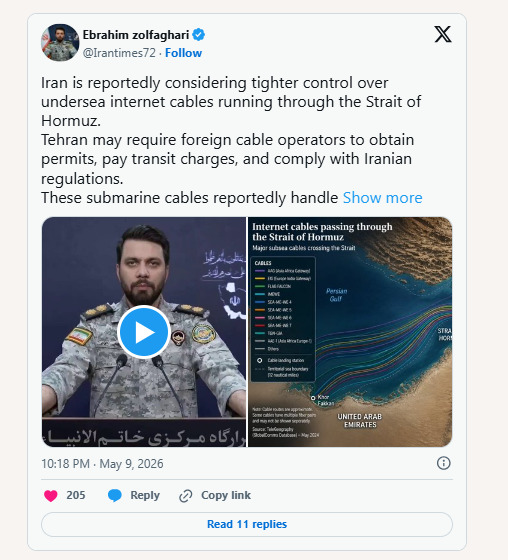
Iranian military spokesperson Ebrahim Zolfaghari wrote on X, “We will impose fees on internet cables.”
State-linked media associated with Iran’s Revolutionary Guards later reported that operators of subsea cables would have to comply with Iranian laws and pay licensing charges.
Adding to this, the reports also said repair and maintenance work on those cables could be restricted to Iranian companies.
Iran's Revolutionary Guard (IRGC) and affiliated outlets (such as Tasnim News Agency) suggest that tech giants (including Meta, Google, Amazon, and Microsoft) pay licensing and "protection payments" to operate over Iranian-claimed seabed.
This out of the box proposal could affect firms including Google, Microsoft, Meta and Amazon, whose services rely heavily on the global subsea cable network
Mostafa Ahmed, a senior researcher at think tank Al Habtoor Research Center highlighted that the Strait of Hormuz is not just an energy chokepoint but also one of the world’s most critical digital bottlenecks.
“Because modern global economies rely on submarine cables for over 95% of international data transmission. The clustering of these multi-terabit cables in such a shallow, volatile maritime corridor creates a massive single point of failure for the global internet backbone,” he further highlighted.
Internet & 5G has become a foundational utility in providing high-speed access to 970 million users, with 5G covering 99.9 percent of districts.
Furthermore, with the stride of IndiaAI Mission, AI integration has been up for accelerated growth across healthcare, banking, and manufacturing realms. Especially, the focus has been on sovereign AI models and agentic AI for voice-enabled services in regional languages. For this to come to reality, digital connectivity across the country is a must.
Furthermore, this article will be incomplete if we miss out on mentioning UPI (Unified Payments Interface). This technology has been a game-changer - playing a major factor in making India’s population go digital when it comes to facilitating financial transactions.
UPI is the world's largest real-time payment system, processing over 21.7 billion transactions monthly as of Jan 2026, representing over 85 percent of retail digital payments.
Adding to this, an integrated framework of Jan Dhan accounts, Aadhaar identity, and Mobile connectivity has been enabling direct benefit transfers (DBT) and digital authentication for >1.35 billion residents.
Finally banking, a sector now has become 95 percent digital, where services like Direct Benefit Transfer have moved over INR 49 lakh crore directly to citizens.
India's "Digital Lifeline" must cusp the significant strategic risk. This is due to its high reliance on a small number of concentrated cable landing stations (CLS) for international connectivity - approximately 60 percent of India’s data traffic flows westward through the Red Sea and Strait of Hormuz to reach Europe and the US. This narrow corridor is highly vulnerable to geopolitical conflicts and accidental damage.
The Strait of Hormuz is not only the critical lifeline of global oil transport but also a major digital chokepoint. The number of international fiber optic cables pass through this critical juncture connecting Europe, Asia and the Middle East.
Furthermore, two-thirds of India’s international traffic is funneled through Mumbai, while the rest via Chennai. Critically, 15 of India’s 17 cables land within a single six-kilometer stretch of Versova beach in Mumbai, creating a catastrophic single point of failure.
Now Let us delve deeper and highlight some of the aspects that can bring impending difficulties:
Concentrated Landing Stations (Mumbai/Chennai): Two-thirds of India's international subsea capacity lands in Mumbai (primarily Versova), with Chennai acting as the secondary hub. A localized disaster, sabotage, or failure at these two points could cripple national connectivity.
Red Sea Chokepoint Dependency: Around 17 international subsea cables (e.g., SEA-ME-WE-4, AAE-1, IMEWE) carry the majority of India’s westward data traffic to Europe through the narrow Red Sea and Suez Canal.
Rising Security Threats: As mentioned above, the Red Sea region has become a high-risk zone, with Houthi rebels' attacks on shipping resulting in damage to critical cables in 2024 and 2025, demonstrating the vulnerability of this "invisible digital backbone".
The Western Allies (The United States, EU, and G7) has highlighted that the consensus among Western leaders is that digital chokepoints are actively targeted by adversarial states like Russia and China, as well as non-state proxies.
In a Joint Statement on the Security and Resilience of Undersea Cables, the U.S. and key allies explicitly declared that global internet routing must be built on "reliable and secure" frameworks. They have aggressively pushed to exclude Chinese companies like HMN Tech from international consortiums, warning that dependency on hostile nations for cable laying creates a catastrophic intelligence risk.
Leaders of the Quad (U.S., India, Japan, Australia) have launched dedicated "cable resilience" initiatives. Japanese leadership has ring-fenced hundreds of millions of dollars to build redundant landing stations away from congested hubs, explicitly stating that a concentration of lines leaves the Indo-Pacific economically vulnerable.
Following a string of highly suspicious cuts in the Baltic Sea and North Atlantic, NATO officials have labeled subsea networks a "strategic priority for Europe".
The UK Defence Ministry revealed that tracking hostile submarine activity near these cables is now treated with the same urgency as protecting territorial borders.
India's "Digital Lifeline" is the invisible infrastructure enabling the nation's rapid transition into a global hub in terms of digitalization, encompassing high-speed internet, real-time payments, and advanced computing. India is actively diversifying by developing new landing stations across cities like Visakhapatnam, Kochi, and Puducherry to reduce dependence on Mumbai and Chennai.
The Submarine Cable Expansion - new projects such as IAX/IEX (Reliance Jio), 2Africa/EMIC-1, and SEA-ME-WE 6 aim to increase route diversity.
Additionally, by leveraging AI-Driven Security, we can enable predictive maintenance and monitoring of cable health to proactively manage potential disruption. India is currently connected by approximately 19 international submarine cable systems.
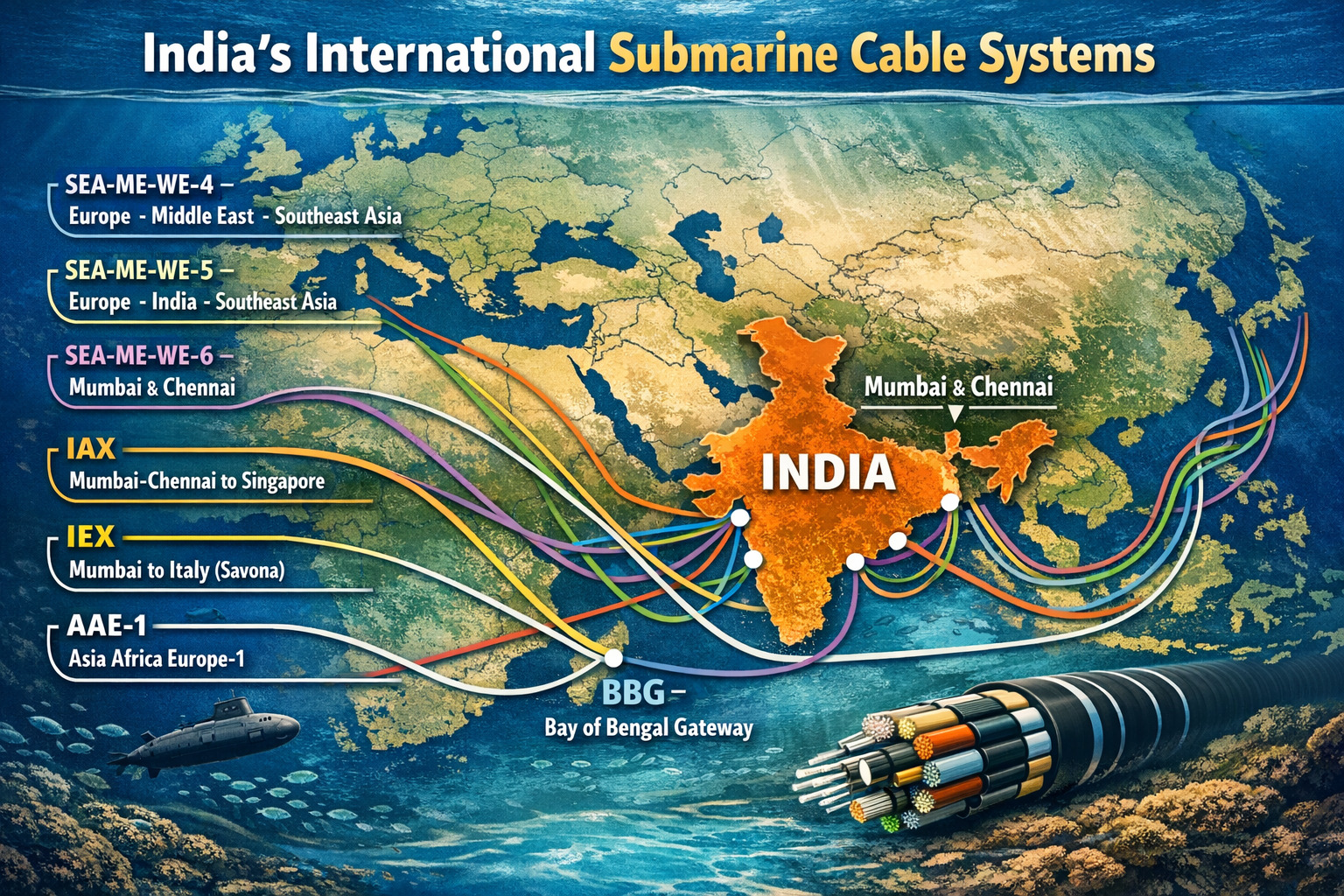
SEA-ME-WE-4: A high-capacity legacy system connecting Southeast Asia, the Middle East, and Western Europe.
SEA-ME-WE-5: Focuses on the "lowest latency" route between Europe and Southeast Asia via India.
SEA-ME-WE-6: A newer, high-speed system currently under commissioning as of early 2026, with landing points in Mumbai and Chennai.
India-Asia-Xpress (IAX): An eastbound system connecting Mumbai and Chennai directly to Singapore, Thailand, and Malaysia.
India-Europe-Xpress (IEX): A westbound system linking Mumbai to Italy (Savona) via the Middle East and North Africa.
AAE-1 (Asia Africa Europe-1): One of the world's largest cable systems by length, landing in Mumbai.
BBG (Bay of Bengal Gateway): Connects India (Mumbai and Chennai) to Southeast Asia and the Middle East.
Cable Landing Stations (CLS) are the physical interface where undersea cables connect to India's internal power and data grids.
Mumbai (The Primary Hub)
Versova Beach: The most critical chokepoint, hosting the landing for major systems like FALCON, AAE-1, and the upcoming IEX.
Silver Beach: Another key landing zone in Mumbai for high-capacity traffic.
Chennai (The East Coast Gateway): Serves as the main hub for eastbound traffic to Singapore and serves as the landing point for the i2icn, BBG, and IAX systems.
Cochin (Kochi): A strategic southern gateway hosted by Tata Communications, serving systems like SAFE and the domestic Kochi-Lakshadweep Island (KLI) link.
While digital data feels ethereal, it relies on physical threads thinner than a garden hose. For India, the concentration of these threads creates a high-stakes vulnerability in global maritime chokepoints.
Damage to India's digital lifeline generally falls into two categories, both of which are difficult to prevent. Now let’s discuss accidental vs. deliberate sabotage:
Accidental Damage (The Common Threat): Statistically, 70 percent of cable breaks are caused by fishing trawlers and ship anchors. In shallow waters near Mumbai or the Red Sea, a single ship dragging its anchor during a storm can snap multiple fiber optic strands simultaneously.
Deliberate Sabotage (The Strategic Threat): Modern naval strategy now includes "seabed warfare." Technologically sound and sophisticated actors can use unmanned underwater vehicles (UUVs) to cut cables at depths where repair is difficult and time-consuming. Unlike an accidental break, deliberate sabotage can be coordinated across multiple cables (as seen in the 2024 Red Sea incidents) to completely isolate a nation's digital economy.
It is noteworthy that India’s digital economy contributes approximately 11.74 percent to the national GDP. It has become a sector that is nearly five times more productive than traditional sectors. Any disruption to its physical "lifeline"—the undersea cables—creates an immediate ripple effect across finance, technology, and service industries.
The nation’s digital push will never be like the juggernaut which it is today if it wouldn’t be for the Unified Payments Interface (UPI). Today, the UPI system has become the backbone of retail commerce, processing over 18 billion transactions monthly.
Transaction failures are another critical area of impact, where major outages, such as those in March and April 2025, showed that even a one-hour disruption can strand millions of users at points of sale, including grocery stores and gas stations.
Furthermore, transaction success rates can plummet to 50–60 percent during network instability caused by cable cuts; forcing businesses to revert to cash or face total revenue loss.
While domestic backups like UPI Lite exist for offline small-value payments, the lack of robust international fail-safe alternatives makes the system highly dependent on the core fiber network.
India’s rapid cloud adoption makes it heavily reliant on global hyperscalers like Microsoft Azure, AWS, and Google Cloud.
Undersea cable cuts in the Red Sea (e.g., September 2025) directly impacted Azure services by forcing traffic to be rerouted, resulting in higher "ping" times and slower application performance for Indian enterprises.
Cloud service providers face higher OPEX when buying alternate transit, a cost that can trickle down to Indian startups and SaaS companies that depend on seamless cross-border data flow.
While India is pushing for localized data centers like Mumbai and Chennai, these facilities still require international fiber links to sync with global cloud regions, maintaining a level of inescapable vulnerability.
India hosts 55 percent of the world's Global Capability Centers (GCCs), making internet uptime critical for the global supply chain of IT services.
For the 14.6 million workers in the digital economy, a minute of screen freeze or a dropped video call during a client presentation isn't just an irritation; it can lead to missed business commitments and reputational damage.
Remote employees are often the "weakest link" in infrastructure, as home setups rarely have the leased-line redundancy found in corporate offices.
High-sensitivity sectors like Banking BPOs are most affected, as strict client protocols often disallow work-from-home modes when secure, high-bandwidth connections are unstable.
The transformation of India's subsea infrastructure from a commercial utility to a national security priority is documented through these official channels:
Under the Telecommunications Act 2023 and the subsequent 2025 Rules, the Department of Telecommunications (DoT) has streamlined the "Landing Station" permissions. This includes the Statutory Guidelines for Submarine Cable Operations, which allow for CLS-PoP (Point of Presence), enabling non-telco entities like hyperscalers to manage data landings directly.
As per the Press Information Bureau (PIB), the official announcements regarding the Kochi-Lakshadweep Islands (KLI) submarine cable project and the designation of cables as Critical Infrastructure highlight the government's focus on both domestic resilience and international redundancy.
Telecom Regulatory Authority of India’s 2023 Recommendations on "Recommendations on Submarine Reporting and Maintenance" serve as the blueprint for India's push toward indigenous repair vessels and the "Sovereign Fleet" concept.
National Critical Information Infrastructure Protection Centre (NCIIPC): As the designated agency for protecting "Digital India," NCIIPC categorises cable landing stations as Protected Systems. This ensures that physical and cyber-attacks on hubs like Versova are met with national-level security protocols.
To safeguard the digital economy, India is moving from a reactive to a proactive stance. This move will be focused towards geographic de-risking and robust legal protections. Some of them are:
The over-concentration at Versova (Mumbai) is being addressed by developing new coastal gateways that will ensure a single localized event won't sever national connectivity.
Visakhapatnam (Vizag) as the New Frontier: Emerging as the "east coast AI and data nerve centre," Vizag has been selected by Meta as a landing site for its massive Waterworth subsea cable. While Google is also establishing an international subsea gateway here to link India directly to Singapore and Australia.
Expansion in Tier-2 Coastal Cities: Infrastructure is being scaled in Tuticorin, Kochi, and Thiruvananthapuram to provide alternative paths for traffic from the Bay of Bengal and the Indian Ocean.
Carrier-Neutral "Open CLS": Unlike traditional stations owned by single telcos, newer facilities in Vizag are being designed as carrier-neutral hubs allowing any operator to land cables without building separate, costly infrastructure.
India currently relies heavily on foreign-flagged vessels for repairs, which can lead to delays of weeks or even months if any real-time crisis occurs.
Sovereign Repair Fleet: The Department of Telecommunications is facilitating a consortium of public and private players to acquire and operate Indian-flagged cable repair vessels.
Naval Support: The Indian Navy is commissioning large diving support vessels (Nistar and Nipun) to be equipped with remotely operated submersibles that can be rapidly repurposed for cable repair during conflicts.
Coastal Cable Depots: Plans are underway to establish dedicated storage depots on both the east and west coasts to house spare fiber and repair kits, ensuring materials are immediately available for emergency splicing.
The "Digital Lifeline" is no longer a luxury but a fundamental requirement for India’s sovereignty. As the nation aims for a USD 1 trillion digital economy, the focus must remain on "diversity by design."
Future resilience will depend on whether India can successfully transition from its dependency on narrow chokepoints like the Red Sea to a multi-directional network involving space-based internet and decentralized coastal hubs.
Given the uncertainty, space-based internet driven by Low Earth Orbit (LEO) constellations like Starlink and OneWeb will be the most critical, geographically diverse fail-safe for undersea cable outages. LEO networks bypass seabed choke points entirely, using cross-space laser links to route data independent of terrestrial infrastructure.
While they cannot match the massive bandwidth of fiber-optics, their rapid deployment and global reach keep essential communications online when physical networks are severed.
Also, modern LEO constellations operate just a few hundred miles above Earth and offer latencies of around 20 to 40 ms, making them viable for real-time applications like voice calls and VPNs.
However, LEO satellites are not a substitute for the high-capacity fiber backbone. Instead, they function as an essential survival mechanism which helps in maintaining critical public services, financial routing, and military communications until underwater cables are repaired.
FAQs
Which regions are the major chokepoints?
Global data flow is carried through several narrow geographical corridors. Here are four major choke points:
The Red Sea & Bab-el-Mandeb Strait: A primary bottleneck connecting Asia, the Middle East, and Europe.
The Strait of Hormuz: Critical for Persian Gulf data routing.
The Luzon and Malacca Straits: Dense areas for data transit throughout the Indo-Pacific.
Egypt: The narrow land bridge connecting the Red Sea to the Mediterranean, which makes overland cables here a major point of failure.
Why can't we just switch to satellite internet?
Satellite systems (including LEO constellations like Starlink) don't have that capacity to act as an immediate, large-scale replacement for undersea cables. Satellites lack the massive bandwidth and scalability that are required to handle petabytes of continuous daily global traffic.
How are damaged cables repaired?
Repairing a deep-sea cable is complex and time-consuming. Specialized cable ships must locate the break, retrieve the severed cable using grappling hooks, splice the fragile glass fibers aboard the ship, and drop it back to the ocean floor. Repairs can take weeks, frequently prolonged by weather conditions and slow bureaucratic permit processing in foreign territorial waters.
.jpg "Saksham Enterprises: Optimizing Mission- Critical HVAC Infrastructure For The High Precision Sector")

.jpg "JDS Group of Companies: Innovating Smart Solutions For Modern Power Transmission & Distribution Infrastructure")




We use cookies to ensure you get the best experience on our website. Read more...