Electronic component manufacturing has moved a long way from manual soldering lines and paper-based quality logs.
Over the last decade, component manufacturing plants have absorbed sensors, software, and connected machines at a pace few other industries can match.
Global demand for semiconductors and passive components keeps climbing. The electronic components market touched USD 500 billion in 2022. Industrial electronics alone is projected to reach USD 2.1 trillion by 2026. That growth brings pressure. Buyers want tighter tolerances, faster delivery, and zero defects, all at once.
This is where emerging technologies step in. Factories are shifting from Industry 4.0's connectivity-first model toward Industry 5.0, where automation works alongside people instead of replacing them. AI models catch defects human eyes would miss.
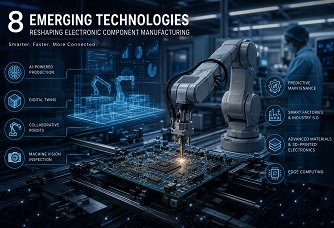
Digital twins test a production line before it's built. Cobots share a workbench with technicians. Together, these tools are rewriting how components get designed, built, inspected, and shipped. Below are eight technologies leading that shift, along with the data and voices shaping their rollout.
AI-powered production uses machine learning.jpg) models to guide manufacturing decisions in real time, from adjusting solder paste volumes to flagging faulty batches before they leave the line. In electronic component manufacturing, 72 percent of manufacturers had already integrated AI into quality control by 2026, up from 45 percent just five years earlier. Contract manufacturers are applying it to inspection consistency, supply chain visibility, and design-for-manufacturability checks.
models to guide manufacturing decisions in real time, from adjusting solder paste volumes to flagging faulty batches before they leave the line. In electronic component manufacturing, 72 percent of manufacturers had already integrated AI into quality control by 2026, up from 45 percent just five years earlier. Contract manufacturers are applying it to inspection consistency, supply chain visibility, and design-for-manufacturability checks.
Roland Busch, President and CEO of Siemens AG, said the company's AI-native capabilities help manufacturers "anticipate issues, accelerate innovation and reduce cost." Looking ahead, AI is expected to move from isolated pilots into standard practice across mid-sized component plants, not just large OEMs.
Soumitra Bhattacharya, Independent Director Non Executive, Tata Elxsi says “It is projected that in the next couple of years more than two-thirds of the Indian manufacturing sector will embrace Industry 4.0… it’s very important to… reinvent manufacturing and not look at manufacturing as ‘make’ but look at the source-make-deliver… digital competency is a must… it’s a mindset and a culture — a data-driven organization.”
A digital twin is a virtual replica of a factory, product, or process that engineers can test and tweak before touching physical equipment. The global digital twin market is projected to grow from roughly USD 35 billion in 2026 to well over USD 120 billion by 2030. PepsiCo used Siemens' Digital Twin Composer to redesign two facilities digitally first. The approach avoided more than 90 percent of potential operational issues and cut capital spending by 10–15 percent.
Tony Hemmelgarn, President and CEO of Siemens PLM Software, said manufacturers need systems built to "respond as production, supply, regulatory, and material conditions change." For component makers, this means shorter engineering cycles and fewer costly shop-floor redesigns.
Vishal Dhupar, Managing Director, South Asia, NVIDIA “India has large grand challenges, and applying AI to solve these will not only benefit India, but will also provide valuable insights to the world… The world of manufacturing is about physical AI and it can’t be described in words. We need to teach models physics and we need to create a new foundation, a new world model.”
Cobots are robotic arms designed to work directly beside human operators, without the safety cages traditional industrial robots require. The global cobot market is expected to grow from roughly USD 2.8 billion in 2026 to well beyond USD 10 billion by the early 2030s. That marks a compound annual growth rate above 20 percent. Around 70 percent of electronics and automotive production units are already integrating cobots for safer, more flexible task handling.
Andrea Cassoni, Head of Collaborative Robots at ABB Robotics, noted that "cobots are growing significantly faster than traditional industrial robots." Small manufacturers starting automation and large enterprises scaling it are both driving that growth. In component plants, cobots now handle fine assembly, pick-and-place, and quality checks once reserved for skilled technicians.
Also Read: Future of Sustainable Electronics Manufacturing: Trends and Practices
Machine vision systems use cameras and AI algorithms to inspect components at speeds and precision levels no human inspector can match. The global machine vision market, valued at roughly USD 14–21 billion in 2025–26, is projected to reach USD 25–35 billion by 2030. Electronics and semiconductor inspection is driving much of that demand.
Matt Moschner, President and CEO of Cognex, said newer embedded AI vision systems mean "manufacturers no longer have to choose between inspection depth and line speed."
Predictive maintenance uses sensor data and AI forecasting to flag equipment problems before a breakdown happens, instead of servicing machines on a fixed calendar. The global predictive maintenance market was valued near USD 14–19 billion in 2025–26. It's forecast to grow at a CAGR between roughly 20 percent and 34 percent through the early 2030s.
Industry data shows predictive maintenance can cut maintenance costs by up to 40 percent and reduce unplanned downtime by up to 50 percent. Unplanned downtime already costs global manufacturing an estimated USD 864 billion annually. Edge AI is the fastest-growing segment here, since fault detection increasingly needs to happen in under 100 milliseconds. For component manufacturers running high-speed SMT lines, this translates directly into higher uptime and yield.
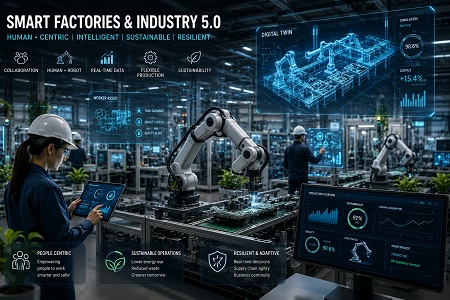 Smart factories connect machines, sensors, and software into one continuously monitored system, while Industry 5.0 adds a human-centric layer on top of that connectivity. Simon Ellis, IDC Group Vice President for U.S. Manufacturing Insights, noted that Industry 5.0 is especially critical for midmarket manufacturers.
They face the same competitive pressure as larger firms but with far fewer resources to spend. Sustainability is now a core pillar too: energy efficiency and waste reduction are increasingly judged by return on investment, not just compliance. In component manufacturing, this shows up as real-time energy dashboards, human-AI collaboration on the floor, and production lines that adapt output without a full re-tooling cycle.
Sanjeev Sharma, Country Head & Managing Director, ABB India “Digitalization is a key enabler of sustainability and makes automation safer and greener… Indian companies… have realized the potential of not only automation but also digitalization to render people, process and asset efficiency with resultant environmental sustainability.”
Additive manufacturing is moving beyond prototypes into functional electronics, using conductive inks and flexible substrates to print circuits directly onto unconventional surfaces. This lets manufacturers create flexible, lightweight components for wearables, medical devices, and aerospace systems that traditional PCB fabrication cannot easily produce.
Advanced packaging technology is projected to reach USD 148 billion by 2028, with embedded AI components expected to reach USD 23 billion by 2030. 3D-printed electronics still face cost and scale hurdles compared to conventional PCB assembly. But they are opening new design possibilities for low-volume, high-mix, and highly customized runs, where speed to market matters more than unit cost.
Edge computing processes data locally, on or near the machine generating it, instead of sending everything to a distant cloud server first. The global edge computing market is projected to grow from roughly USD 111 billion in 2026 to over USD 317 billion by 2031. That's a CAGR above 23 percent. In predictive maintenance alone, edge AI deployment is expanding at nearly 35 percent annually because real-time fault detection needs latency under 100 milliseconds, something cloud-only systems struggle to guarantee.
For electronic component manufacturing, edge computing lets machine vision, robotics, and quality checks make split-second decisions on the floor. There's no waiting on network round-trips, which matters most on high-speed lines.
|
Company |
Key Technologies |
Why It Stands Out |
|
Siemens |
AI, Digital Twins, Smart Factories |
Digital manufacturing software, factory automation, digital twin leadership |
|
ABB |
Robotics, Predictive Maintenance |
Industrial robots and intelligent automation |
|
Schneider Electric |
Smart Factory, AI, Predictive Maintenance |
EcoStruxure platform and connected factories |
|
Bosch |
AI, Industry 5.0, Smart Manufacturing |
AI-enabled production across global plants |
|
Universal Robots |
Cobots |
Pioneer in collaborative robotics |
|
Cognex |
Machine Vision |
AI-powered industrial inspection systems |
|
Nano Dimension |
3D-Printed Electronics |
Additive manufacturing of electronic components |
|
NVIDIA |
Edge AI, Digital Twins |
AI computing platforms and industrial digital twin ecosystem |
These eight companies represent different links in the same chain rather than direct competitors chasing one market. Siemens and Schneider Electric anchor the software and digital twin layer, giving manufacturers a way to simulate and monitor entire plants. ABB and Universal Robots supply the physical automation, robots built to work safely alongside human operators on assembly and material handling.
Cognex owns the inspection layer, where AI-driven cameras catch defects that speed past the human eye. Nano Dimension pushes the boundary of what additive manufacturing can produce electronically. NVIDIA supplies the computing backbone, edge AI chips and digital twin platforms, tying the rest together. Bosch sits across several of these categories at once, running AI-enabled production across its global plant network.
For component manufacturers evaluating where to invest first, this ecosystem view matters more than picking a single vendor. A plant chasing predictive maintenance gains typically needs three things: sensor hardware, an edge or cloud AI platform, and a digital twin to test changes safely.
That spans at least three of the companies above. Universal Robots' installed base alone has crossed 100,000 units globally. That shows how fast collaborative automation has scaled from pilot lines to standard equipment across electronics and other sectors.
The next phase of electronic component manufacturing won't be defined by any single breakthrough. It will come from AI, robotics, IoT, and advanced materials converging on the same factory floor, each technology reinforcing what the others can do.
Sustainability and supply chain resilience are becoming competitive advantages rather than compliance checkboxes, as manufacturers face tighter component lead times and rising material costs. Product innovation cycles are compressing too. Digital twins that once took months to build can now be assembled in weeks, letting companies test new component designs before committing capital.
None of this replaces human expertise. Certification sign-offs, customer-specific requirements, and process development for new products still need engineers who understand the physics behind the parts, not just the algorithm's output.
The factories that get the most value from these emerging technologies are the ones combining automation with experienced teams, not the ones removing people from the equation. The future factory will be intelligent, connected, and adaptable, built around machines and people working the same shift.
AI-powered production and quality control are currently driving the biggest transformation across electronic component manufacturing facilities worldwide. Manufacturers use AI to detect microscopic defects, optimize production processes, and significantly improve product quality and manufacturing yields. The technology enables real-time monitoring, faster inspections, and data-driven decisions that reduce waste while increasing operational efficiency.
Predictive maintenance can reduce unplanned equipment downtime by up to 50 percent, improving production continuity and overall factory performance. It can also lower maintenance costs by as much as 40 prcent compared with traditional reactive or scheduled maintenance approaches.
Industry 4.0 focuses on automation, connectivity, and data-driven manufacturing through technologies such as IoT, AI, and cloud computing. Industry 5.0 builds upon this foundation by emphasizing human collaboration, sustainability, resilience, and more personalized manufacturing processes. Instead of replacing workers, Industry 5.0 uses intelligent technologies to enhance human expertise and improve workplace safety and productivity
.jpg "Textile Special")





We use cookies to ensure you get the best experience on our website. Read more...