Sustainability is no longer a side project for electronics makers; it is becoming the backbone of how devices are designed, built, and retired.
Green electronics manufacturing now covers everything from recycled metals to renewable-powered factories, and the shift is happening fast.
The global green electronics manufacturing market is set to grow from USD 20.37 billion in 2025 to USD 54.65 billion by 2030, a CAGR of nearly 22 percent. Energy use in semiconductor production is also projected to reach 736 billion kWh by 2035, growing 12 percent a year, while water use climbs 8 percent a year.
This article covers what sustainability means for electronics manufacturers, why it matters now, and the materials, technologies, benefits, and challenges shaping the industry.
Sustainable manufacturing means designing, producing, using, and retiring electronics in ways that cut environmental harm across the entire product lifecycle, not just at the factory stage. A gain made in one stage, like cleaner assembly, can be undone by poor end-of-life handling, which is why sustainability is treated as a lifecycle discipline.
Electronics now power artificial intelligence, healthcare devices, and climate technology, and their rising energy and water demands make sustainability a core engineering priority. E-waste is also rising faster than recycling capacity can absorb it, compounding the industry's environmental cost each year.
Conventional manufacturing relies on hazardous chemicals, high water use, and energy-intensive processes at nearly every stage. Integrated circuits are the third most-traded product globally, so small inefficiencies scale into a massive footprint once multiplied across billions of units.
Rising Environmental Regulations: Rules like the EU's Ecodesign for Sustainable Products Regulation are forcing manufacturers to prove sustainability claims with verified data.
Consumer Demand for Sustainable Products: Sustainable electronics made up about 18.5 percent of the consumer packaged goods market in 2023, up from 17.3 percent in 2022.
Corporate ESG Goals: Boards and investors increasingly tie executive pay and public reporting to environmental, social, and governance targets.
Competitive Advantages: Companies that adopt green practices early often gain pricing power and stronger brand loyalty compared with those that wait until rules force their hand.
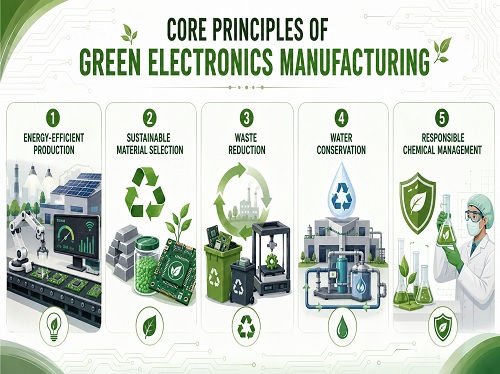
Smart scheduling, LED retrofits, and process optimization let factories cut electricity use without slowing output. IoT-based energy monitoring has helped some manufacturing sites cut consumption by more than 20 percent.
Choosing recycled metals, bioplastics, and halogen-free components reduces the toxic load embedded in every device. Leading manufacturers now run life-cycle assessments before finalizing a bill of materials.
Lean production and etchant regeneration systems keep hazardous by-products out of landfills and waterways. Additive manufacturing is also gaining ground since it builds parts layer by layer instead of cutting material away.
A large semiconductor fab can use up to 38 million litres of water a day, mostly for producing ultrapure water used in wafer cleaning. Closed-loop recycling systems have become essential, with some facilities now recycling up to 90 percent of process water.
Replacing PFAS and other persistent chemicals with safer alternatives protects workers and ecosystems from long-term exposure risks. Substitutions require careful validation, since changing chemicals can affect yield and reliability.
Alexandre Eiji Amano, Sustainability Director for Europe at WEG, has explained that evaluating product design from the start is the natural starting point for any manufacturer serious about improving its ESG profile, since sustainable products create value across their entire lifecycle.
Copper, gold, and rare earth recovery from decommissioned devices cuts the need for fresh mining, which is often linked to habitat destruction. Urban mining is increasingly viewed as a viable alternative to traditional ore extraction.
Plant-based polymers, such as polylactic acid, are emerging as alternatives to the conventional FR4 substrate used in most circuit boards. As performance gaps close, bioplastics are expected to move from niche to mainstream use.
Low-temperature, lead-free solder alloys reduce the energy needed during component attachment while meeting modern safety standards. Newer alloys can perform comparably while enabling assembly on thermally fragile substrates.
Halogen-free circuit boards lower toxic emissions if devices are incinerated or improperly disposed of at end of life. The cost premium has narrowed considerably as suppliers scale production.
Recyclable and biodegradable packaging materials are steadily replacing single-use plastics across the electronics supply chain. This is often one of the simplest and fastest sustainability wins available to a manufacturer.
The table below compares traditional manufacturing choices with sustainable alternatives gaining traction across the industry.
|
Material/Process |
Traditional Approach |
Sustainable Alternative |
Key Benefit |
|
PCB Substrate |
FR4 (fibreglass-epoxy) |
Bioplastics, recyclable resins |
Biodegradable, lower carbon footprint |
|
Solder |
Standard lead-based/high-temp |
Low-temperature, lead-free alloys |
Less energy use, safer disposal |
|
Semiconductor material |
Silicon |
Gallium Nitride, Silicon Carbide |
Higher efficiency, smaller footprint |
|
Packaging |
Single-use plastic |
Recyclable/biodegradable packaging |
Less landfill waste |
|
Etching |
Wet chemical etching |
Dry etching with solvent regeneration |
Reduced hazardous chemical waste |
IoT sensors and connected machines flag inefficiencies in real time, letting plant managers fix energy leaks within days instead of waiting for a scheduled audit. This data also feeds predictive maintenance programs that prevent costly equipment failures.
Manufacturers are increasingly signing power purchase agreements and installing on-site solar to cut reliance on fossil fuels. Some major semiconductor makers have already reached close to 100 percent renewable electricity across several regions.
AI-driven scheduling matches production speed to actual demand, avoiding the energy waste of running machinery at full capacity unnecessarily. Digital twins let engineers test energy-saving changes safely before applying them to live equipment.
Combining renewable power with efficient equipment can meaningfully cut a factory's emissions within a few years. Roughly 80 percent of semiconductor manufacturing emissions fall into direct and purchased-electricity categories, so factories retain significant control over their own footprint.
Hitesh Garg, Vice President and India Managing Director, NXP Semiconductors: “At NXP, caring for our environment and our workforce are deeply interconnected. This World Environment Day, we reaffirm our commitment to building a sustainable future through measurable action — from reducing Scope 1, 2, and 3 emissions and scaling renewable electricity, to recycling over 89% of our waste and 55% of our wastewater.
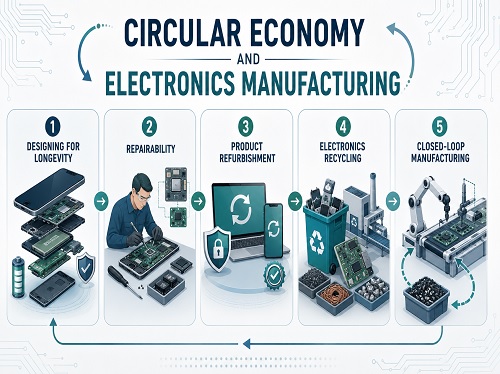 Designing for Longevity
Products built with durable, repair-friendly components last years longer than devices designed around a disposable model. Extending a cell phone's working life by one year across the EU could remove roughly 2.1 million tonnes of carbon dioxide annually.
Modular board design lets technicians replace a single failed component instead of scrapping the entire device. Right-to-repair movements in multiple countries are pushing manufacturers to make spare parts and repair manuals more widely available.
Refurbishing and reselling used electronics keeps working components in active circulation far longer than a single ownership cycle would allow. Refurbishment programs increasingly include data wiping and quality certification to build buyer confidence.
Recovering metals and plastics from old devices reduces pressure on virgin material extraction while lowering hazardous landfill waste. Recycling rates for critical semiconductor materials still lag behind recovery rates for more common metals like copper.
Factories that recycle their own production scrap directly back into new manufacturing cut material costs and waste simultaneously. As material costs rise, this approach is becoming financially attractive on its own merits.
Also Read: How LiDAR, Thermal & UV Payloads Revolutionize Power Transmission
Mehmet Akif Özdemir, CEO and co-founder of EasyCep, a refurbished-electronics company, has said the business's vision is to expand the circular economy globally so that every device gets a genuine second life. He has cited United Nations figures showing 62 million tonnes of e-waste were generated in 2022, expected to reach 82 million tonnes by 2030.
The world generated 62 million tonnes of e-waste in 2022, projected to hit 82 million tonnes by 2030, far outpacing recycling capacity growth. E-waste is now the fastest-growing waste stream on the planet, driven by shorter device lifespans and rising demand.
Take-back schemes and certified recyclers help recover valuable metals safely while preventing hazardous leakage into the environment. Many manufacturers now run their own collection programs, offering trade-in credit to encourage participation.
EPR rules make manufacturers accountable for collecting and processing their own products at end of life. The EU's WEEE directive is widely viewed as the model framework other regions are adapting, and India has its own EPR rules with annual targets.
Proper handling prevents toxic substances like lead, cadmium, and mercury from leaching into soil and water during unregulated disposal. Formal, certified recycling facilities offer a much safer alternative to informal processing.
Jeremy Sutcliffe, Chief Executive of Sims Group, has pointed out that the knowledge his company has built through the European WEEE recycling model could prove critical in helping governments and manufacturers in North America and Australia design workable legislation for end-of-life electronics.
Verifying that minerals come from conflict-free, responsibly managed sources builds long-term trust with regulators and customers. New EU due diligence rules are pushing manufacturers to trace materials further back through their supply chains.
Regular audits confirm suppliers meet the same environmental standards manufacturers set for their own operations. Leading companies now build supplier scorecards that rank environmental performance alongside cost and quality.
Consolidating shipments and choosing nearby suppliers cuts logistics-related carbon output across the supply chain. Air freight carries a substantially higher carbon cost than sea or rail, making mode selection an important lever.
Digital tracking tools give buyers visibility into every stage of a component's journey, from raw material extraction to final assembly. Dashboards that centralize emissions data are replacing manual spreadsheets prone to error.
Kelly Scanlon, who leads technical strategy for Evolve, the Global Electronics Association's sustainability program, has noted that ESG in electronics cannot be managed effectively as a standalone reporting exercise, since its risks stretch across procurement, manufacturing, and product design all at once.
Machine learning models predict peak energy loads across a facility and adjust production schedules accordingly, avoiding costly demand spikes. These systems become more accurate over time as they learn from historical usage patterns.
Sensors placed throughout a facility track water, power, and chemical use continuously, flagging waste before it becomes an entrenched habit. This also supports more accurate sustainability reporting, since figures come directly from sensors.
Virtual factory models let engineers test efficiency changes safely before applying them to a real, live production line. This reduces the risk of costly mistakes and lets companies model environmental impact before committing capital.
Connected systems link design, production, and logistics data, making it easier to spot sustainability gaps hidden across departments. This is increasingly viewed as the operational backbone that makes broader sustainability goals achievable.
3D printing cuts material waste by building components layer by layer instead of cutting away material from larger stock blocks. This is particularly useful for prototyping and low-volume runs where traditional tooling generates excess waste.
Kartik Daftari, Managing Director & CEO, Hitech Radiators: “As climate change accelerates, sustainable manufacturing must evolve from aspiration to action… We see sustainable production as the future of heavy industry—meeting demand without exceeding planetary limits.”
Initial Investment Costs: Green equipment and renewable infrastructure require significant upfront capital that smaller manufacturers may struggle to raise.
Material Availability: Recycled and bio-based materials aren't yet available at the scale conventional supply chains offer, creating real constraints for manufacturers wanting to switch quickly.
Supply Chain Complexity: Coordinating consistent sustainability standards across dozens of global suppliers takes considerable time and expertise.
Regulatory Compliance: Differing rules across regions, particularly between the EU and Asia-Pacific, add real complexity for manufacturers operating globally.
Balancing Cost and Sustainability: Manufacturers must weigh short-term costs against long-term savings, a balance that is rarely straightforward.
Benefits of Sustainable Electronics Manufacturing
Lower Operating Costs: Energy-efficient equipment and water reuse systems cut utility bills significantly, often recovering their initial investment within a few years.
Improved Brand Reputation: Green credentials increasingly sway purchasing decisions among consumers and enterprise buyers evaluating potential vendors.
Regulatory Compliance: Meeting sustainability standards early helps manufacturers avoid fines and the disruption of last-minute compliance scrambles.
Increased Customer Trust: Transparent sustainability reporting builds confidence with retail customers and enterprise clients skeptical of vague environmental claims.
Long-Term Business Resilience: Companies with diversified, sustainable supply chains handle resource shortages and price shocks considerably better than competitors.
Vishal Salvi, CEO, Quick Heal Technologies: “Sustainability is not a checkbox. Hence, it is a strategic, long-term commitment embedded in our operations, product design, and corporate responsibility… Our Extended Producer Responsibility program ensures that all e-waste is recycled through authorized partners.”
Several large manufacturers now source a significant share of factory electricity from solar and wind power purchase agreements. This shift is most advanced in regions with strong renewable infrastructure and supportive incentives.
Some semiconductor facilities now recycle up to 90 percent of their process water, dramatically cutting fresh-water withdrawal from local sources. These systems require significant upfront investment but deliver substantial long-term savings.
Modular laptops and smartphones with replaceable batteries and user-serviceable components are steadily extending average device lifespans. This directly supports growing right-to-repair movements and regulatory pressure toward repairable design.
Supplier scorecards ranking environmental performance alongside cost and quality are becoming a standard procurement tool. Long-term partnerships with certified sustainable suppliers are proving more effective than one-off audits.
More facilities are setting targets to reach net-zero emissions within the next decade, combining renewable power and efficiency upgrades. These commitments are increasingly backed by detailed, publicly reported roadmaps rather than vague pledges.
Combining renewable sourcing, efficient equipment, and verified offsets is becoming a standard framework for net-zero roadmaps. Scope 3 emissions, covering suppliers and logistics, remain the hardest category to address.
Materials like gallium nitride and silicon carbide enable smaller, more efficient chips with a meaningfully lower footprint than conventional silicon. As production costs fall, adoption is expected to expand well beyond current niche uses.
Predictive analytics will increasingly guide real-time decisions on energy, water, and material use, moving sustainability management toward continuous, automated optimization. Manufacturers investing early here are likely to gain a head start over slower competitors.
Refurbishment, modular design, and closed-loop recycling are expected to become mainstream practices rather than the niche initiatives they have largely remained. Over the next decade, circularity is expected to shift from a differentiator to a basic expectation.
Sustainability in electronics manufacturing now touches every stage, from material choice to end-of-life recycling, with pressure coming from regulators, investors, and consumers all at once. Green electronics manufacturing is proving that lower environmental impact and stronger business performance can go hand in hand, as energy-efficient equipment and circular design cut costs while meeting rising expectations. Manufacturers that invest early in renewable energy, sustainable materials, and transparent supply chains are consistently better placed to handle future rules and resource constraints than those that wait.
The circular economy in electronics manufacturing is a production model that keeps materials and products in use for as long as possible. It focuses on designing electronics that are easier to repair, upgrade, reuse, and recycle instead of being discarded after use. This approach reduces electronic waste, conserves valuable raw materials, and lowers the environmental impact of manufacturing. It also helps manufacturers build more sustainable and resource-efficient supply chains.
Green manufacturing reduces costs by improving energy efficiency, minimizing material waste, and optimizing production processes. Using renewable energy, recycling production scrap, and adopting efficient technologies can lower electricity and raw material expenses. It also reduces waste disposal costs and helps companies comply with environmental regulations, avoiding potential fines. Over time, these savings improve operational efficiency and increase profitability.
Recycling is a key part of sustainable electronics manufacturing because it recovers valuable materials such as copper, gold, silver, aluminum, and rare earth elements from discarded devices. Reusing these materials reduces the need for mining, conserves natural resources, and lowers greenhouse gas emissions. Recycling also helps reduce electronic waste sent to landfills while supporting a circular economy. As a result, manufacturers can lower material costs and decrease their overall environmental footprint.
.jpg "Textile Special")





We use cookies to ensure you get the best experience on our website. Read more...