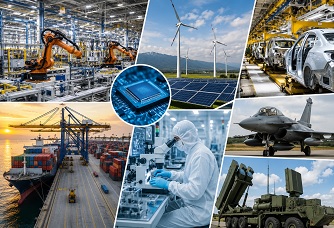
India's industrial and manufacturing ecosystem continues to witness significant developments across government policy, corporate performance, clean energy, defense, and semiconductor manufacturing. Recent announcements reflect sustained investment momentum, growing emphasis on self-reliance, and expanding industrial capabilities. Below is a roundup of the key developments shaping India's manufacturing landscape today.
As the country accelerates its journey towards becoming a global manufacturing hub, both public and private sector initiatives continue to drive capacity expansion, technological innovation, and infrastructure development. Government-backed programs, strategic investments, and robust corporate performance are reinforcing confidence across key industries while creating new opportunities for sustainable economic growth.
India's Production Linked Incentive (PLI) schemes continue to strengthen the country's manufacturing ecosystem, with cumulative investments reaching Rs 2.40 lakh crore and incentive disbursements touching Rs 35,354 crore. The schemes have played a pivotal role in boosting domestic production, exports, and employment across strategic sectors while reinforcing India's position as a global manufacturing destination.
Welspun Corp reported its highest-ever quarterly performance in Q1 FY27, with net profit rising sharply to Rs 1,046 crore. The strong earnings were supported by healthy execution across domestic and international markets, operational efficiencies, and a robust order pipeline that continues to provide long-term business visibility.
Vipul Mathur, Managing Director and CEO, Welspun Corp said, the company's strategic capacity expansions in the United States and Saudi Arabia remain on track for commissioning within FY27, which will strengthen its global manufacturing footprint and reinforce its leadership in the line pipe industry.
Hindustan Zinc is placing greater strategic emphasis on its silver business as global demand accelerates across renewable energy, electronics, automotive, and industrial applications. The company believes silver will become a key growth driver alongside its core zinc operations amid the increasing demand for critical minerals.
Arun Misra, Chief Executive Officer, said: "We have started the year on a strong note with our highest-ever first-quarter mined metal production of 268 KT for the fifth consecutive year, reflecting the strength of our world-class assets and our relentless focus on operational excellence.:
Union Minister for New and Renewable Energy Pralhad Joshi has underscored the importance of battery energy storage systems in supporting India's expanding renewable energy capacity. According to the minister, integrating large-scale storage infrastructure will be essential for improving grid reliability while enabling the country's transition towards cleaner and more sustainable energy sources.
PTC Industries has secured a new order from Gun Factory Kanpur for the supply of artillery components, further strengthening its presence in India's defense manufacturing ecosystem. The contract reflects the continued push towards indigenous defense production under the Make in India initiative.
Avenue E-Commerce reported a wider consolidated net loss of Rs 306.53 crore for FY26 as the company continued investing aggressively in expansion, technology, and customer acquisition. While profitability remained under pressure, the company maintained its focus on long-term business growth and market expansion.
Kalpana Unadkat, chairperson of Avenue Supermarts, said on the macroeconomic environment, “The global economy continues to face challenges arising from geopolitical tensions and the consequent supply chain disruptions. Despite the external headwinds, the Indian economy remained robust during the year, driven by effective monetary and fiscal measures that helped contain inflation while supporting steady economic growth.”
Also Read: Driving Profitable Growth in India’s Automotive Manufacturing Sector
Paras Semiconductors has announced plans to invest Rs 6,200 crore in establishing an Outsourced Semiconductor Assembly and Test (OSAT) facility in Madhya Pradesh. The proposed investment is expected to strengthen India's semiconductor value chain while supporting the country's broader ambitions of becoming a global electronics manufacturing hub.
The Defense Research and Development Organisation (DRDO) has successfully developed India's first indigenous 350 kg thrust expendable turbojet engine, marking a major milestone in the country's defense technology capabilities. The achievement is expected to strengthen indigenous missile propulsion systems and reduce dependence on imported technologies.
The latest developments across manufacturing, defense, semiconductors, renewable energy, and industrial policy reflect India's continued progress towards building a globally competitive manufacturing ecosystem. Backed by sustained government initiatives, strategic investments, technological advancements, and expanding industrial capabilities, these developments are expected to further strengthen the country's position as a preferred destination for manufacturing and innovation.
.jpg "AR Enterprises: Building The Supply Networks Behind India's Construction Growth")
.jpg "Industrial Packers: Engineering Industrial Packaging for India's Manufacturing Future")



We use cookies to ensure you get the best experience on our website. Read more...