India is entering a decisive decade for mobility, where leadership, policy, innovation, and local capabilities must come together to strengthen the country's position in the global market.
In an exclusive interaction with Thiruamuthan, Assistant Editor at India Outlook Magazine, Akash Passey, President, ZF Group India, shares how India's mobility journey is moving beyond products to building an ecosystem that is safer, smarter, and ready to compete globally.
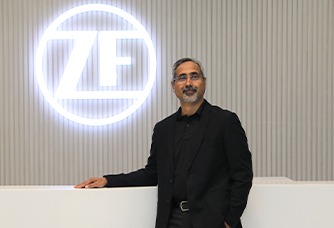
Akash Passey is a seasoned business leader with over three decades of experience shaping India's commercial vehicle and mobility landscape, driving business transformation across ZF Group, Volvo Group, and VE Commercial Vehicles. From establishing Volvo Buses in India to leading international operations across Asia Pacific, the Middle East, Africa, China, and CIS markets, his leadership spans mobility, manufacturing, market expansion, and sustainable transportation
Read the full interaction below to understand the thinking behind this transformation.
With three decades across global mobility leadership roles, how has your approach to leadership and decision-making evolved in today’s rapidly transforming mobility landscape?
I think leadership evolves through experience. Over the years, I've had the privilege of building a rewarding career, but it has also been a journey of learning from mistakes. Those experiences have shaped how I make decisions today.
One thing I strongly believe is that when you're leading in a country like India, you have to think beyond maintaining the status quo. India is still on a remarkable growth journey, and as leaders, we have a responsibility to build for the future rather than simply manage the present.
That's why I've always believed in setting ambitious long-term goals. At ZF, for example, we're aiming for 300% growth over the next five years while bringing meaningful technologies that improve safety, support lower emissions, and contribute to sustainability.
At the same time, leadership is about people. I believe in walking the talk, setting clear goals, and building teams that are aligned around a common purpose. We are here to serve our customers, so every decision we make has to create value both internally and externally.
I'm also a strong believer in India's capabilities. We have exceptional engineering talent, manufacturing expertise, and a young workforce that is eager to innovate. That's why we're focused on strengthening local engineering, local sourcing, local manufacturing, and developing local talent. With nearly 16,000 employees, most of them under the age of 35, we also have a responsibility to evolve as leaders so that we can match their aspirations and create an environment where they can succeed.
India is entering a defining decade, and I see leadership not just as delivering business growth, but as contributing to the country's larger growth story. That's what continues to motivate me every day.
Having led businesses across diverse international markets, how has that experience shaped the way you approach balancing innovation, scalability, and market-specific mobility needs in India?
I would say having an international career has been a real blessing. It hasn't always been easy, but those experiences have shaped the way I lead today. I've spent nearly half of my working life outside India, across Europe and Southeast Asia, and the other half building businesses here. About 27 years ago, I helped build an automobile OEM business from the ground up, and today we're doing something similar in the auto components space by bringing the latest technologies for both electric mobility and ICE platforms into India.
Working across different countries exposes you to different cultures, working styles, and ways of thinking. But one thing I've learned is that, at the end of the day, people are more similar than they are different. Even within India, every region has its own way of working, and as leaders, we have to appreciate and adapt to those differences.
My approach has always been to build a collaborative work environment where diverse perspectives, technologies, and cultures come together around a common purpose. When people share that common purpose, it's much easier to maintain high standards, drive innovation, scale the business, and achieve long-term growth. I believe that's one of the biggest lessons my international experience has taught me, and it's something we're applying every day as we contribute to India's evolving mobility ecosystem.
India's mobility future will be defined not only by technology but by how effectively leadership turns ambition into globally competitive capabilities.
Where do you believe India still lags in its evolving mobility journey, and what must change to bring its standards closer to global benchmarks?
I always say there are many good things happening in India, but there are even more opportunities for improvement. It's never difficult to list the challenges. The real focus should be on how we address them.
For me, one of the biggest challenges is creating a mobility ecosystem that people can rely on every day. Something as simple as travelling to work can still be unpredictable. Whether it's traffic congestion, poor road conditions, or heavy rains disrupting daily life, these are realities that affect millions of people.
I believe one of the reasons is that our infrastructure planning has struggled to keep pace with the country's rapid population growth and urbanization. As a nation, we need to build an environment where people can enjoy a better quality of life with fewer disruptions.
From a mobility perspective, our priorities are clear. We need cleaner mobility through better emission standards, smarter traffic management, and, above all, safer roads. People should be able to travel safely, reach their destinations on time, and have confidence in the systems around them.
If we continue improving these fundamentals while adopting global technologies and standards, I believe India will be well-positioned to strengthen its place in the global mobility landscape.
India’s mobility ecosystem is undergoing multiple shifts, from electrification to safety and infrastructure. How do these changes redefine how mobility solutions are conceived today?
India’s mobility landscape is evolving from product focus to integrated technology ecosystems and solutions where electrification, safety, software, connectivity and intelligent vehicle control work together.
At the same time, India’s unique operating conditions require a strong focus on localization, fit-for-market engineering, and modular platforms that combine global innovation and performance standards with local manufacturing excellence and supply chain resilience.
As customer expectations on safety standards continue to rise, advanced technologies such as electronically controlled braking, ADAS, by-wire systems and integrated vehicle motion control are becoming key differentiators.
They enable shifting focus from only regulatory compliances to accident prevention and enhanced efficiency. In the upcoming future, manufacturing competitiveness will increasingly be driven by technological capabilities, requiring a combination of advanced engineering, digital expertise, sustainable manufacturing and localization.
At the ZF Group, we see India not only as a manufacturing base but as a strategic hub for engineering, software development, sourcing and global technology deployment, enabling us to develop solutions that address the local requirements while strengthening our contribution to global mobility innovation.
Also Read: Zero-Emission Mobility: India's Path to Cleaner Urban Transport
In this context, how is the role of technology evolving around safety and intelligence, and how are ADAS and automation shaping expectations across passenger and commercial mobility segments?
The future of mobility is being shaped by intelligent, software-driven vehicle control systems that go beyond traditional hardware to deliver safety and efficiency. Technologies such as brake-by-wire, steer-by-wire, integrated chassis control and software-defined vehicle architectures enable vehicles to anticipate and respond more effectively to real-world conditions.
Today, ADAS is fast becoming a business necessity rather than a premium feature, helping OEMs and fleet operators improve safety, reduce downtime, lower operating costs and enhance overall efficiency.
The path towards automated mobility is by practical, scalable innovations that deliver measurable value including a focus on improving driver support, productivity and reliability. To fully realize India's potential as a leader in intelligent mobility, strong collaboration between OEMs, suppliers, policymakers and technology partners is essential to accelerate the adoption of advanced, affordable and market-relevant mobility solutions for both domestic and global markets.
While innovation accelerates and localization gains importance under initiatives like Make in India and PLI, how should companies balance building local capabilities with global innovation alignment?
To successfully balance localization with global innovation, we need to view localization as more than just limited to manufacturing. We must invest equally in engineering, software development and supplier capability.
For the ZF Group, we believe the most effective approach is to develop products that meet global quality and technology standards while addressing the specific needs of the Indian market, essentially creating solutions that are competitive both locally and internationally. Initiatives such as Make in India and PLI schemes provide us with an opportunity to strengthen the domestic supplier ecosystem.
Through collaboration, technology transfer and process excellence, we can turn localization into a key driver of innovation rather than simply a cost advantage. At the same time, India’s growing strengths in engineering, software and digital technologies position it as a strategic co-creation hub within global R&D networks, enabling faster innovation and scalable solutions for multiple markets.
Ultimately, long-term competitiveness will not be dependent on cost alone, but it will be based on the capability to combine local manufacturing with advanced technology, digitalization, and sustainability, strengthening domestic presence and global value chains.+
Railways are emerging as a new focus area for ZF in India, including contributions like Vande Bharat gearboxes. How do you see this segment shaping future mobility?
Rail is one of the most efficient and sustainable modes of transport, and India’s growing investments in high-speed, regional, metro and freight rail networks are creating significant opportunities to strengthen the country’s mobility ecosystem. As transportation becomes increasingly multimodal, rail will play a vital role in enhancing connectivity while reducing emissions and improving energy efficiency.
At ZF, we contribute to this transformation through advanced rail gearbox technologies, including solutions for the Vande Bharat platform, focused on delivering high reliability, operational efficiency, extended service intervals and lower lifecycle costs. At the same time, India’s emergence as a manufacturing and engineering hub enables the combination of local production capabilities with globally proven engineering expertise and quality standards.
Looking ahead, the future of rail will be shaped not only by advanced mechanical systems but also by digitalization, predictive maintenance and lifecycle support services that improve fleet availability and operational performance. Technology partners will create value by delivering integrated solutions that enhance reliability, safety and asset utilization across the rail ecosystem.
Also Read: Navigating the Future of Rail Manufacturing in India
With construction equipment and off-highway mobility gaining traction alongside core transportation, what lesser-discussed opportunities or bottlenecks could influence their growth trajectory in India’s industrial landscape?
India's continued investment in infrastructure, mining and construction is driving demand for equipment that delivers higher productivity, lower fuel consumption and greater reliability.
The opportunity lies in adopting technologies that improve efficiency, operator comfort and lifecycle performance rather than competing solely on acquisition cost. While electrification is gaining momentum, digitalization, predictive maintenance, telematics and intelligent driveline control will have an equally significant impact on equipment utilization and fleet productivity.
A key opportunity for industry is to continue investing in skilled talent, component quality and technology partnerships to support increasingly sophisticated off-highway equipment. As customers increasingly evaluate equipment based on lifecycle value, there will be greater adoption of technologies. For the industry, balancing performance, sustainability and affordability will be critical to achieving profitable growth.
How can leaders align short-term execution with sustained investments in future-ready mobility technologies without compromising competitiveness?
The mobility transition is not uniform across markets or vehicle segments. ZF Group is investing in technologies while building software-defined capabilities, allowing customers to transition at a pace that matches market demand without disrupting business continuity.
Future technologies should also balance operational excellence. Continued investment in manufacturing efficiency, localization, and engineering capabilities enables companies to remain competitive while creating the foundation for tomorrow. Long-term competitiveness depends on strong partnerships across OEMs and suppliers, along with academia and policymakers.
Companies that combine all this will be better positioned to respond to changing customer needs while contributing to India's ambition of becoming a global manufacturing and mobility hub.
Also Read: Optimizing Production Processes for Zero-Defect Auto Manufacturing
As ZF expands across multiple mobility segments in India, how do you ensure innovation remains cohesive while addressing diverse customer needs, regulatory frameworks, and operational realities?
ZF Group in India operates across Passenger Car, Commercial Vehicle, Wind Power, Railways, Mining, Agriculture, Construction Equipment, and Tests Systems sectors and is supported by our Engineering Centers.
Successful innovation across such diverse mobility segments requires a balance of adaptability and customer focus. For this we leverage technology platforms like electrified drivetrains, software-defined vehicle architectures, advanced braking systems and digital controls, and build on our internal capabilities to support it across applications. This is enabling faster and more efficient innovation.
At the same time, for India globally we explore how proven technologies can be combined with local engineering, validation and manufacturing capabilities to address specific market requirements while maintaining global competitiveness.
As mobility ecosystems become increasingly interconnected, close collaboration between engineering, manufacturing, software teams, suppliers and customers is essential to accelerate development and respond effectively to evolving industry needs. Ultimately, the true measure of innovation lies in its ability to deliver the right mobility solutions with long-term value for customers across all mobility segments.
Looking ahead, as mobility becomes increasingly connected and multi-dimensional, what will define leadership in shaping future mobility ecosystems across segments in India?
The future of mobility will be defined by the ability to innovate across ecosystems rather than individual products. We have a unique advantage of combining world-class engineering talent with our manufacturing strengths, which can make us a global co-creation hub for next-generation mobility technologies.
To achieve this leadership in a sustainable manner, it will need stronger collaboration between industry, government, academia and technology partners to accelerate innovation, harmonize standards and build resilient supply chains that can serve both India and global markets.
Finally, for emerging leaders, what skills and mindset will be most critical in building resilient, people-centric organizations in the years ahead?
I believe that for any emerging leader, the ability to adapt and learn continuously is critical. Leading through change and building resilient and people-centric organizations has become one of the key defining character traits of leaders in today’s dynamic global environment.
In this rapidly evolving business environment, success is when you create a culture where people feel empowered, engaged and motivated to contribute. Equally important is the ability to build trust and collaboration.
8 Key leadership principles from Akash:
.jpg "Textile Special")

We use cookies to ensure you get the best experience on our website. Read more...