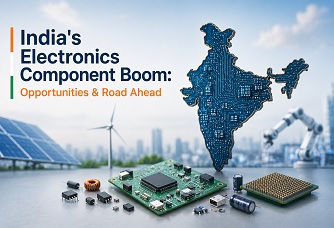
India's electronics component manufacturing story has moved past the assembly line. For a decade, the country's electronics growth centered on putting together smartphones and appliances using imported parts.
That story is changing fast. Electronics component manufacturing is now the sector that the policymakers and investors talk about. Because components hold real value, margins, and technology ownership.
Global brands are actively looking beyond China for suppliers, and India's factories, incentives, and talent pool are positioned to catch that demand. To add further, according to the Press Information Bureau, Domestic electronics production has grown six-fold in eleven years, touching INR 11.3 lakh crore in FY25.
“As we embark on the road to build a USD 500 billion mission, it is critical to build a sustainable and competitive electronics manufacturing ecosystem. India has witnessed an unprecedented growth in the mobile and electronics sector. Domestic production has increased 400 per cent to an estimated USD 135-140 billion over the last decade since FY15. The ECMS will now catalyse the industry to deepen integration with Global Value Chains (GVCs), establish large-scale manufacturing units, and enable significant employment generation,” said Pankaj Mohindroo, Chairman, ICEA.
The real question now is whether India can move from assembling devices to owning the components that power them. And can it become a genuine global hub rather than a final-stop factory floor.
In this article, we'll explore what electronics component manufacturing includes, why it has become India's next major industrial growth engine. We will also look at key government initiatives driving the sector.
Furthermore, we'll examine the fastest-growing component categories, emerging technologies like AI and smart manufacturing, investment opportunities and industry challenges.
Electronic components are the building blocks inside every device, vehicle, and machine. Before diving into demand and policy, it helps to understand what this ecosystem actually includes.
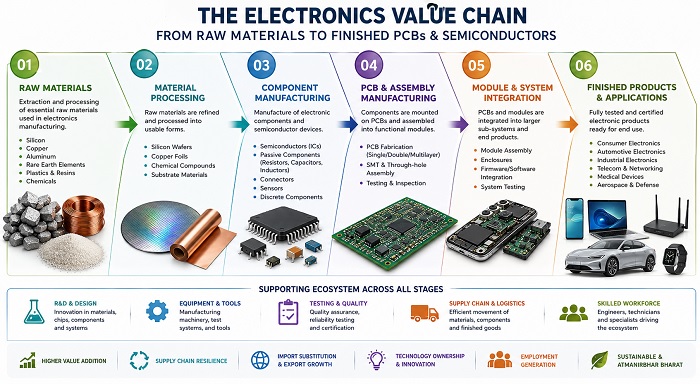
Assembling a phone earns a company a thin margin. Making the camera module, battery management chip, or display driver inside it earns far more. That is the core shift behind India's electronics component manufacturing push.
Components carry higher value addition and stronger margins than final assembly work. They also give a country technology ownership, since designing a sensor or power module requires real engineering depth. This ownership feeds export competitiveness, because component-exporting nations control pricing rather than reacting to it. It also builds supply chain resilience, reduces reliance on single-country imports, and pulls a domestic ecosystem of tool-makers, testers, and material suppliers.
HCL founder Ajai Chowdhry, who is also chairman of EPIC Foundation, said that this was a much-awaited electronics components manufacturing scheme. “From EPIC, we had been requesting this for a long time. This will enable much higher value addition in the country for electronics manufacturing and will attract more investments in system products as local availability will enable just-in-time manufacturing.”
India's electronics sector has quietly become one of its fastest-growing export categories. The numbers tell a clear story of scale and momentum.
|
Indicator |
FY 2014-15 |
FY 2024-25 |
Growth |
|
Electronics production |
INR 1.9 lakh crore |
INR 11.3 lakh crore |
6x |
|
Electronics exports |
INR 38,000 crore |
INR 3.27 lakh crore |
8x |
|
Mobile phone production |
INR 18,000 crore |
INR 5.45 lakh crore |
28x |
|
Mobile phone exports |
INR 1,500 crore |
INR 2 lakh crore |
127x |
Electronics became India's third-largest export category in FY25, up from seventh place just three years earlier, per the Economic Survey 2025-26. In the first half of FY26 alone, electronics exports touched USD 22.2 billion, keeping the sector on track to become India's second-largest exported item overall. India is also the world's second-largest mobile phone manufacturer, running over 300 manufacturing units compared to just two in 2014. The government's own target is a USD 500 billion electronics manufacturing ecosystem by 2030-31, and components are meant to carry a much larger share of that value than they do today.
This turning point is visible in domestic consumption patterns too. India's own appetite for electronics, from EVs to industrial machinery to home appliances, is growing faster than most mature markets. This gives domestic component makers a captive market to scale into before chasing exports. Localization initiatives under ECMS and PLI are nudging brands to source components domestically rather than import them. This slowly rebalances the bill-of-materials for Indian-made devices.
At the same time, changing global supply chains are pushing multinational OEMs to qualify Indian vendors alongside Chinese and Southeast Asian ones. Industrial demand, particularly from automotive and renewable energy, is now growing as fast as consumer electronics demand. This is giving the component ecosystem a broader, more resilient base than the mobile-phone-led growth of the last ten years.
Also Read: How LiDAR, Thermal & UV Payloads Revolutionize Power Transmission
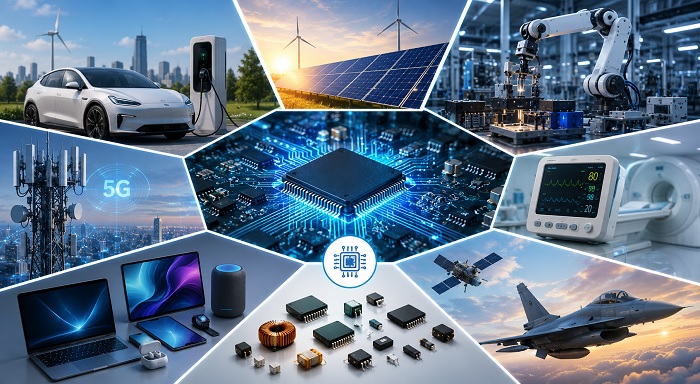
Smartphones built India's electronics base, but new sectors are now pulling electronics component manufacturing in fresh directions.
 Electric Vehicles
EVs need far more electronics than combustion vehicles, including power electronics, motor controllers, battery management systems, and charging modules. Industry estimates put the electronics content of an EV at three to four times that of a comparable petrol vehicle, largely due to power semiconductors and battery management systems.
Every EV rolling out of an Indian factory increases demand for sensors and control units, and India's EV sales are projected to cross 1 crore units annually by 2030 across two-wheelers, three-wheelers, and passenger vehicles. This single sector is becoming one of the biggest pull factors for domestic component makers, particularly for GaN and silicon carbide-based power modules that improve charging speed and efficiency.
Solar inverters, wind controllers, grid electronics, and smart meters all rely on components made or imported at scale. India's renewable energy capacity addition target of 500 GW by 2030 is directly tied to demand for power electronics, since every solar and wind installation needs inverters, controllers, and grid-balancing electronics to function.
Smart meter rollout across states is adding further volume, with over 10 crore smart meters targeted under the Revamped Distribution Sector Scheme. As India expands solar and wind capacity, demand for power electronics and energy storage systems grows alongside it, making renewable energy one of the steadiest, policy-backed demand sources for domestic component makers.
Factories adopting automation need industrial controllers, PLC electronics, sensors, and networking hardware. This is quietly building a steady, less headline-grabbing source of component demand.
Diagnostic equipment, wearables, and patient-monitoring devices require compact, reliable components. India's growing medical device sector is a smaller but fast-scaling consumer of precision electronics.
Televisions, smart home devices, and audio systems continue to need displays and power modules. 5G rollout is driving demand for RF modules and optical networking gear. Aerospace and defense electronics, meanwhile, need high-reliability components built to stricter standards, opening a specialized, high-margin niche for Indian manufacturers.
Certain components sit at the center of this growth story more than others.
|
Component |
Why demand is rising |
|
Printed Circuit Boards (PCBs) |
Backbone of every device; India imports ~88 percent of bare PCB demand today |
|
Capacitors & Resistors |
Core passive components used across all electronics categories |
|
Connectors & Relays |
Critical for automotive, industrial, and telecom electronics |
|
Power Modules & Power Semiconductors |
Central to EVs, renewable energy, and industrial drives |
|
Sensors |
Powering EVs, automation, and medical devices alike |
|
Microcontrollers |
Embedded logic for nearly every smart device |
|
Displays |
Driven by consumer electronics and automotive dashboards |
|
Lithium Battery Electronics |
Rising with EV and energy storage adoption |
|
GaN and Silicon Carbide Components |
Enabling faster charging and higher-efficiency power systems |
|
Electronic Wiring Harnesses |
Growing with vehicle and industrial electrification |
India's PCB market alone was valued at roughly USD 7.27 billion in 2025 and is projected to reach USD 25.48 billion by 2034, growing at nearly 15 percent a year, driven by PLI support, 5G rollout, and EV adoption. Yet the country still imported USD 3.7 billion worth of bare PCBs in FY25 against total demand of USD 4.2 billion, leaving a wide domestic-manufacturing gap still to close.
Power semiconductors and sensors deserve particular attention, since both sit at the intersection of India's biggest demand drivers. Power semiconductors, including GaN and silicon carbide devices, are what let EV chargers run faster and renewable inverters lose less energy in conversion; India currently imports the vast majority of these high-end chips, making domestic packaging and assembly capacity a near-term priority rather than a long-term ambition.
Sensors follow a similar pattern: automotive sensors alone are expected to see double-digit annual growth in India through the rest of this decade, driven jointly by EV adoption and stricter vehicle safety norms. Microcontrollers and displays round out the list of components where India's own consumption already justifies local assembly, even before exports are factored in. Connectors and relays, often overlooked in favor of flashier chip-level components, are seeing steady demand growth from both automotive wiring harnesses and industrial automation panels, making them a reliable, if less glamorous, entry point for new manufacturers.
Policy support has become the single biggest catalyst behind India's electronics component manufacturing momentum.
Beyond these headline schemes, state governments are running their own parallel incentive programs, including capital subsidies, stamp duty exemptions, and dedicated electronics parks in Uttar Pradesh, Tamil Nadu, Karnataka, and Gujarat. Export incentives under the Remission of Duties and Taxes on Exported Products scheme further improve the economics for component makers selling overseas. Whereas cluster development funding under EMC 2.0 is meant to give smaller manufacturers shared access to testing labs and common facilities they could not otherwise afford individually.
Ease-of-doing-business reforms, including single-window clearances for electronics units in several states, are also being cited by industry bodies as a meaningful contributor to investment decisions. Taken together, these overlapping layers of central and state support are designed to de-risk the long gestation periods that component manufacturing, unlike assembly, typically requires.
ELCINA Secretary General Rajoo Goel said India's next phase of growth "will depend on strengthening its component ecosystem," pointing to printed circuit boards and critical inputs as priority segments the ECMS scheme was designed to support.
Also Read: Ethanol Epidemic in India: Factory Pollution, Vehicle Problems & More
Global brands no longer want all their manufacturing sitting in one country. That single shift, known as China+1, is reshaping where component orders land.
Companies are actively diversifying suppliers to cut geopolitical and supply-chain risk. India offers scale, a large workforce, and government incentives that make it an attractive second or third manufacturing base. This has already translated into new factories, fresh foreign investment, and strategic partnerships between Indian and global component makers.
ICEA Chairman Pankaj Mohindroo said India's electronics manufacturing journey "is now entering a phase where scale must be matched with depth," a signal that component-level investment, not just assembly capacity, is the next priority.
Behind the big-ticket investments, a quieter localization story is unfolding among smaller manufacturers.
Import substitution is pulling MSMEs and Tier-2 suppliers into the component ecosystem for the first time. Vendor development programs run by large OEMs are helping smaller firms meet quality and testing standards needed to supply global brands.
IESA President Ashok Chandak noted that component-level PLI support "will accelerate the 'Make in India' initiative, driving higher value addition and strengthening the domestic supply chain with import reductions." This localization push matters most for PCBs, passive components, and display modules, categories where India still depends heavily on imports.
Factories making components are themselves being transformed by new technology.
The road ahead isn't without friction. Several structural gaps still hold back faster growth.
Machines and incentives alone cannot build a components industry; skilled hands and design talent matter just as much. Component manufacturing needs precision-assembly technicians, quality inspectors, and design engineers who understand PCB layout, semiconductor packaging, and embedded systems, not just generic factory-floor skills. India's engineering colleges produce large numbers of graduates, but industry bodies including IESA and MAIT have repeatedly flagged a gap between classroom training and factory-floor readiness in electronics manufacturing specifically.
The government's Electronics Sector Skills Council, along with company-run training centers inside clusters like Sriperumbudur and Noida, are working to close that gap through hands-on certification programs. Design-led manufacturing, where Indian engineers create original component designs rather than just building to a foreign blueprint, is where this skilling push matters most, since it is the step that would let India move from an assembly economy to a true component-innovation economy.
The component boom is opening doors for more than just large manufacturers.
Component factories are also under pressure to grow cleanly, not just quickly.
Energy-efficient production lines, recycling programs, and reduced electronic waste are becoming part of factory design rather than an afterthought. Several Indian PCB and component makers have already picked up sustainability recognition for water-recycling systems and eco-friendly processes.
As global buyers tighten ESG requirements, sustainable practices are turning into a competitive differentiator, not just a compliance checkbox, for Indian suppliers chasing export orders. A circular-economy approach to component manufacturing, where scrap PCBs and rejected units are processed for metal recovery rather than landfilled, is also gaining traction as raw material costs rise, giving manufacturers a cost incentive that lines up neatly with their environmental one.
India still trails established hubs on scale, but its trajectory stands out.
|
Country |
Position in Electronics Supply Chain |
|
China |
Dominant hub; ~50-60 percent share of global PCB production |
|
Taiwan |
Global leader in semiconductor fabrication and design |
|
Vietnam |
Strong assembly base, growing component investment |
|
South Korea |
Leader in displays, memory chips, and advanced materials |
|
Malaysia |
Established packaging and testing hub |
|
Thailand |
Automotive electronics and component manufacturing base |
|
Mexico |
Nearshoring hub for North American electronics demand |
|
India |
Rapidly scaling component base, still import-dependent in PCBs and semiconductors |
India's advantage over Vietnam and Thailand lies in sheer domestic market size, which gives component makers a home base of demand that smaller economies cannot match. Its disadvantage against Taiwan and South Korea is decades of accumulated design and fabrication expertise that cannot be built overnight, however generous the incentive scheme. Against China specifically, India's pitch is less about matching scale and more about offering a lower-risk, policy-friendly alternative for global brands that no longer want a single-country supply chain.
Mexico's nearshoring advantage for North American buyers is a useful comparison too, since it shows that geography and trade agreements matter as much as manufacturing cost, an area where India's free trade agreement negotiations with the EU, UK, and other blocs could meaningfully shift its competitive position over the next few years.
Numbers only tell part of the story. On-ground clusters show how electronics component manufacturing is actually taking shape.
Avneet Singh Marwah, CEO of Super Plastronics, said component-focused incentive schemes are being taken seriously by manufacturers this time around, since "the government only wants players who are willing to invest" rather than firms that claim incentives without building capacity. That shift in enforcement is itself shaping how seriously new clusters are being built out.
India's electronics component ambitions are backed by real numbers, not just intent. The government's USD 500 billion electronics ecosystem target for 2030-31 depends heavily on components carrying a larger share of that value than today. ELCINA-Feedback Advisory projects India's PCB output could reach nearly USD 14 billion by 2029-30, about 10 percent of the broader USD 150 billion component manufacturing target. Semiconductor Mission 2.0's INR 1.27 lakh crore push, alongside ECMS and PLI support, gives India a genuine shot at owning more of its component value chain by 2035, provided the workforce, testing infrastructure, and R&D gaps get addressed at the same pace as investment.
India's electronics component manufacturing is expanding due to rising domestic demand, government initiatives such as the Production Linked Incentive (PLI) Scheme and Electronics Component Manufacturing Scheme (ECMS), and the global shift toward supply chain diversification. Increasing investments in semiconductors, consumer electronics, automotive electronics, and telecom infrastructure are also driving growth. The push for self-reliance and exports has further strengthened the sector.
The highest-demand electronic components include semiconductors and integrated circuits (ICs), printed circuit boards (PCBs), capacitors, resistors, connectors, sensors, displays, batteries, and power management devices. Demand is rising rapidly due to the growth of smartphones, electric vehicles (EVs), data centers, industrial automation, IoT devices, and 5G infrastructure.
Artificial intelligence is transforming electronics manufacturing by improving quality control, predictive maintenance, production planning, and supply chain management. AI-powered vision systems can detect defects with greater accuracy, while machine learning optimizes production efficiency and reduces downtime. It also enables smarter factories through real-time monitoring and automated decision-making.
This article draws on verified data from the Press Information Bureau, Union Budget 2026-27, ELCINA, ICEA, and IESA, along with named industry commentary. Figures reflect the latest available government and industry reports as of publication. Readers are advised to check scheme-specific portals for real-time updates, as component manufacturing incentives are revised periodically.
.jpg "Textile Special")






We use cookies to ensure you get the best experience on our website. Read more...