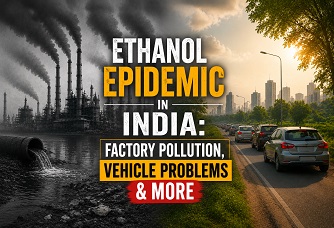
The ethanol pollution crisis in India is spreading faster than the clean-up can keep pace with. The Ethanol Epidemic in India is no longer a policy footnote.
It is showing up in village wells, vehicle service bills, and some of the world's worst air quality readings. India blended 20% ethanol into petrol by 2025, five years ahead of schedule.
But that speed has come at a cost: distillery effluent poisoning farmland, E20 fuel complaints piling up, and a border town now infamous for its toxic air.
In this article, we have covered the pollution side of India's ethanol story: factory waste, vehicle problems, real emissions data, policy gaps, and the Byrnihat controversy.
India's ethanol blending program expanded from under 1.5% in 2013-14 to 20% by 2025-26. That is the number the government leads with. What it leads with less often:
Officials call this a green fuel success story tied to thecountry's 2070 net-zero pledge. Farmers near new distilleries in Chhattisgarh, Punjab, and the northeast describe a different reality: foul odour, blackened wastewater, and crop damage. That gap between the official narrative and ground-level complaints is where the ethanol mission is now facing its sharpest scrutiny.
The latest clarification also comes amid an 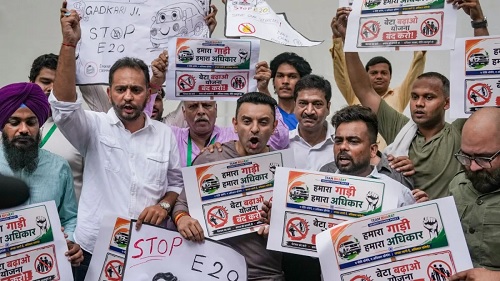 ongoing debate over ethanol blending. Concerns have been raised over higher water consumption for ethanol production, pollution from some ethanol manufacturing units, and lower fuel efficiency in certain vehicles. However, the government maintains that the long-term benefits of reducing crude oil imports and improving energy security outweigh these challenges.
Despite its environmental and energy security benefits, the nationwide rollout of E20 petrol has faced criticism from vehicle owners, particularly those driving older petrol vehicles. A LocalCircles survey reported by Livemint found that 53% of petrol vehicle owners viewed the rollout negatively, with 42% describing it as "disastrous."
The biggest concern was fuel efficiency, with 66% of owners of pre-2023 vehicles claiming their mileage dropped by more than 10%, significantly higher than the 1–6% reduction estimated by the Automotive Research Association of India (ARAI). Additionally, 45% of respondents reported increased maintenance or repair costs, while 31% said they would prefer the option to purchase E0 or E10 petrol instead of being limited to E20.
These findings highlight the gap between consumer experiences and the government's position that E20 is safe for compatible vehicles and offers long-term benefits such as reduced oil imports, lower emissions, and improved energy security.
"If international crude oil is trading at around USD 70 per barrel, E20 is actually costlier to produce than pure petrol. If crude rises to USD 120-130 per barrel, the economics naturally reverse and ethanol becomes even cheaper," said Petroleum and Natural Gas Minister, Hardeep Singh Puri.
Ethanol factory pollution starts with spent wash, a dark, acidic byproduct generated at 8 to 15 litres for every litre of ethanol produced. India's 315-plus distilleries generate roughly 40.4 billion litres of this distillery pollution every year. Its Biochemical Oxygen Demand runs at 30,000 to 80,000 mg/L, among the highest of any Indian industrial effluent.
|
Distillery Waste Parameter |
Typical Value |
|
Spent wash generated per litre of alcohol |
8–15 litres |
|
BOD of raw spent wash |
30,000–80,000 mg/L |
|
COD of raw spent wash |
80,000–100,000 mg/L |
|
Total distilleries in India |
315+ |
|
Annual wastewater generated |
~40.4 billion litres |
.jpg) What untreated or poorly treated spent wash actually does on the ground:
What untreated or poorly treated spent wash actually does on the ground:
Kumari Sahu, a farmer in Patharra village, Chhattisgarh, said her paddy crop failed after a nearby distillery began operating. "Because of the constant stench, it is difficult to find labourers," she said.
In neighbouring Ranka village, sarpanch Ghanaram Nishad has opposed a new distillery on similar grounds. "The pollution has made life miserable for the people of Patharra," he said.
"We won't allow our village to become the next Patharra." Gautam Bandopadhyay, convener of the environmental group Nadi Ghati Morcha, noted that land acquired for such plants often includes village commons, undermining the rural economy.
A similar pattern played out in Zira, Punjab, where the Malbros ethanol plant was shut down in 2023 after months of protest. A CPCB investigation there found hazardous industrial waste had contaminated groundwater in nearby villages.
E20 fuel problems have dominated consumer complaints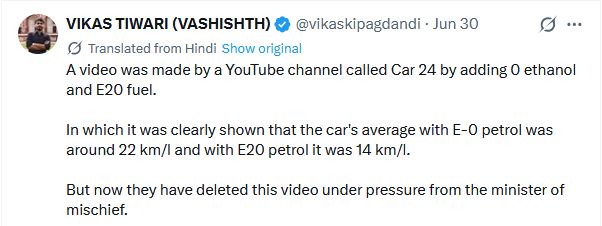 since the nationwide mandate took effect in April 2026. The core issues raised by owners and independent experts:
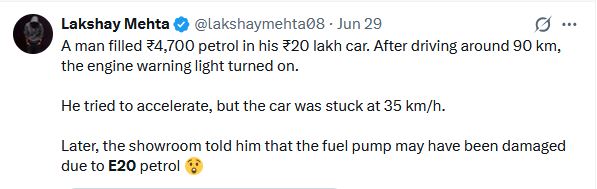 had warned lower-powered two-wheelers could face drivability problems on higher blends.
A recent survey found 53% of petrol vehicle ownersfaulted the government's handling of the E20 rollout. Automobile expert Dinesh, speaking on a Federal panel, argued that official tests showing a 4-6% efficiency loss likely understate real-world losses. "Congestion, potholes, and frequent braking increase engine stress," he said, adding that mileage directly affects household budgets and shouldn't be dismissed.
Automakers have pushed back on the scale of the problem. Maruti Suzuki's Rahul Bharti said the company tested older E10-era cars on E20 and found no significant wear. Hero MotoCorp's Ashutosh Varma cited service records showing no rise in damage cases.
Critics note that SIAM itself had flagged compatibility risks for older vehicles just years earlier, raising questions about how quickly those concerns were resolved. Toyota Kirloskar's Vikram Gulati pointed to UNECE-aligned testing protocols behind the fuel's approval.
Also Read: E20 Petrol Rollout Faces Questions After Vehicle Damage Report
|
Concern |
What Owners Report |
Industry Response |
|
Mileage drop |
5-10% reported by users |
4-6% under lab conditions |
|
Warranty validity |
Uncertainty among older-vehicle owners |
SIAM confirms warranties remain intact |
|
Fuel system wear |
Corrosion, leaks reported anecdotally |
No rise in damage per service data |
|
Pre-2023 vehicles |
Higher perceived risk |
"No significant concerns," per Maruti Suzuki |
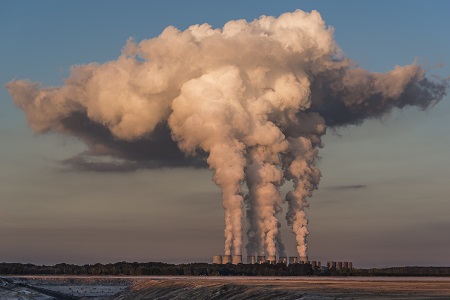 Ethanol carbon emissions look far better at the tailpipe than across the full production cycle. India's E20 rollout has cut an estimated 832 lakh metric tonnes of CO2, a genuine gain for greenhouse gas emissions from road transport.
But lifecycle emissions depend heavily on feedstock, and that's where the picture gets murkier:
Water use compounds the problem. A single litre of ethanol from rice can consume over 10,000 litres of water; sugarcane and maize need roughly 3,600–4,700 litres. Rice and sugarcane both demand far more irrigation cycles than maize, which is largely rain-fed. In water-stressed states like Maharashtra and Uttar Pradesh, this biofuel sustainability trade-off is rarely discussed alongside the emissions wins.
India ethanol policy runs on GST cuts, procurement pricing, and blending mandates. The subsidy and pricing structure looks like this:
The gaps that concern independent researchers:
Dr. C.K. Jain, President of the Grain Ethanol Manufacturers Association, has defended the programme's intent, arguing it should be judged on energy security and farm income rather than a simplistic food-versus-fuel framing. But that defence doesn't address why enforcement gaps keep surfacing at the state level.
Byrnihat, a border town between Meghalaya and Assam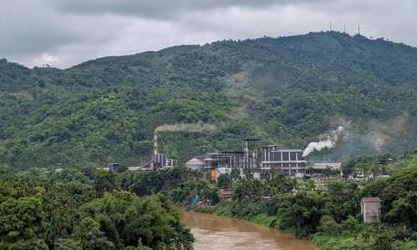 , has become the flashpoint in India's Byrnihat pollution debate after a viral documentary blamed a single ethanol plant for the town's toxic air.
The numbers here are stark:
Residents describe soot on leaves, rooftops, and vegetables every morning, and say they must wash produce repeatedly before eating it. Many report respiratory illness and skin problems, though no scientific study has directly linked specific illnesses to a single factory.
“Ethanol production causes significant environmental pollution, even though the final fuel burns cleaner than gasoline when used in vehicles. Ethanol is widely promoted as a "green" or climate-friendly energy source because plants absorb carbon dioxide while growing. However, the actual process of manufacturing it creates critical environmental trade-offs,” said Sanjeev Jain, Vice President, Society of Energy Engineers and Managers (SEEM).
Also Read: How LiDAR, Thermal & UV Payloads Revolutionize Power Transmission
Byrnihat pollution data points to a cluster problem, not a single culprit. Devesh Walia, Dean at North-Eastern Hill University, told Mongabay India that industrial density combined with the valley's trapped, low-pressure air is what drives the crisis, not any one plant.
The ethanol plant now blamed, Umiam Distillation Pvt. Ltd., only began commercial operations in September 2024 — two years after CPCB's initial critical-pollution flag. A June 2026 government inspection found the plant operating within its permitted emission limits. That doesn't clear Byrnihat's air; it simply means the pollution has many sources, most of them older and unrelated to ethanol:
Cleaner biofuel growth depends on fixing the gaps this article has covered, not just hitting the next blending target. The priorities that would actually reduce harm:
The gap between official messaging and ground reality remains one of the biggest obstacles to fixing any of this. Union Road Transport Minister Nitin Gadkari said that not a single vehicle had faced a verified problem from E20 fuel, challenging critics to name even one.
The same week, farmers in Chhattisgarh described crop damage and unusable wells near new distilleries, and Byrnihat residents continued reporting soot, respiratory illness, and skin problems. A 2026 ARAI study had already found that prolonged E20 use in older, E10-designed vehicles could gradually affect rubber fuel-system parts, a finding that sits uneasily next to any "zero complaints" claim. Responses to the ethanol epidemic remain this mixed: confident denials from the top, and a very different story from the people living and driving closest to it.
Sustainable biofuels and genuine environmental protection aren't automatically the same thing. Until pollution complaints get the same urgency as blending milestones, India's ethanol epidemic will keep generating headlines for the wrong reasons.
Is ethanol causing pollution in India?
Ethanol fuel itself burns cleaner than petrol. But ethanol production generates high-BOD spent wash that has poisoned farmland and groundwater in multiple states when treatment norms weren't enforced.
Does E20 fuel reduce mileage?
Yes. Owners report 5-10% drops; official lab tests cite 4-6%, though experts argue real-world losses run higher.
Is E20 fuel safe for older vehicles?
Automakers say warranties remain valid, but SIAM itself flagged compatibility risks for pre-2023 vehicles, and wear over sustained use remains a live concern.







We use cookies to ensure you get the best experience on our website. Read more...