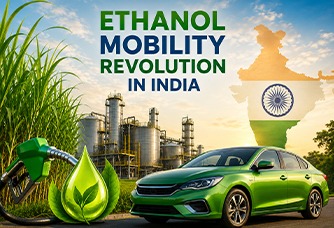
The West Asia crisis has showcased how fragile the world’s energy supply chain can be. And for countries such as India, where 80 percent energy requirement is met by import, it has become imperative for the automotive industry to push forward towards alternative fuel. In this case, India must focus on accelerating the ethanol mobility revolution by democratizing flex-fuel vehicles in India.
And to start with, India's transition toward cleaner and more sustainable transportation took a significant step forward with the landmark delivery of Maruti Suzuki Wagon R Flex-Fuel vehicles to members of the Indian Sugar & Bio-energy Manufacturers Association (ISMA).
This move of Maruti Suzuki resulted in the much-needed leap in India's ethanol journey with the launch of the WagonR Flex-Fuel - the country's first passenger car capable of running on E85 fuel.
This promising event greatly symbolizes a critical shift in India's ethanol journey, i.e., India is transitioning itself from being a leading ethanol producer to becoming a large-scale ethanol consumer.
Highlighting how flex-fuel technology can create benefits across multiple sectors, from agriculture to energy security, Hisashi Takeuchi, Managing Director & CEO, Maruti Suzuki India stated, “Flex fuel will help meet India's two national objectives of cutting crude oil imports and reducing carbon emissions.”
“The benefits of flex-fuel go much beyond the automobile sector, supporting the economy, society, environment, farmers, ethanol producers and the larger rural ecosystem,” he further emphasized.
Unveiled in the presence of Union Ministers Nitin Gadkari and Hardeep Singh Puri, the car can operate on fuel blends which contain up to 85 percent ethanol, making Maruti Suzuki the first carmaker in India to bring a flex-fuel passenger vehicle to market.
Furthermore, Nitin Gadkari, the Union Minister of Road Transport and Highways of India, has also highlighted the push to E30 and eventually 100 percent ethanol. This meticulously crafted article will offer readers with comprehensive information around every aspect of the Flex-Fuel.
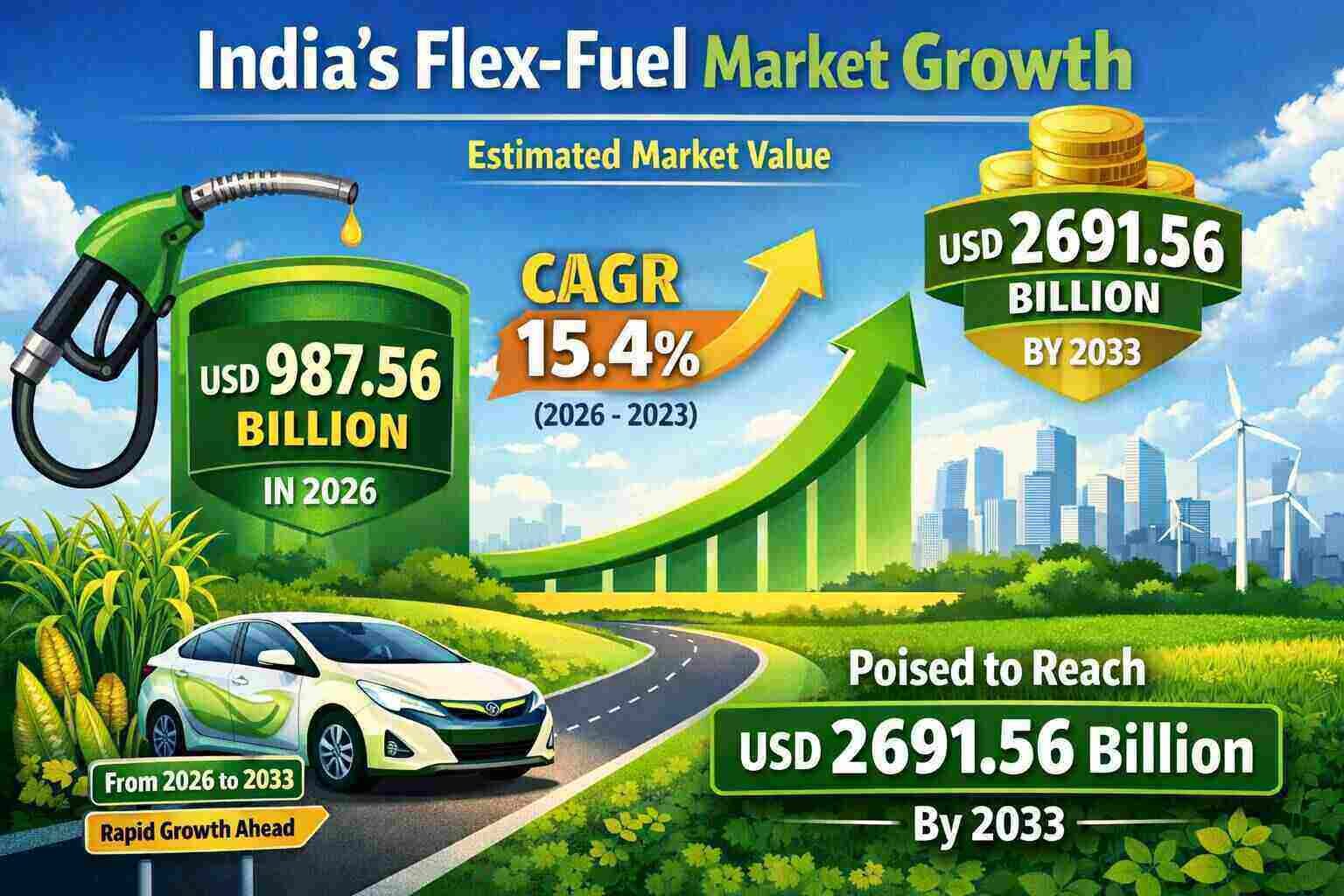
As per Coherent Market Insights, India’s flex-fuel market is estimated to be valued at USD 987.56 billion in 2026 and is robustly set to reach USD 2691.56 billion by 2033, growing at a CAGR of 15.4 percent from 2026 to 2033.
Furthermore, according to the Indian government, the push towards flex-fuel vehicles is more than what goes into a car's fuel tank. But rather, the ultimate goals would be to cut crude oil imports, increase fuel production within India, and create more opportunities for farmers.
The government has also taken a promising step by removing excise duty on 30-33 percent variant of ethanol petrol.
Considering this, flex-fuel is not just another engine technology, but rather, it is a long-term energy plan that is now making its way onto Indian roads.
Playing a pivotal role, the Indian government has also started setting up E85 fuel dispensing stations across the country in partnership with Indian Oil. For instance, E85 is currently priced at Rs 82.12 per litre, which lowers the price by somewhere around Rs 20 cheaper than the E20 petrol most people fill up with today.
Also, E85 stations will carry clear branding and distinct labels so drivers can easily identify the right nozzle. This is carried out to avoid any confusion at the pump. The ground work for this ethanol-driven mobility ecosystem has been seeded slowly over the past decade - India has rapidly expanded its ethanol blending programme, achieving milestones that have significantly reduced fuel imports while supporting domestic agriculture.
So to say, the integration of flex-fuel vehicles (FFVs) represents the next logical step in building a complete ethanol mobility ecosystem. As India pursues energy security, carbon reduction, and rural economic growth simultaneously, flex-fuel technology is emerging as a practical and scalable pathway toward sustainable transportation. “Flex-fuel cars are key to meeting stringent emission norms while offering customers affordable and sustainable options,” said Piyush Arora - Managing Director & CEO Volkswagen Group. The automaker plans to launch these vehicles in key markets, ensuring they adhere to both local emission standards and global climate goals.
The role of sugar and bio-energy companies in this promising shift have been pivotal in India’s push to develop a robust energy ecosystem.
And if we were to speak of India's position in the global biofuel landscape, the nation is increasingly recognized among leading global biofuel markets alongside countries such as Brazil, United States, and Thailand.

The recent delivery of Wagon R Flex-Fuel vehicles to ISMA members has marked one of the first organized deployments of flex-fuel passenger cars in India, demonstrating industry’s confidence in ethanol-based mobility solutions while paving the roadmap for the adoption of flex-fuel technology for Indian roads.
So, why does this event matter to ramp-up India's clean mobility mission? The answer would be that the significance extends beyond automotive innovation. It creates a direct link between ethanol producers and ethanol users, helping establish real-world demand for biofuels.
As India's sugar and bio-energy industry played a central role in increasing ethanol production, industry leaders are reinforcing confidence in the fuel they help produce by adopting flex-fuel vehicles themselves.
ISMA leadership has consistently emphasized the importance of creating a robust ethanol ecosystem - be it production, distribution, or consumption. Their participation showcases a broader industry commitment to India's energy transition and biofuel economy.
ISMA President Niraj Shirgaokar said the adoption would "directly contribute to the next phase of clean mobility, reducing crude oil import dependency and creating a sustainable demand cycle that benefits Indian farmers".
Deepak Ballani, Director General of ISMA said the move was meant to signal confidence to automakers and consumers alike. "The ethanol ecosystem is mature, reliable, and ready to power the future of Indian transport," he further pointed out.
The innovative flex-fuel vehicles are meticulously designed to operate on varying blends of petrol and ethanol. So, unlike conventional vehicles that are optimized primarily for petrol, FFVs can seamlessly use fuels ranging from standard petrol blends to high-ethanol fuels such as E85 and E100.
Toyota Kirloskar Motor’s Executive Vice Chairman Vikram Gulati stated, “The entire capability to make a petrol vehicle into a flexible-fuel vehicle is indigenously developed. Flex-fuel hybrids and biofuels will play a crucial role in India's clean mobility transition.” Vikram has consistently argued for a multi-technology approach combining ethanol, hybrids, and EVs to reduce oil imports and emissions.
While flex-fuel vehicles (FFVs) may appear similar to conventional petrol-powered vehicles from the outside, they are meticulously engineered with several specialized components and technologies that enable them to operate efficiently on varying blends of petrol and ethanol. These modifications ensure optimal performance, durability, and fuel efficiency regardless of the fuel composition.
One should know that ethanol is more chemically reactive than petrol. Thereby, it can degrade certain plastics, rubber seals, gaskets, and metal components commonly used in traditional fuel systems. So to curb this, flex-fuel engines utilize specially designed ethanol-resistant materials throughout the fuel lines, fuel tank, seals, and hoses. These materials prevent premature wear, swelling, cracking, and fuel contamination, ensuring long-term reliability even when high-ethanol blends such as E85 (85 percent ethanol) are used regularly.
Ethanol contains less energy per litre than petrol, meaning a larger volume of fuel must be injected into the combustion chamber to produce the same power output. Flex-fuel vehicles are equipped with high-capacity fuel injectors that can precisely deliver the additional fuel required for ethanol-rich blends.
These injectors are designed to maintain accurate fuel atomization and combustion efficiency across a wide range of ethanol concentrations, helping preserve engine performance and drivability.
The Engine Control Unit (ECU) in a flex-fuel vehicle is programmed with advanced algorithms, which is capable of adjusting engine parameters in real time based on the fuel blend being used.
To optimize power delivery, fuel economy, and emissions, the ECU continuously modifies fuel injection timing, ignition timing, air-fuel ratios, and combustion strategies. This dynamic calibration enables seamless operation whether the vehicle is running on pure petrol, E20, E85, or any blend in between.
Ethanol absorbs moisture more readily than petrol. This can increase the risk of corrosion within the fuel system and engine components. Hence, to address this challenge, flex-fuel engines incorporate corrosion-resistant metals, protective coatings, and specially treated internal components.
Furthermore, fuel pumps, fuel rails, injector assemblies, and storage tanks are often manufactured using stainless steel, anodized aluminum, or other corrosion-resistant materials to ensure durability under prolonged exposure to ethanol-blended fuels.
One of the defining features of a flex-fuel engine is its ability to automatically detect the percentage of ethanol present in the fuel. This innovation is made possible through advanced fuel composition sensors that continuously analyze the fuel mixture flowing through the system.
The sensor transmits this information to the ECU, which instantly adjusts engine settings to match the detected blend. This intelligent monitoring ensures smooth starting, consistent performance, reduced emissions, and optimal fuel efficiency without requiring any manual intervention from the driver.
These enhancements allow the engine to adapt to different ethanol concentrations without affecting drivability.
One of the most advanced features of a flex-fuel vehicle is its ability to automatically recognize and adapt to different ethanol-petrol blends.
For instance, whether the vehicle is running on E20, E85, or E100, a network of sensors and the Engine Control Unit (ECU) work in tandem to maintain optimal performance, fuel efficiency, and emissions compliance.
Ethanol contains oxygen within its chemical structure and burns differently from petrol. Given this, the ECU continuously adjusts the air-fuel ratio based on the ethanol content detected by the fuel sensor to ensure efficient combustion.
Higher ethanol blends require more fuel to be injected into the engine because ethanol contains less energy per litre than petrol.
The ECU calculates the ideal fuel-air mixture in real time to maintain smooth engine operation.
This helps maximize power output while minimizing fuel wastage and emissions.
Another noteworthy aspect of ethanol is that it has a higher octane rating than conventional petrol, making it more resistant to engine knocking or premature combustion.
Fuel Injection Volume Control
Since ethanol and petrol have different energy densities, the amount of fuel injected into the combustion chamber must be adjusted accordingly.
This ensures consistent acceleration, drivability, and fuel efficiency regardless of the fuel blend being used.
The ECU constantly monitors several combustion-related parameters, including engine temperature, oxygen levels in exhaust gases, throttle position, and fuel composition.
The combination of advanced sensors and intelligent engine management enables flex-fuel vehicles to transition seamlessly between petrol and ethanol blends without requiring any driver intervention. This adaptability ensures:
✔ Consistent engine performance
✔ Improved fuel efficiency
✔ Lower emissions
✔ Enhanced engine protection
✔ Greater fuel flexibility for consumers
In essence, the vehicle automatically "understands" the fuel being used and optimizes itself accordingly, making flex-fuel technology both practical and user-friendly for everyday driving.
 Wagon R from Maruti Suzuki has been built upon the company’s proven powertrain architecture, modified to accommodate ethanol-rich fuels.
Some of the key technical enhancements include ethanol-compatible engine components, upgraded fuel delivery systems, flex-fuel sensors, and enhanced engine management software.
The vehicle is designed to operate on fuel blends ranging from E20 to E100. Furthermore, ethanol offers a higher octane rating than petrol, enabling efficient combustion and potentially smoother engine operation.
This innovative vehicle with conventional petrol vehicles, ethanol-powered vehicles can significantly reduce carbon monoxide emissions, hydrocarbon emissions, and lifecycle greenhouse gas emissions. ]
Also to note, drivers can refuel using available ethanol blends without requiring major changes to driving habits.
The most important reason to bolster flex-fuel vehicles in India would be to reduce crude oil import dependence. We are not speaking about the complete import stoppage but at least a substantial portion of its crude oil requirements. Furthermore, the increasing ethanol consumption can reduce foreign exchange outflows associated with petroleum imports.
Further, flex-fuel usage can greatly help the nation to strengthen its national energy security. Domestically produced ethanol diversifies fuel sources and reduces vulnerability to global oil price fluctuations.
While at the same time, flex-fuel technology encourages domestic manufacturing, innovation, and localization within the automotive sector. Flex-fuel provides a lower-carbon alternative to conventional fossil fuels, helping India progress toward climate commitments.
India’s Ethanol Blended Petrol (EBP) programme has emerged as one of the fastest-growing biofuel initiatives globally. What began as a modest effort to blend 5 percent ethanol with petrol has evolved into a nationwide E20 programme, positioning India among the world’s leading biofuel economies.
The initiative is playing a pivotal role in reducing crude oil imports, improving energy security, supporting farmers, and lowering transportation-sector emissions. Let’s delve in more detail:
India’s ethanol blending journey has accelerated dramatically over the past decade:
E5 Introduction: The Ethanol Blended Petrol Programme was launched to reduce dependence on imported fossil fuels and create an alternative market for agricultural produce.
Expansion to E10: Through supportive pricing mechanisms and increased ethanol procurement by Oil Marketing Companies (OMCs), India achieved the E10 milestone ahead of schedule.
Rapid Scale-Up to E20: Ethanol blending increased from approximately 1.5 percent in 2014 to nearly 20% by 2025, making India one of the fastest-growing ethanol markets globally. The country achieved its E20 target nearly five years ahead of the original 2030 timeline.
This progression reflects growing confidence in ethanol as a mainstream transportation fuel and demonstrates the success of coordinated efforts across agriculture, energy, automotive, and manufacturing sectors.
The Government of India has played a central role in accelerating ethanol adoption through a comprehensive policy framework. As ethanol infrastructure expands, FFV owners may benefit from broader fuel availability and evolving policy support.
Speaking of which, some of the key initiatives are laid down below:
The National Policy on Biofuels (2018), subsequently amended in 2022, expanded approved feedstocks and advanced the E20 target from 2030 to Ethanol Supply Year (ESY) 2025–26.
Public Sector Oil Marketing Companies have steadily increased ethanol procurement requirements, ensuring a stable and predictable market for producers. Average blending levels crossed 19% during ESY 2024–25, bringing India extremely close to sustained nationwide E20 implementation.
The government introduced:
These measures have encouraged substantial private-sector investment in biofuel infrastructure. Significant investments have been made in:
This ecosystem approach has ensured that fuel vailability, production capacity, and vehicle readiness progress simultaneously.
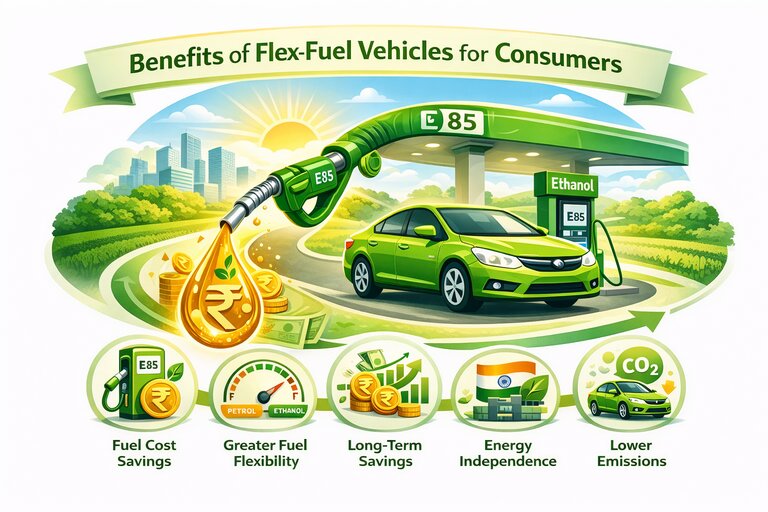 As the adoption of flex-fuel vehicles in India continues to gain momentum, consumers are increasingly recognizing the practical, economic, and environmental advantages of this innovative automotive technology.
Designed to operate on varying blends of petrol and ethanol—including higher ethanol concentrations such as E85 - flex-fuel vehicles (FFVs) offer a sustainable alternative to conventional petrol-powered cars while delivering greater fuel flexibility and long-term value.
One of the most attractive benefits of flex-fuel vehicles is the potential for reduced fuel expenses. Ethanol is typically produced from domestically available agricultural feedstocks such as sugarcane, corn, and other biomass sources, which can help stabilize fuel prices and reduce exposure to volatile global crude oil markets.
Depending on government policies, taxation structures, and local fuel pricing, ethanol-blended fuels may be more affordable than conventional petrol. As India continues to expand its ethanol ecosystem under the national ethanol blending programme, consumers could benefit from more competitive fuel costs, making flex-fuel cars in India an economically appealing choice.
Another significant advantage is the potential reduction in greenhouse gas emissions. Ethanol is considered a renewable fuel because it is derived from plant-based sources that absorb carbon dioxide during their growth cycle. As a result, ethanol-powered vehicles can help lower lifecycle carbon emissions compared to traditional fossil fuels. By supporting cleaner combustion and reducing dependence on purely petroleum-based fuels, flex-fuel vehicles contribute to India's broader sustainability and climate goals. This makes them an attractive option for environmentally conscious consumers seeking eco-friendly vehicle technologies.
Unlike conventional vehicles that are designed for a specific fuel type, flex-fuel engines can seamlessly operate on different petrol-ethanol blends without requiring any modifications from the driver. Advanced sensors and engine management systems automatically detect fuel composition and optimize engine performance accordingly. This flexibility provides consumers with greater convenience, allowing them to choose the most readily available or cost-effective fuel option. As ethanol infrastructure expands across India, this adaptability is expected to become an increasingly valuable feature.
Flex-fuel technology supports the transition toward renewable energy by increasing the use of biofuels and reducing reliance on imported petroleum products. Every litre of ethanol used in place of petrol helps decrease fossil fuel consumption and supports domestic energy production. For consumers, choosing a flex-fuel vehicle in India not only offers practical benefits but also contributes to strengthening national energy security, supporting local agriculture, and promoting a more sustainable transportation ecosystem for the future.
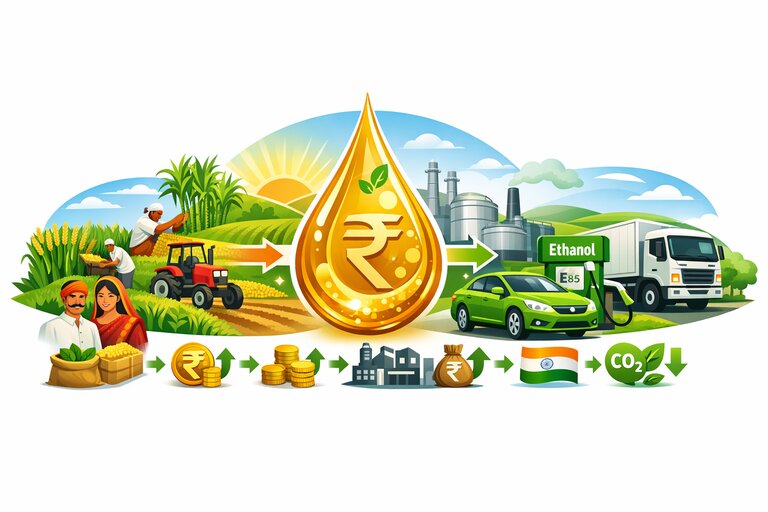 The rapid growth of ethanol-based mobility in India is creating significant opportunities for the country's agricultural sector. As the government accelerates its ethanol blending targets and promotes flex-fuel vehicles in India, farmers are emerging as key stakeholders in the nation's clean energy transition.
Beyond reducing fuel imports and carbon emissions, the expanding ethanol ecosystem is helping strengthen rural livelihoods, improve agricultural profitability, and create a more resilient farm economy. For millions of Indian farmers, ethanol production represents a promising pathway to sustainable income growth and greater participation in India's evolving biofuel industry.
One of the most important advantages of ethanol fuel production is the creation of new and diversified revenue sources for farmers. Traditionally, agricultural income has been heavily dependent on food crop demand and market price fluctuations.
However, the growing demand for ethanol has opened additional markets for feedstocks such as sugarcane, maize, damaged food grains, and agricultural residues. By supplying raw materials to ethanol producers, farmers gain access to new buyers and more stable demand. ‘
This diversification can help reduce income volatility while improving overall farm profitability. As India's ethanol blending programme continues to expand, the demand for agricultural feedstocks is expected to increase further, providing long-term opportunities for rural producers.
The growth of the biofuel industry in India is also stimulating economic development across rural regions. Ethanol production facilities, storage infrastructure, transportation networks, and associated industries generate employment opportunities both directly and indirectly.
These investments encourage local economic activity, create jobs in processing and logistics, and support ancillary businesses that serve the agricultural and energy sectors.
As a result, ethanol-based mobility contributes not only to cleaner transportation but also to stronger rural economies. Increased industrial activity in farming regions can help improve household incomes and drive broader socio-economic development.
The expansion of ethanol production is helping build stronger connections between agriculture and industry. Farmers are becoming increasingly integrated into organized supply chains that link feedstock cultivation, procurement, processing, and fuel production.
This enhanced integration can improve market access, encourage adoption of modern farming practices, and provide greater visibility into future demand. Stronger agricultural value chains also help reduce inefficiencies and create more predictable income opportunities for producers.
As India advances toward greater adoption of flex-fuel vehicles and ethanol-powered transportation, farmers stand to play a central role in supporting the country's renewable energy goals while benefiting from a more robust and diversified agricultural economy.
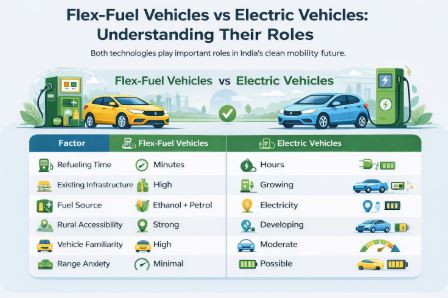 In today's time, two technologies are attracting significant attention: flex-fuel vehicles (FFVs) and electric vehicles (EVs) as India accelerates its transition toward sustainable transportation.
While these technologies are often portrayed as competing solutions, they are better understood as complementary pathways that can help India achieve its energy security, emissions reduction, and mobility goals.
Given the country's diverse transportation needs, infrastructure challenges, and economic realities, both flex-fuel vehicles in India and electric mobility are expected to play important roles in shaping the future of the automotive sector.
One of the primary differences between FFVs and EVs lies in their underlying technology. Flex-fuel vehicles are based on conventional internal combustion engine (ICE) platforms but are engineered to operate on varying blends of petrol and ethanol, including high-ethanol fuels such as E85. This allows manufacturers to leverage existing vehicle architectures while supporting cleaner fuel alternatives.
In contrast, electric vehicles in India rely entirely on battery-electric powertrains and electric motors, eliminating the need for conventional fuel altogether.
While EVs represent a significant technological shift, FFVs offer a more gradual transition by building upon familiar automotive technologies, manufacturing processes, and maintenance ecosystems.
Infrastructure remains a critical factor in determining the pace of adoption for any alternative mobility solution. One of the key advantages of ethanol-powered vehicles is that they can utilize much of the existing fuel distribution network. With appropriate upgrades, existing petrol stations can support ethanol-blended fuel distribution, enabling faster scalability across urban and rural regions.
Electric vehicles, on the other hand, require extensive charging infrastructure, including public charging stations, fast chargers, and grid upgrades to support large-scale adoption. While India's EV charging network is expanding rapidly, ethanol distribution can often be integrated more easily into the country's current fuel ecosystem, offering a practical advantage in the near term.
The transition to cleaner mobility must also be economically viable for consumers. Flex-fuel cars in India may involve lower upfront adoption barriers because they largely retain conventional vehicle usage patterns. Consumers can continue refueling in a familiar manner without significant changes to driving habits or travel planning.
EV adoption, while increasing steadily, may involve higher initial vehicle costs and considerations related to charging accessibility, battery range, and charging times. As a result, FFVs can serve as an accessible intermediate solution while the broader electric mobility ecosystem continues to mature.
India's transition toward cleaner, more sustainable, and energy-secure transportation is expected to accelerate significantly over the next decade. With strong government support, rising ethanol production capacity, expanding fuel infrastructure, and increasing interest from automotive manufacturers, ethanol-based mobility in India is poised to become an important component of the country's long-term transportation strategy.
As the ecosystem matures, flex-fuel vehicles (FFVs) have the potential to complement electric vehicles and other alternative fuel technologies while contributing to India's goals of reducing crude oil imports, lowering emissions, and strengthening domestic energy resources.
The future of flex-fuel vehicles in India appears promising as infrastructure development and policy support continue to gain momentum. The rollout of higher ethanol blends, advancements in vehicle technology, and growing consumer awareness are expected to drive increased adoption in the coming years.
As more manufacturers introduce ethanol-compatible models and fuel availability improves, FFVs could become a mainstream mobility option across multiple vehicle categories. Industry observers expect that expanding ethanol infrastructure, combined with supportive regulations and favorable market conditions, will help accelerate the adoption of ethanol-powered vehicles among both private and commercial users.
TVS Motor Company’s Chairman and Managing Director, Sudarshan Venu, confirmed that the company is preparing to introduce ethanol-powered vehicles in a phased manner and these models are already production-ready.
A critical factor influencing the success of flex-fuel mobility will be the expansion of E100 and other high-ethanol fuel distribution networks. While India has already made substantial progress in implementing E20 fuel, the next phase of development will focus on increasing access to E85 and E100 fuels through a broader network of retail fuel stations.
Greater fuel availability will improve consumer confidence and reduce concerns regarding refueling convenience. As investments in storage, transportation, and dispensing infrastructure continue, access to ethanol fuels is expected to become more widespread across urban, semi-urban, and rural regions, creating a stronger foundation for large-scale FFV adoption.
The growth of flex-fuel technology in India will depend heavily on the participation of a diverse range of automotive manufacturers. While early initiatives from companies such as Maruti Suzuki India Limited have helped bring attention to ethanol-compatible vehicles, broader industry participation is expected in the coming years.
Automakers across passenger vehicle, two-wheeler, commercial vehicle, and fleet segments are likely to explore flex-fuel technologies as part of their broader sustainability and alternative fuel strategies. Increased competition and product diversity can provide consumers with more choices while helping accelerate market adoption.
The introduction of FFVs across multiple vehicle categories will also strengthen economies of scale, encourage innovation, and support the development of a more mature ethanol mobility ecosystem.
One of the most compelling aspects of India's ethanol economy is its ability to generate benefits across multiple sectors simultaneously.
This broad-based economic impact makes ethanol mobility unique among alternative fuel solutions, as it connects agriculture, energy, manufacturing, and transportation within a single value chain.
At the heart of India's ethanol strategy is the goal of reducing dependence on imported crude oil and strengthening domestic energy production. As one of the world's largest energy consumers, India remains highly reliant on petroleum imports, making energy security a national priority.
The expansion of flex-fuel vehicles in India can help address this challenge by increasing the use of domestically produced renewable fuels. Every litre of ethanol blended into transportation fuels contributes to reducing fossil fuel consumption and retaining more economic value within the country.
Combined with ongoing investments in renewable energy, electric mobility, and alternative fuels, FFVs can become a critical pillar of India's long-term strategy for achieving greater energy self-reliance and resilience.
Directly linking biofuels and flex-fuel adoption with India's energy security and economic resilience goals, Pramod Chaudhari, President of Indian Federation of Green Energy stated, “The need for energy self-reliance is more pressing than ever.”
The next decade is likely to be a defining period for ethanol-based mobility in India. Continued progress in ethanol production, fuel infrastructure, vehicle availability, and policy support is expected to create favorable conditions for widespread adoption of flex-fuel technology.
As consumers, farmers, automakers, fuel producers, and policymakers work together to strengthen the ecosystem, flex-fuel vehicles have the potential to play a significant role in building a cleaner, more sustainable, and energy-independent future. By balancing environmental responsibility with economic opportunity, ethanol mobility can help shape the next chapter of India's transportation and energy transformation.
The adoption of flex-fuel vehicles by ISMA members represents a pivotal moment in India's biofuel journey. It signals a transition from ethanol production leadership toward real-world ethanol utilization, helping create a complete ethanol mobility ecosystem.
The Maruti Suzuki Wagon R Flex-Fuel initiative demonstrates how automotive innovation, agricultural growth, and national energy security can work together to support India's sustainability goals.
By reducing dependence on imported oil, creating new opportunities for farmers, lowering emissions, and expanding consumer fuel choices, ethanol-powered transportation has the potential to become a cornerstone of India's green mobility future.
As government policy, industry investment, and consumer awareness continue to evolve, flex-fuel vehicles are well-positioned to become a major component of India's multi-pathway clean transportation strategy over the coming decade.






We use cookies to ensure you get the best experience on our website. Read more...