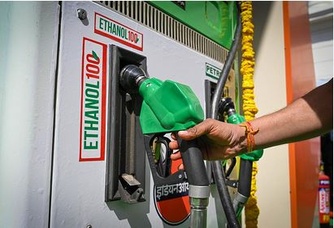
India’s ethanol blending program has risen sharply over the past decade, increasing from just 1.4 percent in 2014 to nearly 20 percent today, Petroleum and Natural Gas Minister Hardeep Singh Puri said.
Speaking at a sector event, the minister said the rapid expansion reflects India’s growing focus on energy security and reducing dependence on imported crude oil, especially amid recurring global geopolitical disruptions.
He said India’s large vehicle fleet of nearly 30 crore vehicles makes the shift to alternative fuels critical for long-term economic and energy stability.
Also Read: Flex-Fuel Guidebook: Accelerating the Ethanol Mobility Revolution
Puri said countries such as Brazil, the United States, and China had adopted ethanol-based fuels much earlier, using sugarcane and corn-based biofuels to reduce fossil fuel dependence.
He recalled that India had once targeted only 5 percent ethanol blending across 10 states, while today it has achieved near 20 percent nationwide blending.
The minister noted that ethanol adoption has been enabled by sustained policy support and coordinated execution across the agriculture and energy sectors.
He added that the United States had previously imposed tariffs on Brazilian ethanol imports, highlighting how global fuel markets are often shaped by protectionist policies and supply security concerns.
According to the minister, India’s ethanol blending initiative has already delivered significant economic and environmental benefits.
The program has helped substitute 302 lakh metric tonnes of crude oil, generated foreign exchange savings of Rs 1.84 lakh crore, and reduced carbon emissions by 909 lakh metric tonnes.
It has also created additional income streams for farmers, contributing Rs 1.58 lakh crore in earnings and transforming agricultural producers into energy contributors in the value chain.
Puri said even a 1 percent increase in annual petrol vehicle adoption could generate demand for 4 crore liters of ethanol, creating new revenue opportunities for distilleries and farmers while further reducing import dependence.
The minister said flex-fuel vehicles represent the next phase of India’s mobility transition, enabling engines to run on ethanol blends ranging from E20 to E85.
He said India’s future mobility ecosystem will combine electric vehicles, biofuels, hydrogen, and renewable energy in a diversified model suited to domestic conditions.
India currently imports nearly 88.5 percent of its crude oil requirement, making the economy highly vulnerable to global price shocks and geopolitical tensions, he added.
Puri said flex-fuel adoption offers a scalable solution that can be deployed faster than large-scale EV infrastructure, while directly supporting rural income generation.
Also Read: India's Ethanol Drive Gains with Maruti Flex-Fuel Car Launch
At the launch of Hero MotoCorp’s flex-fuel motorcycles, the minister said E85 fuel will be priced significantly lower than conventional petrol to encourage adoption.
He said consumer economics will be central to driving adoption, with studies suggesting that users could recover vehicle costs within three years if fuel pricing remains favorable.
The government is also evaluating supportive policy measures, including pricing frameworks and incentives, to accelerate adoption and improve affordability.
Hero MotoCorp’s flex-fuel motorcycles, including variants of Splendor Plus and HF Deluxe, can operate across multiple ethanol blends from E20 to E85, marking one of the first large-scale entries of flex-fuel technology into India’s two-wheeler segment.
The government said flex-fuel mobility provides a practical and immediate pathway to reducing oil imports while strengthening rural incomes through increased demand for ethanol feedstocks.
Officials said widespread adoption, particularly in India’s large two-wheeler market, could significantly reshape fuel consumption patterns and accelerate the country’s energy transition.
Puri said India’s mobility future will not depend on a single technology but will evolve through a combination of multiple clean energy pathways tailored to Indian realities.





We use cookies to ensure you get the best experience on our website. Read more...