India National Highway and expressway projects in 2026 are transforming how people and goods move across the country.
With new expressways opening, existing highways being upgraded, and major infrastructure investments underway, India's transport network is evolving faster than ever.
This article looks at India national highway and expressway projects 2026, breaking down the budgets, the timelines, the technology, and what it all means for the everyday traveler and for the economy as a whole.
If you have searched for upcoming highway projects India 2026 or wanted an expressway projects India latest update, this guide brings together verified numbers from the Ministry of Road Transport and Highways (MoRTH), the National Highways Authority of India (NHAI), and Parliament records, so you get a clear, fact-checked picture rather than guesswork.
"The changes this year and next year will be so significant that earlier I used to say our highway road network would match that of the US, but now I say that within two years, our highway network will be even better than the US," says Nitin Gadkari, Union Minister for Road Transport and Highways.
India's national highway network has grown from around 91,000 km in 2014 to nearly 1.46 lakh km today, and the government has no plans of slowing down. The Union Budget 2026-27 has allocated Rs 3.09 lakh crore to MoRTH, an 8 percent jump from the Rs 2.87 lakh crore allocated in 2025-26. Out of this, NHAI alone has received Rs 1.87 lakh crore, a 10 percent rise from last year's Rs 1.70 lakh crore.
"The forthcoming Union Budget 2026-27 has to serve the dual role of stabiliser and growth enabler, and promoting investments will be one of the most critical components in this regard," said Chandrajit Banerjee, Director General, Confederation of Indian Industry (CII).
This increase is not just about building more roads. It reflects a shift in strategy. For years, NHAI borrowed heavily from the market to fund its projects, and its debt touched a peak of Rs 3.5 lakh crore in 2021-22. The government is now recapitalizing NHAI through direct budgetary support instead of market loans, and as of December 2025, that debt had already come down to around Rs 2.35 lakh crore, with a target to bring it below Rs 2 lakh crore by March 2026.
The Ministry of Road Transport and Highways, under Minister of Road Transport and Highways, Nitin Gadkari, has set an ambitious construction target of around 5,000 km for FY26, and NHAI has actually gone past its own goals before, building 5,313 km against a 4,640 km target, and 5,614 km in FY25. For FY26, NHAI has invited bids for 52 highway projects, with 18 already approved, aiming to award 4,500 km of new contracts.
A big part of the funding, Rs 1,21,999 crore, goes specifically toward roads and bridges, covering new highways, expressways, lane widening, and connectivity in regions affected by left-wing extremism. This is the financial backbone behind every project discussed below, and it sets the tone for how India national highway projects 2026 are expected to roll out across the country.
Also Read: Building EV Bus Ecosystems for India's Clean Mobility Goals
|
Item |
FY 2025-26 |
FY 2026-27 |
Change |
|
Total MoRTH allocation |
Rs 2.87 lakh crore |
Rs 3.09 lakh crore |
+8% |
|
NHAI allocation |
Rs 1.70 lakh crore |
Rs 1.87 lakh crore |
+10% |
|
Roads and bridges allocation |
Rs 1,16,337 crore |
Rs 1,21,999 crore |
+5% |
|
NHAI debt (peak vs current) |
Rs 3.5 lakh crore (2021-22 peak) |
Rs 2.35 lakh crore (Dec 2025) |
-33% from peak |
|
CRIF maintenance allocation |
Rs 4,915 crore |
Rs 5,020 crore |
+2% |
This section covers the headline expressway projects India latest update lists usually focus on, but with the actual data behind each one rather than just announcements.
 Delhi-Mumbai Expressway
The Delhi-Mumbai Expressway is India's longest expressway and one of the largest infrastructure undertakings in the country's history.
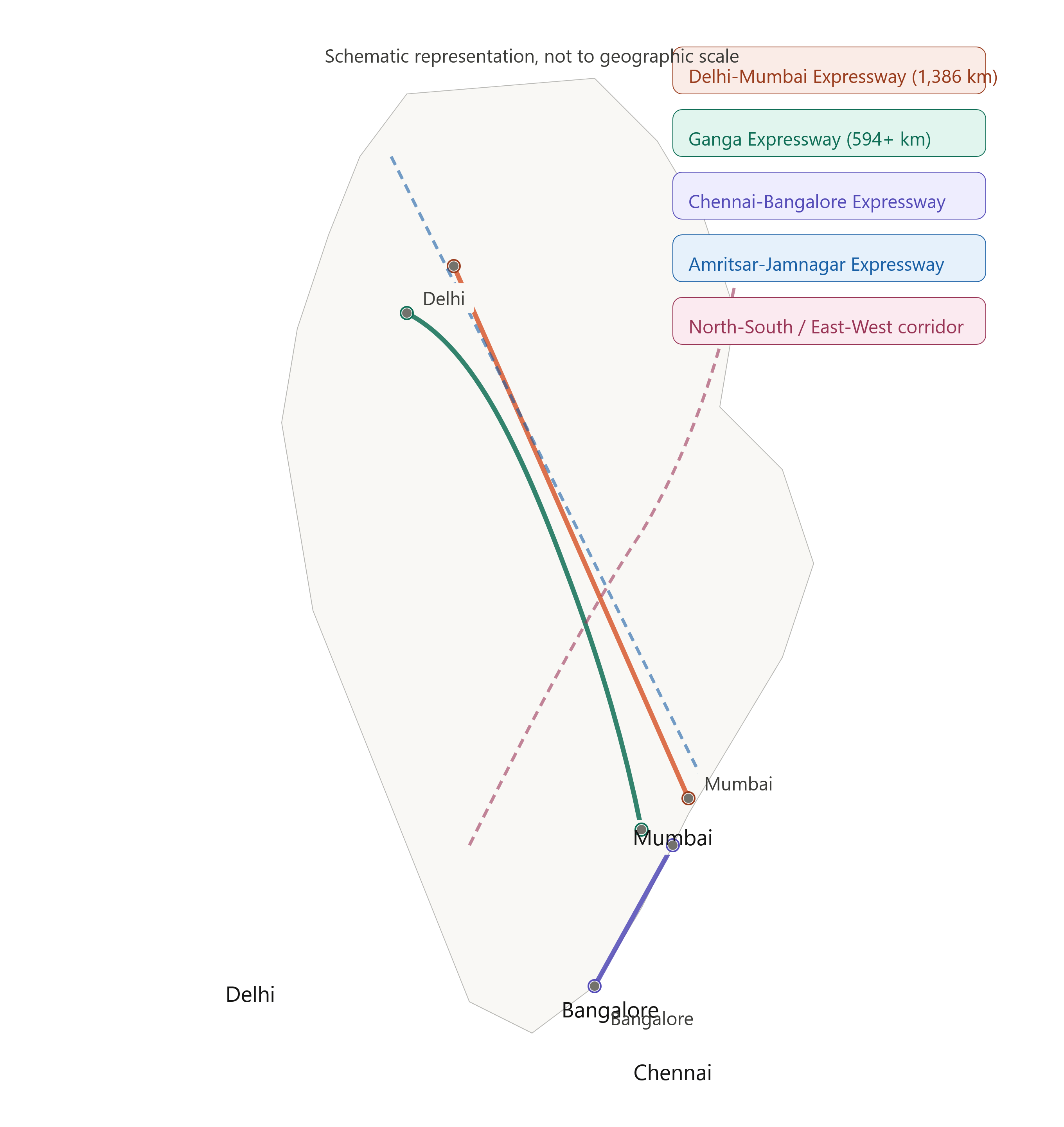
Length: 1,386 km (some official documents round this to 1,350 km), spanning Delhi, Haryana, Rajasthan, Madhya Pradesh, Gujarat, and Maharashtra across 54 construction packages.
Cost: Rs 96,547 crore sanctioned, with Rs 77,558 crore already spent as of December 2025.
Timeline: Out of the total corridor, 929 km is already operational. The Delhi-Vadodara section (912 km) is 697 km complete, with the remaining 215 km targeted for completion by June 2026. Three packages in Gujarat on the Vadodara-Mumbai stretch have been delayed and are now expected only by March 2028. A 9 km stretch near Delhi connecting to the Meethapur area was around 94 percent complete and expected to open by mid-2026.
Strategic importance: Once fully operational, the expressway is expected to cut travel time between Delhi and Mumbai from roughly 24 hours to around 12 hours, while also feeding into the Jewar International Airport (Noida) through a dedicated spur. It is an 8-lane, access-controlled greenfield highway, expandable to 12 lanes, with a design speed of 120 km/h.
The Ganga Expressway, developed by the Uttar Pradesh Expressways Industrial Development Authority (UPEIDA), is set to become one of the longest expressways in the state.
Length: Phase 1 covers 594 km from Meerut to Prayagraj, while the full corridor including future extensions is being planned at over 1,000 km, eventually linking toward Ballia near the Bihar border.
Status: Phase 1 was opened in 2026, connecting Meerut to Prayagraj and significantly shortening travel times across western and central Uttar Pradesh. Phase 2, which would extend the corridor by around 110 km toward Tigri and a further 314 km toward Ballia, is expected to be developed post-2026.
Strategic importance: The expressway is designed with five major bridges, eight Road Over Bridges, 18 flyovers, 94 minor bridges, and 960 culverts, and it directly supports real estate and industrial growth along its route, in addition to improving connectivity for one of India's most densely populated regions.
Also known as the Bengaluru-Chennai Expressway or National Expressway 7 (NE-7), this corridor is meant to dramatically cut travel time between two of South India's major economic hubs.
Length: 258 to 262 km, running from Hoskote in Karnataka through Andhra Pradesh's Chittoor district to Sriperumbudur in Tamil Nadu.
Cost: Approximately Rs 17,000 to 18,000 crore.
Timeline: As of late 2025, around 71 km had been completed. The project's completion date has been revised multiple times, from an original August 2025 target to December 2025, and now to around July 2026 for partial opening, with full operations expected by 2027.
Strategic importance: It is a four-lane expressway, expandable to eight lanes, that will reduce the Bangalore-Chennai travel time from the current 5-6 hours to roughly 2.5-3 hours. The project also anchors the Chennai-Bangalore Industrial Corridor, intended to boost manufacturing activity in the region.
The North-East region has historically lagged in highway connectivity due to difficult terrain, border sensitivities, and lower population density compared to other parts of India. Bharatmala Pariyojana has specifically prioritised this region, with the North-South and East-West Corridor network (totalling around 7,300 km) including the NH-27 stretch of 3,300 km connecting Silchar in Assam to Porbandar in Gujarat.
Multiple economic corridors and feeder routes under Bharatmala are being built to connect district headquarters in states like Assam, Manipur, Sikkim, Mizoram, and Arunachal Pradesh to four-lane national highways, with the broader goal of moving 80 percent of freight traffic onto national highways (up from around 40 percent earlier). These corridors are strategically important not just for trade, but for national security and for integrating the region more closely with the rest of the country.
|
Project |
Length |
Estimated Cost |
Target Completion |
States Covered |
|
Delhi-Mumbai Expressway |
1,386 km |
Rs 96,547 crore |
June 2026 (Delhi-Vadodara); 2027-28 (full) |
Delhi, Haryana, Rajasthan, MP, Gujarat, Maharashtra |
|
Ganga Expressway |
594 km (Phase 1) |
Multi-thousand crore (UPEIDA funded) |
Phase 1 opened 2026; Phase 2 post-2026 |
Uttar Pradesh |
|
Chennai-Bangalore Expressway |
258-262 km |
Rs 17,000-18,000 crore |
July 2026 (partial); 2027 (full) |
Karnataka, Andhra Pradesh, Tamil Nadu |
|
Amritsar-Jamnagar Expressway |
1,257 km |
Part of Bharatmala economic corridor |
Largely completed by Dec 2025 |
Punjab, Haryana, Rajasthan, Gujarat |
|
Bengaluru-Vijayawada Expressway |
518 km |
Bharatmala economic corridor |
2026-27 onward |
Karnataka, Andhra Pradesh |
Bharatmala Pariyojana, approved in 2017, is the 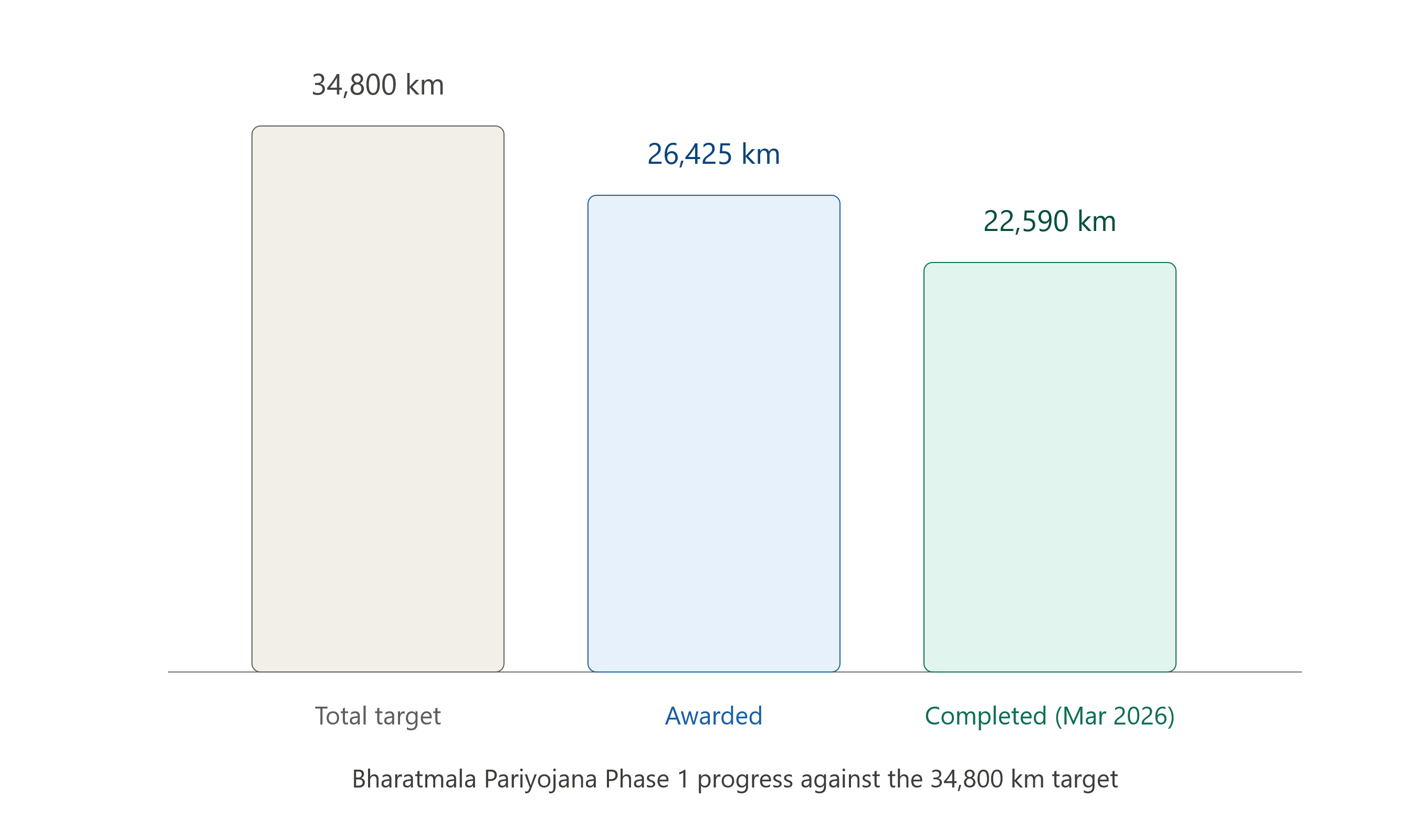 umbrella program behindmost of India's expressway projects India latest update headlines. It aims to develop 34,800 km of highways across 31 states and union territories, covering more than 550 districts, at an originally estimated cost of Rs 5.35 lakh crore (this figure has since risen to around Rs 8.3-8.5 lakh crore due to scope expansion and cost escalation).
As per the latest Bharatmala projects status 2026 figures shared in Parliament, projects covering 26,425 km have been awarded, and 22,223 km had been constructed as of February 2026, with a more recent PIB update putting the figure at over 22,590 km completed by 31 March 2026. The remaining roughly 4,200 km is targeted for completion during FY 2026-27.
The program covers around 26,000 km of Economic Corridors, 8,000 km of Inter-Corridors, and 7,500 km of Feeder Routes, along with coastal roads, border roads, and a network of 35 Multimodal Logistics Parks planned at an investment of about Rs 46,000 crore, which together would be capable of handling around 700 million metric tonnes of cargo once fully operational. Discussions around a Bharatmala Phase 2, focused on roughly 8,500 km of new corridors with an estimated investment of Rs 3.5 lakh crore, are already underway, with detailed project reports and surveys in progress.
Vinayak Pai, Managing Director & CEO, Tata Projects says, "I foresee continued growth in the engineering, procurement and construction sector, fuelled by progressive policies and sustainable investments."
PM Gati Shakti is the National Master Plan that ties together highways, railways, ports, airports, and logistics parks into a single digital platform, so that infrastructure planning across ministries does not happen in silos. New highway projects, including greenfield corridors connecting industrial zones and Special Economic Zones (SEZs), are now aligned with Gati Shakti's economic nodes from the design stage itself. The government has stated that new sanctions under Bharatmala Phase-I have been discontinued, and fresh projects are now approved under the National Highway (Original) Scheme, with approvals based on connectivity needs, traffic density, and synergy with PM Gati Shakti principles.
The National Highways Authority of India remains the primary executing agency for greenfield highways India is building, alongside the National Highways and Infrastructure Development Corporation Limited (NHIDCL), which handles strategic and border-area projects. NHAI's improving financial position, with debt reduction from Rs 3.5 lakh crore to around Rs 2.35 lakh crore, gives it more room to award new contracts without depending on market borrowing. NHAI also leverages monetisation tools like Toll Operate Transfer (TOT), Infrastructure Investment Trusts (InvIT), and toll securitisation to recycle capital from completed assets into new construction. A new instrument, the Raajmarg InvIT, is also in the pipeline, with SEBI clearance under process.
The most visible benefit of these projects is time saved. The Delhi-Mumbai Expressway alone is projected to cut the journey between the capital and the financial hub from about 24 hours to roughly 12 hours. The Chennai-Bangalore Expressway is expected to bring travel time down from 5-6 hours to about 2.5-3 hours. Multiplied across thousands of kilometres and millions of daily commercial trips, these time savings translate into real fuel savings, lower vehicle wear, and faster turnaround for trucking fleets.
Sahil Barua, Co-Founder & CEO, Delhivery says, "The future of logistics lies in integration — of modes, markets, and minds. The strongest logistics asset is not just infrastructure, but informed professionals."
India's logistics costs have historically been estimated at around 13-14 percent of GDP, notably higher than in many developed economies where the figure is closer to 7-9 percent. Bharatmala's Economic Corridors, Inter-Corridors, and Feeder Routes are specifically designed to shift freight traffic from longer, congested routes onto faster, access-controlled expressways. The plan to move 80 percent of freight onto national highways (from around 40 percent earlier) is central to bringing these logistics costs down to more globally competitive levels. The 35 planned Multimodal Logistics Parks, capable of handling 700 million metric tonnes of cargo, will play a key role here by integrating road transport with rail and warehousing.
Greenfield expressways are increasingly being built with industrial development in mind rather than just point-to-point travel. The Chennai-Bangalore Expressway directly supports the Chennai-Bangalore Industrial Corridor, while the Delhi-Mumbai Expressway runs close to the Delhi-Mumbai Industrial Corridor (DMIC), one of India's largest planned manufacturing zones. New corridors like the Bengaluru-Vijayawada Expressway are being aligned with PM Gati Shakti economic nodes, including seafood clusters and SEZs, so that the highway becomes a backbone for new factories, warehouses, and logistics hubs rather than just a faster road.
"Infrastructure spending of this scale has a multiplier effect well beyond the construction sector itself; every rupee spent on a national highway tends to generate downstream activity in cement, steel, logistics, and local real estate markets along the corridor," is the kind of assessment commonly echoed by infrastructure sector analysts tracking capital expenditure trends in India's road sector.
Rajnath Singh, Defence Minister says, "Logistics should be seen through the prism of strategic importance and not just as a process of delivering goods. India has witnessed unprecedented infrastructure development in the last 11 years — its impact is not limited to physical connectivity, but it has also increased economic productivity, reduced logistics cost and improved service delivery."
.jpg) Smart highways
Smart highwaysNew-generation expressways like the Delhi-Mumbai Expressway are being built with sophisticated traffic management systems, automated toll collection, and entry-exit controlled access points designed to reduce congestion and improve safety. These features mark a shift from older highways, which often passed directly through towns and villages, to access-controlled corridors where vehicles cannot enter or exit except at designated points.
The push toward electric mobility is now built into highway planning. Under the FAME-II scheme and related programs, around Rs 2,000 crore has been allocated to install approximately 72,000 EV chargers across 50 national highway corridors and high-footfall locations by FY 2025-26. NHAI has separately announced plans to place an EV charging station roughly every 40-60 km along national highways, eventually covering close to 700 charging points nationwide, alongside other amenities like restrooms and food courts at wayside facilities. The Ministry of Power's guidelines call for public charging infrastructure at intervals of around 25 km on highways.
A pilot program called National Highways for Electric Vehicles (NHEV) has already tested corridors on Delhi-Agra (Yamuna Expressway), Delhi-Jaipur (NH-48), and Chennai-Trichy (NH-179B), and is now expanding toward a target of 5,500 km of e-highways along Bharatmala and Sagarmala routes connecting Delhi, Mumbai, and Kolkata, with the broader e-highway upgrade program estimated at around Rs 5,000 crore. The Delhi-Mumbai Expressway itself is often cited as a strong candidate to become India's first long-distance electric highway corridor.
Environmental considerations are increasingly built into project design from the start, with developers required to factor in measures such as wildlife crossings and tunnels in ecologically sensitive zones. One notable example is a 4.9 km tunnel with two parallel tubes, each with four lanes, built along the Delhi-Mumbai Expressway near the Mukundra Hills Tiger Reserve in Rajasthan, designed specifically to avoid disturbing the protected habitat while still allowing high-speed connectivity through the region.
Land acquisition remains one of the most persistent obstacles to timely project completion. As of June 2025, the Bhoomi Rashi Portal, the digital land acquisition platform used by NHAI, had incorporated 3,427 online projects, reflecting the scale of land-related processes the agency manages. Delays in land handover have repeatedly pushed back individual packages, including parts of the Delhi-Mumbai Expressway in Gujarat, where three packages were delayed enough to shift their completion target from 2026 to March 2028.
Even with the recent improvement in NHAI's balance sheet, the agency was carrying debt of around Rs 2.35 lakh crore as of December 2025, down from a peak of Rs 3.5 lakh crore in 2021-22. The shift toward a "zero market borrowing" model, relying instead on budgetary support and asset monetisation through TOT and InvIT structures, is a direct response to concerns that excessive debt could constrain future project awards. The planned Raajmarg InvIT is intended to widen the investor base further, though its rollout depends on regulatory clearances.
Several Bharatmala projects, particularly in ecologically sensitive states like Bihar and parts of the North-East, have faced delays attributed to a combination of factors including pending environmental and railway permissions, utility shifting, and design finalization. According to a Lok Sabha reply from December 2025, revised completion schedules for various stretches now extend across 2025, 2026, and 2027, with causes ranging from land acquisition problems to slow contractor performance and earlier disruptions from COVID-19 and flooding. These factors illustrate why even well-funded flagship projects routinely see multi-year slippages between original and revised completion dates.
Beyond the projects already underway, MoRTH has identified a Public-Private Partnership (PPP) project pipeline of 13,400 km, estimated at around Rs 8.3 lakh crore, to be developed over the next three years. Bharatmala Phase 2, covering approximately 8,500 km of new corridors at an estimated cost of Rs 3.5 lakh crore, is in the planning stage, with detailed project reports and surveys already underway for several stretches. Corridors like the Bengaluru-Vijayawada Expressway (518 km), expected to come up through 2026-27, and the Varanasi-Kolkata Expressway (around 610 km), targeted for 2028, point to the next wave of greenfield highways India will be building through the rest of this decade.
The shift toward asset monetisation, including Toll Operate Transfer bundles and the upcoming Raajmarg InvIT, reflects a broader strategy to bring private capital into both new construction and the operation of existing assets. With NHAI's debt declining and the government providing larger direct budgetary support, the financial environment is increasingly geared toward attracting private developers and institutional investors into both Hybrid Annuity Model (HAM) and Build-Operate-Transfer (BOT) projects.
India's stated goal of bringing logistics costs down from around 13-14 percent of GDP toward more globally competitive levels (closer to single digits, as seen in many developed economies) is the underlying benchmark against which all this expressway construction is being measured. The Ministry's Vision 2047 document goes further, aiming to ensure that high-speed corridors are available within 100-150 km of every citizen in the country, alongside world-class wayside amenities. If the current pace, including the FY26 achievement of 5,313 km against a 4,640 km target, can be sustained or improved, India's highway network density and quality could move it closer to the standards seen in countries with mature expressway systems, while also supporting its broader manufacturing and export ambitions.
What is the budget allocation for highways in India for 2026-27?
The Ministry of Road Transport and Highways has been allocated Rs 3.09 lakh crore for 2026-27, an 8 percent increase over the previous year, with NHAI receiving Rs 1.87 lakh crore of that total.
When will the Delhi-Mumbai Expressway be fully completed?
The Delhi-Vadodara section is targeted for completion by June 2026, while three delayed packages on the Vadodara-Mumbai stretch in Gujarat are now expected to be ready only by March 2028.
How is India developing EV-friendly highways?
Through programs like NHEV and FAME-II, India is targeting around 72,000 EV chargers across 50 highway corridors by FY 2025-26, alongside NHAI's plan to add charging stations every 40-60 km on national highways.

.jpg "AR Enterprises: Building The Supply Networks Behind India's Construction Growth")
.jpg "Industrial Packers: Engineering Industrial Packaging for India's Manufacturing Future")



We use cookies to ensure you get the best experience on our website. Read more...