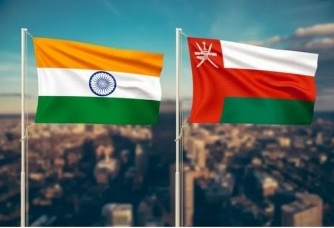
India’s Comprehensive Economic Partnership Agreement (CEPA) with Oman has come into force at a strategically critical moment, offering not just trade benefits but also an alternative route to the Gulf that bypasses the volatile Strait of Hormuz.
Signed in December during Prime Minister Narendra Modi’s visit to Muscat, the agreement provides zero-duty access to a wide range of Indian exports, marking a significant step in India’s global trade expansion strategy.
Union Commerce and Industry Minister Piyush Goyal described the pact as a “defining milestone” in creating new economic pathways for Indian businesses and workers.
However, beyond trade liberalization, the timing of the deal underscores a deeper geopolitical and energy security calculus.
The CEPA comes into effect amid the ongoing US-Iran conflict, which has severely disrupted shipping through the Strait of Hormuz, which is a critical global energy chokepoint handling nearly 20 percent of global oil consumption and 25 percent of seaborne oil trade.
Recent disruptions have already impacted India’s trade flows with key Gulf suppliers such as Saudi Arabia, Qatar, and the UAE. Imports from major Gulf economies dropped sharply from $15 billion in April 2025 to $9.8 billion in April 2026, while exports also declined significantly.
In contrast, Oman has emerged as a resilient partner. India’s imports from Oman surged over 246 percent, rising from $430 million to nearly $1.5 billion, driven by crude oil and fertilizer purchases.
The key differentiator lies in geography. Unlike most Gulf nations, Oman’s ports such as Salalah and Duqm are located outside the Strait of Hormuz, directly along the Arabian Sea. This allows uninterrupted access even during geopolitical tensions.
This makes Oman a strategic fallback corridor, ensuring continuity of trade and energy supplies when traditional routes become risky.
Under the CEPA, Oman is offering zero-duty access on 98.08 percent of tariff lines, covering nearly all Indian exports. This is a significant jump from the earlier system, where only about 15.3 percent of exports enjoyed zero-duty access.
The agreement benefits key labor-intensive sectors, including:
India’s exports to Oman stood at $3.64 billion in FY26, led by refined petroleum products, followed by alumina, iron and steel, machinery, and rice.
While average tariffs were already relatively low, certain categories faced duties as high as 100 percent. Their elimination is expected to improve competitiveness, although growth may be moderated by Oman’s relatively small market size.
Also Read: West Asia Crisis Forces FMCG Firms to Diversify Supply
For Oman, the agreement strengthens its position in sectors where it already has a strong export base to India. India imported $7.2 billion worth of goods from Oman in FY26, including crude oil, LNG, fertilizers, methanol, and ammonia.
Under the CEPA, India will reduce or eliminate tariffs on about 78 percent of its tariff lines, facilitating smoother trade flows in energy and industrial inputs.
This reinforces Oman’s role as a reliable supplier while deepening economic interdependence between the two nations.
Beyond economics, the CEPA reflects a deliberate geopolitical alignment. At a time when tensions in the Gulf are reshaping global trade routes, India is actively diversifying its strategic partnerships to reduce overdependence on traditional chokepoints like Hormuz.
Strengthening ties with Oman allows India to secure both energy access and maritime connectivity in a volatile region.
For Oman, the agreement enhances its geopolitical relevance by positioning itself as a stable, neutral, and accessible gateway between Asia, the Middle East, and Africa. It also aligns with Muscat’s broader strategy to attract foreign investment and expand its role in global supply chains.
The pact also signals India’s intent to deepen engagement with middle-power nations in the Gulf, balancing regional dynamics while safeguarding economic interests.
The India-Oman CEPA is more than a trade agreement, it is a strategic hedge against geopolitical risk. As disruptions in the Strait of Hormuz expose vulnerabilities in global energy and trade routes, Oman offers India a viable alternative corridor.
By combining trade liberalization with geographic advantage, the agreement strengthens India’s supply chain resilience, boosts export competitiveness, and enhances energy security.
In an increasingly uncertain global environment, such partnerships highlight how trade deals are evolving into multi-dimensional strategic tools, blending economics with geopolitics.







We use cookies to ensure you get the best experience on our website. Read more...