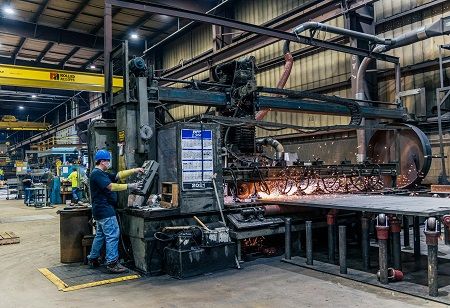
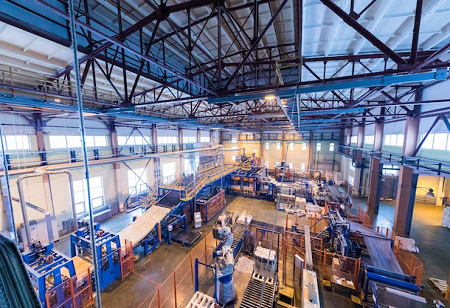
While automakers are at the centre of the 5-million-car story, the wider auto-component and ancillary industry could capture a significant share of the growth. Every additional vehicle produced creates demand across a large network of suppliers, from mechanical components and tyres to electronics, semiconductors and batteries.
Traditional auto-component manufacturers continue to benefit from strong demand for mechanical systems, chassis components, forgings, castings and precision-engineered parts. Tyre makers are also expanding capacity as vehicle production rises and larger SUVs become more popular. However, the biggest supply-chain opportunities are increasingly moving toward higher-value technologies.
Modern vehicles, including both ICE and EV models, require more sensors, electronic control units, semiconductors, power electronics and connectivity systems. The expansion of advanced driver-assistance systems and connected-car features is creating new opportunities for electronics and semiconductor suppliers. As vehicle production grows, the ability of these suppliers to scale alongside automakers will become increasingly important.
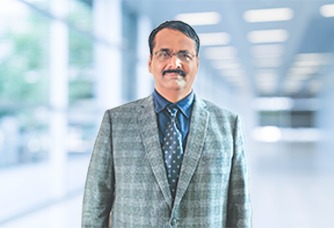
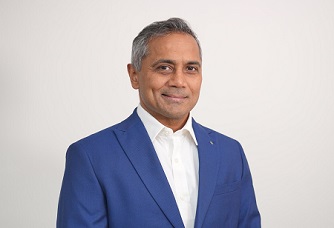
Sachin Lawande, CEO of Visteon pointed out that, “We will only be competitive when we build more of what we use in the country,” highlighting the need to strengthen domestic manufacturing and develop a deeper supplier base.
Supply-chain risks remain. Semiconductor shortages, limited availability of advanced electronics and dependence on certain battery materials could constrain production. Domestic battery-cell manufacturing is expanding under production-linked incentive schemes, but localisation of high-value cells and other advanced technologies is still developing.
Higher vehicle volumes are also increasing demand for steel and aluminium. Automakers are using lighter materials to improve fuel efficiency and extend EV driving ranges. At the same time, logistics and warehousing networks around major automotive clusters are being strengthened. Vendor parks and tier-2 and tier-3 supplier ecosystems will play a growing role in improving localisation and reducing supply-chain dependence.
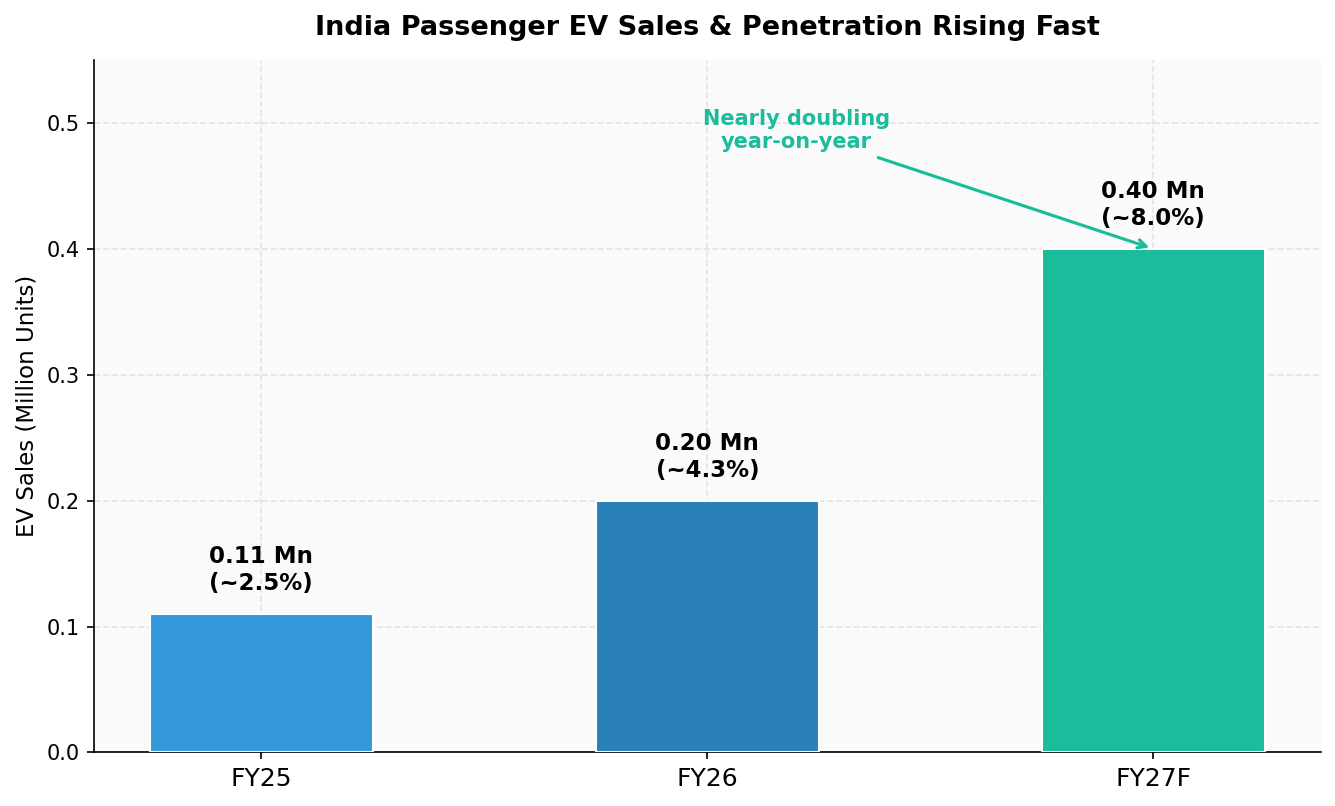
EVs add another dimension to the capacity challenge. Electric vehicles accounted for around 4–5% of passenger-vehicle sales in FY26, with roughly 200,000 units sold. Their share is projected to approach 8% in FY27, potentially pushing annual EV volumes toward 400,000 units. While petrol remains the dominant fuel type and CNG retains a strong double-digit share, EVs are growing faster, creating additional demand for batteries, electric motors, inverters, power electronics, thermal-management systems and charging infrastructure.
Goldman Sachs and industry bodies expect India’s auto-component sector to record roughly 10% annual revenue growth through FY30. Companies that can localise batteries, semiconductors, rare-earth magnets and advanced materials could capture a larger share of this growth.
Ultimately, India’s approach to the 5-million-car milestone is not only about selling more vehicles. It is a test of whether OEMs, component suppliers, technology companies and logistics networks can expand together. A coordinated expansion could strengthen domestic manufacturing, deepen localisation and help India build vehicles at the scale, speed and technological depth required for its next phase of automotive growth.
.jpg "Energy Industry")
.jpg "Aditya Energy Services: Powering India’s Industrial Transition to a Sustainable Future")


We use cookies to ensure you get the best experience on our website. Read more...