India is moving closer to a major milestone in its passenger-vehicle market, with annual sales approaching the 5-million-unit mark. The growth reflects rising incomes, improving road infrastructure, easier vehicle financing and a growing preference for larger, feature-rich vehicles. But as demand accelerates, the bigger question is whether India’s automotive manufacturing ecosystem can produce enough vehicles, components and technology to keep pace.
According to industry estimates, India’s car sales are expected to grow by 5–7 percent in FY27, potentially taking total passenger-vehicle sales, including exports, to around 5.9 million units. Domestic demand remains the primary growth engine, supported by utility vehicles, which now account for roughly two-thirds of the market.
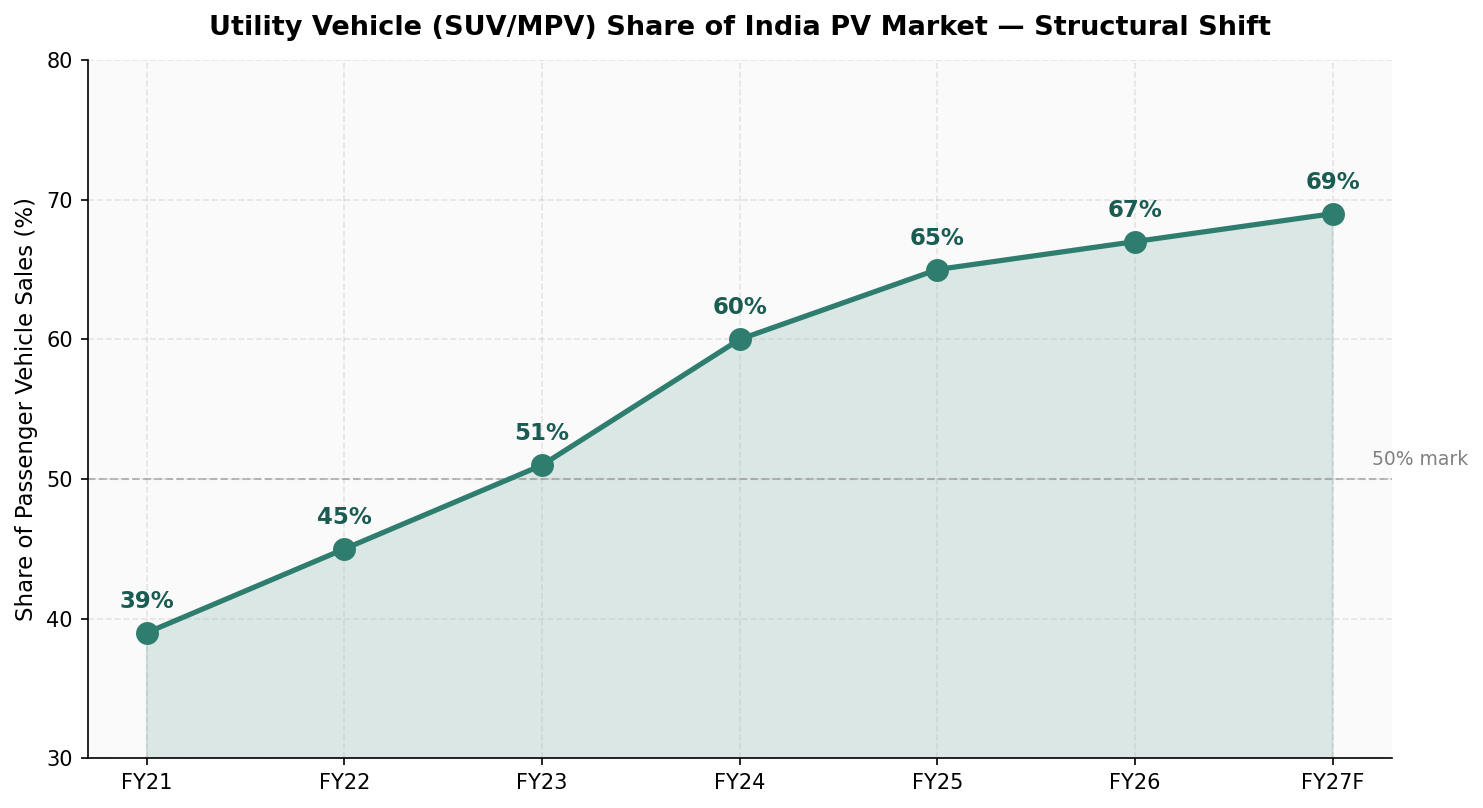
The India SUV market growth story is particularly important. Utility vehicles accounted for about 67 percent of domestic passenger-vehicle sales in FY26 and are expected to rise to around 69 percent in FY27. Higher ground clearance, perceived safety, feature-rich cabins and a wider range of SUV models across price points are continuing to shift consumer preferences.
Maruti Suzuki Chairman R.C. Bhargava has underscored both the scale of the opportunity and the intensity of the response: “Presently, we are estimating that the car industry would grow to 6.1 to 6.3 million units by FY 2030-31. We are adding half a million units this year.”
The capacity expansion is not limited to one manufacturer. Automakers across India are investing in new plants, additional production lines and upgrades to existing facilities. New manufacturing plants are also increasingly being designed to support both internal-combustion-engine and electric vehicles, giving manufacturers greater flexibility as the powertrain mix changes.
.jpg "Energy Industry")
.jpg "Aditya Energy Services: Powering India’s Industrial Transition to a Sustainable Future")





We use cookies to ensure you get the best experience on our website. Read more...