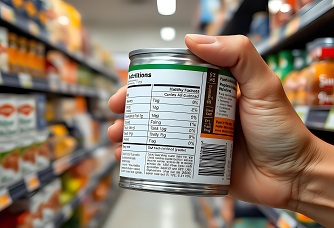
Food giants stand at the center of India’s warning label showdown. Their earlier resistance to front-of-pack labels has shaped a protracted policy contest.
The government now confronts sharp criticism from opposing camps. Health experts judge the latest proposal too weak, whereas food companies judge the same rules excessively strict.
The dispute lays bare tension between public health objectives and commercial interests in India’s packaged-food market, valued at more than USD 100 billion.
A recent raid involving fake labels has added a further dimension of scrutiny. This analysis traces the evolution of the dispute, examines the substance of the proposed labels, and records the latest development involving the same global brands.
The Food Safety and Standards Authority of India proposed a red hexagonal label last week. A product would receive the label only if it exceeds prescribed limits in at least two of three nutrients: added sugar, salt or saturated fat.
Key features of the proposal include:
Health researchers contend that products high in only one nutrient will escape any warning. Barry Popkin, professor at the UNC Gillings School of Global Public Health, observes that no other country employs this double-nutrient approach. Every jurisdiction that has adopted warning labels places a separate, prominent label for each excessive nutrient.
Also Read: How AI-Driven Modernization Is Helping Manufacturers Scale Faster
A product such as Kellogg’s multigrain Chocos, containing 27 per cent added sugar by weight yet remaining within the fat and salt limits, would avoid a warning. The proposal further exempts honey, jaggery and comparable traditional items that are inherently rich in sugar or fat.
The group 3S And Our Health has prepared a submission for the Supreme Court challenging these exemptions and the two-nutrient threshold. The Court is scheduled to hear arguments on 10 September.
Food executives voice equal concern. Seven executives from Indian and foreign firms told Reuters that the strict thresholds and 100-gram benchmark risk flagging a wide range of everyday products. One senior executive notes that consumers do not ingest 100 grams of pickle or ketchup at a sitting and urges the authority to adopt a per-serve calculation instead.
Traditional manufacturers share the apprehension. India’s Federation of Sweets and Namkeen Manufacturers, representing 5,000 members, warns through its director general, Firoz Naqvi, that a substantial majority of packaged traditional sweets and namkeen could attract warnings. Sugar, salt and fat form an integral part of these products, and consumers typically consume only modest portions.
A recent development has returned the same global brands to regulatory attention. Indian authorities raided a Mumbai warehouse, seizing products valued at nearly USD 80,000 together with chemicals and printing equipment. The operation involved the replacement of dates and nutritional information on products of PepsiCo, Nestlé, Coca-Cola and Unilever in order to render them suitable for export.
One packet of PepsiCo’s Kurkure recovered during the raid bore a fabricated label carrying nutrition information in English and French, consistent with the format required in Canada. The Canadian Food Inspection Agency is assessing whether the operation presents any risk to imports into Canada.
At present, the Agency possesses no information indicating that products from the warehouse entered the country. It has stated that it regards food fraud, including false date markings and inaccurate nutrition information, with seriousness. Maharashtra FDA Commissioner Tukaram Mundhe, who led the raid, confirmed that officials have written to the relevant authorities to investigate the nineteen little-known exporters involved.
Retail sales of ultra-processed food increased forty-fold between 2006 and 2019 to reach USD 38 billion. The country recorded 180 million overweight or obese adults in 2021, a figure projected to rise to 450 million by 2050.
Chile’s 2016 labeling law, which places separate black octagons for each excessive nutrient, produced a 23.7 per cent decline in purchases of sugary drinks within eighteen months.
The Supreme Court must now evaluate a proposal that health experts regard as incomplete and industry regards as excessive. Concurrently, the Mumbai raid demonstrates that the integrity of labeling remains a live concern for both domestic regulation and export markets.
The Court’s determination, together with the outcome of the ongoing investigations, will determine whether India’s food labels furnish clear signals to consumers or leave significant gaps that both sides have already identified.







We use cookies to ensure you get the best experience on our website. Read more...