Growth no longer rests on one dominant player. Instead, each major manufacturer brings a distinct strength to the next cycle. Maruti Suzuki still anchors the market with the largest volumes.
The company added 5, 00,000 units of capacity in the first four months of FY27, taking annual capacity to 2.9 million units. By FY31, Maruti targets annual capacity of four million units, with 8, 00,000 units reserved for exports. Its new Sanand facility involves Rs 35,000 crore and will have one million units of annual capacity.
“In the first quarter of FY27, our share of passenger vehicle exports has risen to 55%. Since we are producing cars in India and exporting to Japan, Suzuki became the biggest importer of cars from abroad. Thanks to strong domestic demand and robust exports, almost two-thirds of the global production of Suzuki Group now comes from India,” said Hisashi Takeuchi, Managing Director & CEO, Maruti Suzuki, in an interview with Business Today.
Tata Motors is gaining momentum. Its brand sales grew 48.9 per cent YTD through July 2026, while August sales increased 59 per cent year on year. Mahindra also recorded strong momentum, with brand sales rising 18.6 per cent YTD through July and August sales increasing 50 per cent year on year.
Hyundai continues to expand, with brand sales growing 9.2 per cent YTD through July. Toyota and Kia also recorded gains of 13.8 per cent and 16.8 per cent, respectively, showing that growth is spreading across several established manufacturers.
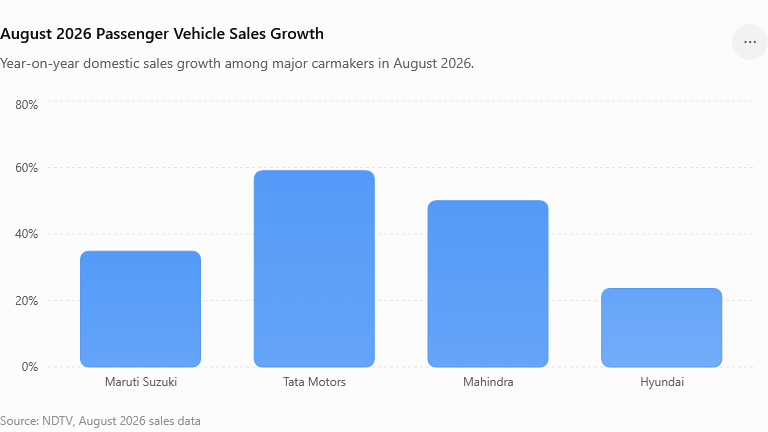
The data points to a more competitive passenger vehicle market, where scale remains important but growth momentum is increasingly distributed across manufacturers. Maruti Suzuki retained a clear volume advantage in August, selling 1, 76,971 domestic units, up 34.8 per cent year on year.
Tata Motors and Mahindra, however, delivered much faster growth of 59 per cent and 50 per cent, respectively. Maruti is responding through capacity expansion and a stronger SUV strategy. Its SUV market share has risen from 11 per cent in FY22 to 21 per cent in Q1 FY27, while the company plans seven new SUV nameplates over the next five years.
Overall, India’s automotive growth story is becoming more competitive. Maruti Suzuki continues to lead through scale and capacity, while Tata Motors and Mahindra are gaining ground through stronger sales growth.
.jpg "Energy Industry")
.jpg "Aditya Energy Services: Powering India’s Industrial Transition to a Sustainable Future")



We use cookies to ensure you get the best experience on our website. Read more...