How India's government policies support chemical manufacturing is becoming an important question as India seeks to strengthen its industrial base. The answer lies in a wider policy framework designed to make manufacturing more competitive, reduce supply risks, and encourage new investment.
India is turning chemical manufacturing into a bigger industrial priority, with new policies aimed at attracting investment and expanding domestic capacity.
The government's 2026 strategy goes beyond helping individual factories. It focuses on chemical parks, shared infrastructure, foreign investment, production incentives, and cleaner technologies.
These measures address some of the biggest challenges that can affect chemical manufacturing in India. Companies need reliable infrastructure, affordable utilities, raw materials, skilled workers, and strong supply chains to compete in domestic and global markets.
Now, let's look more closely at the major government policies supporting chemical manufacturing in India and what they mean for businesses. Each measure addresses a different business need, from setting up infrastructure to attracting investment and reducing production risks. For companies in the chemical industry, understanding these policies can help them identify relevant incentives, choose suitable locations, and plan investments more effectively.
The table below provides a quick overview of the major policies covered in this guide and how each one supports chemical manufacturing.
|
Government policy |
How it supports chemical manufacturing |
|
BHAVYA Rasayan |
Creates three dedicated chemical parks with shared infrastructure |
|
PCPIRs |
Supports large-scale chemical and petrochemical clusters |
|
Plastic Parks |
Supports downstream plastic processing and common infrastructure |
|
FDI policy |
Allows 100 percent foreign investment through the automatic route in most chemical activities |
|
Bulk Drug PLI |
Encourages domestic production of selected pharmaceutical inputs |
|
Bulk Drug Parks |
Provides common infrastructure for bulk drug manufacturing |
|
CCUS support |
Supports development of technologies that can reduce industrial emissions |
|
Quality and skill programs |
Supports product standards, research, and workforce development |
These policies do not provide the same type of support. Some reduce infrastructure requirements, while others encourage investment, domestic production, or cleaner manufacturing. That distinction matters for businesses because the most useful policy will depend on their product, location, investment size, and supply chain. The government's approach also combines long-term policies with newer measures. This gives companies several areas to consider when evaluating India as a manufacturing destination.
The biggest new development in 2026 is the Bharat Audyogik Vikas Yojana Rasayan, or BHAVYA Rasayan. The Union Cabinet approved the scheme on July 24, 2026, after its announcement in the Union Budget 2026-27.
The scheme will establish three dedicated chemical parks with a total financial outlay of Rs 3,030 crore. Of this amount, Rs 3,000 crore will support common infrastructure and basic utilities, while Rs 30 crore is allocated for administration. The scheme will run from FY 2026-27 to FY 2030-31.
According to a Press Release published by Press Information Bureau India (@pibindia), the government will provide a grant of up to Rs 1,000 crore for each park. The concerned state government must contribute at least Rs 500 crore. Each park must also have at least 2,000 acres of contiguous, encumbrance-free land.
States will compete to develop these parks through a challenge-based selection process. This means states must offer suitable locations and development plans to qualify for central support.
Amitt Nenwani, MD, Shivtek Spechemi Industries “The Union Budget 2026 has provided a definitive blueprint for India’s transition from a chemical consumer to a chemical powerhouse. The Finance Minister’s announcement of three dedicated chemical parks is a masterstroke in de-risking global supply chains and fostering a ‘plug-and-play’ ecosystem for specialty chemicals.
The parks will follow a plug-and-play model, which means companies can use shared facilities instead of developing every basic service themselves. The planned facilities include common wastewater treatment, hazardous waste management, water supply, steam networks, solvent recovery, pipelines, logistics, and warehousing.
For a chemical manufacturer, these facilities matter because setting them up separately can require substantial investment. Shared infrastructure can reduce the burden on individual companies and make industrial sites more attractive.
The government expects the parks to improve cost competitiveness, increase domestic production, reduce import dependence, and help Indian companies connect with global markets.
However, these benefits will depend on how quickly the parks are developed and whether the planned facilities become operational. Companies should therefore assess actual infrastructure availability before making investment decisions.
|
Key detail |
What it means |
|
Purpose |
Develop three dedicated chemical parks |
|
Total outlay |
Rs 3,030 crore |
|
Implementation |
FY 2026-27 to FY 2030-31 |
|
Central support |
Up to Rs 1,000 crore per park |
|
State contribution |
Minimum Rs 500 crore per park |
|
Land requirement |
Minimum 2,000 acres per park |
|
Selection model |
Challenge-based selection |
|
Target |
Build a stronger chemical manufacturing ecosystem |
Also Read: Building EV Bus Ecosystems for India's Clean Mobility Goals
BHAVYA Rasayan is not India's first attempt at cluster-based chemical development. The government has used Petroleum, Chemicals and Petrochemicals Investment Regions, or PCPIRs, for more than a decade.
PCPIRs are large industrial regions designed to bring chemical and petrochemical companies together. They are intended to provide common infrastructure and support services while connecting different parts of the chemical value chain.
India has established PCPIRs around Dahej in Gujarat, Visakhapatnam-Kakinada in Andhra Pradesh, and Paradeep in Odisha. These regions had attracted about Rs 3.4 lakh crore in investment and supported more than 2,200 chemical units. They have also generated more than 3.7 lakh jobs, stated a release by Press Information Bureau India (@pibindia).
These figures provide an important reference point for the new chemical parks. They show that clustering chemical companies can attract large investments and create wider industrial activity.
A chemical company does not operate in isolation. It needs raw materials, power, water, transport, waste treatment, storage, maintenance services, and other industrial support.
When these services and businesses are located close together, companies can potentially reduce transport needs and improve supply chain coordination. A cluster can also help one manufacturer become another company's supplier or customer.
This creates a connected manufacturing chain rather than a collection of separate factories.
Government support does not stop with companies producing chemicals. It also extends to industries that use chemical and petrochemical materials. The Plastic Park Scheme supports dedicated industrial areas for plastic processing companies. The aim is to bring businesses together and provide common infrastructure that can support production, investment, exports, and employment.
The government has approved 10 Plastic Parks across India. Four had achieved 100 percent infrastructure completion by August 2026, including three during FY 2025-26. The government provides grants of up to 50 percent of project costs, subject to a maximum of Rs 40 crore per project. This policy is important because plastics sit downstream from much of the chemical and petrochemical industry.
The connection can be understood simply as, chemical and petrochemical companies produce raw materials that plastic manufacturers use to make a wide range of finished products. Supporting the downstream part of this chain can help India capture more value within the country. It can also create demand for domestic chemical and polymer producers.
For manufacturers, Plastic Parks can provide common facilities, better industrial infrastructure, and access to other companies operating in the same value chain.
Infrastructure alone cannot create a manufacturing industry. Companies also need capital to build plants, purchase equipment, expand capacity, and develop new products. India's foreign direct investment, or FDI, policy is therefore another important part of the chemical manufacturing framework. Most chemical-sector activities allow 100 percent FDI through the automatic route, subject to applicable laws and conditions.
The automatic route means eligible foreign investors generally do not need prior government approval for the investment. This can reduce one layer of uncertainty for global companies considering India as a manufacturing base. FDI can also bring technology, international customers, management expertise, and links to global supply chains. This makes foreign investment useful beyond the capital itself.
Government data shows that chemical-sector FDI reached Rs 1,04,895 crore between 2014 and 2026. That was more than double the Rs 45,240 crore received during 2004-2014.
Chemical manufacturers often depend on imported raw materials and intermediate products. Changes in customs duties can therefore affect production costs and the availability of important inputs.
The government demonstrated this during supply disruptions linked to the West Asia conflict in 2026. It temporarily removed customs duties on around 40 critical petrochemical products, including methanol, PTA, polypropylene, and PVC.
The relief was introduced as an emergency response to supply concerns. It was therefore different from long-term measures such as FDI rules or chemical park support. This distinction matters for businesses planning investments.
Some of India's chemical manufacturing policies focus on specific products. One important example is the Production-Linked Incentive, or PLI, Scheme for Bulk Drugs. The scheme supports domestic production of selected pharmaceutical inputs. These include Active Pharmaceutical Ingredients, Key Starting Materials, and Drug Intermediates.
The approved outlay for the scheme is Rs 6,940 crore. As of March 2026, the government had approved 48 projects and reported cumulative investment of Rs 5,070.45 crore against committed investment of Rs 4,329.95 crore. Production capacity had also been created for 28 approved products. However, the government noted that 10 of these had not yet reached commercial production by March 2026.
That detail is worth highlighting because it shows the difference between approved capacity and actual commercial production. The scheme can help India increase domestic production of important pharmaceutical chemicals. It can also reduce dependence on overseas suppliers for selected inputs.
For chemical manufacturers, the PLI scheme can support:
Companies should check product eligibility before including PLI benefits in their investment calculations.
The government is using another cluster-based approach for pharmaceutical inputs through Bulk Drug Parks. Three bulk drug parks have been approved in Andhra Pradesh, Gujarat, and Himachal Pradesh. The scheme focuses on common infrastructure that can support bulk drug manufacturing.
This creates an important connection between infrastructure support and production incentives. Bulk Drug Parks provide shared infrastructure, while the PLI scheme encourages production of selected products.
For manufacturers, this combination can reduce some infrastructure challenges while encouraging investment in eligible products. It also shows how the government is using different policies for different stages of the same manufacturing chain.
Chemical manufacturing also faces growing pressure to reduce emissions. This pressure comes from domestic environmental goals and changing requirements in global markets. The Union Budget 2026-27 announced Rs 20,000 crore over five years for the development and deployment of Carbon Capture, Utilisation and Storage, or CCUS, across five industrial sectors. Chemicals is one of those sectors, alongside power, steel, cement, and refineries.
CCUS involves capturing carbon dioxide from industrial processes. The captured carbon can then be reused or stored instead of being released into the atmosphere. For chemical companies, this creates an opportunity to explore technologies that can reduce emissions from energy-intensive production. It can also help companies prepare for customers and markets that increasingly consider the carbon footprint of industrial products.
However, the Rs 20,000 crore is not a subsidy exclusively for chemical companies. It covers CCUS development across the five identified sectors. That distinction is important when assessing the direct financial benefit available to a particular chemical manufacturer.
“Signals India’s pragmatic approach to industrial decarbonisation, reducing emissions while protecting competitiveness and jobs.” Said Atanu Mukherjee, President & CEO, Dastur Energy
Government support also includes measures that do not look like traditional financial incentives. The Department of Chemicals and Petrochemicals uses Quality Control Orders, or QCOs, to make selected product standards mandatory. As of August 2026, the department said 37 QCOs were in force. These rules aim to improve product quality and control substandard products.
The department has also expanded support for research and innovation through Centres of Excellence. These institutions work on developing new applications, improving manufacturing processes, and supporting technology development in chemicals, polymers, and plastics.
Skills are another part of the industry's competitiveness. The Central Institute of Petrochemicals Engineering & Technology, or CIPET, has expanded its network and provides training for people entering polymer and related industries.
These measures matter because chemical manufacturing needs more than capital and factories. Companies also need trained workers, reliable processes, quality products, and better technology.
Also Read: How LiDAR, Thermal & UV Payloads Revolutionize Power Transmission
Not every government scheme will be equally useful to every company. The right policy depends on what a business manufactures and where it plans to operate. A company planning a new chemical plant may find BHAVYA Rasayan or PCPIR infrastructure more relevant. A foreign company may focus more on India's FDI rules, while a pharmaceutical chemical manufacturer may examine PLI and Bulk Drug Park support.
Companies using large quantities of imported raw materials should monitor customs policy and global supply conditions. Plastic processors can examine Plastic Park opportunities, while energy-intensive manufacturers may need to track CCUS developments. This makes policy mapping an important part of investment planning.
Government support can improve the economics of a project, but companies should not make investment decisions based only on incentives.
Start with the location. Companies should compare land, power, water, transport, waste treatment, and access to raw materials. A government-supported site may not be the best choice if it does not fit the company's supply chain.
Then check scheme eligibility. Not every product or manufacturing activity qualifies for every incentive. Companies should confirm the applicable rules before adding government support to their financial projections.
Compare central and state support. Central schemes provide an important foundation, but state governments influence land, utilities, local infrastructure, and several project-level requirements.
Build supply security into the plan. Companies that depend on imported inputs should assess alternative suppliers and monitor customs changes. Temporary duty relief can help during disruptions, but it should not become the foundation of a long-term business model.
Plan environmental requirements from the beginning. Waste treatment, emissions control, recycling, and cleaner production should be considered during plant design. Retrofitting these systems later can increase costs and disrupt operations.
Look beyond incentives. Market demand, financing costs, raw materials, logistics, competition, and operating expenses will ultimately determine whether a plant succeeds.
Government support can reduce some barriers, but it does not remove every challenge facing India's chemical industry. NITI Aayog's 2025 report identified several structural issues, including infrastructure gaps, high logistics costs, dependence on imported feedstock, regulatory delays, low research spending, and shortages of skilled professionals.
These challenges explain why infrastructure-led policies are important, but they also show why incentives alone are not enough. For example, a chemical park can provide shared infrastructure, but companies still need reliable raw material and customers. A production incentive can support investment, but the resulting product must still compete on price and quality.
The same applies to foreign investment. A clear FDI route can make investment easier, but global companies will still compare India with other manufacturing destinations. The success of India's chemical policy will therefore depend not only on the size of government support. It will also depend on execution, infrastructure quality, project timelines, and how effectively companies use these policies.
India's government policies for chemical manufacturing in 2026 are moving in several directions at once. The government is building new chemical parks, strengthening existing clusters, encouraging investment, supporting selected products, and preparing the industry for cleaner production.
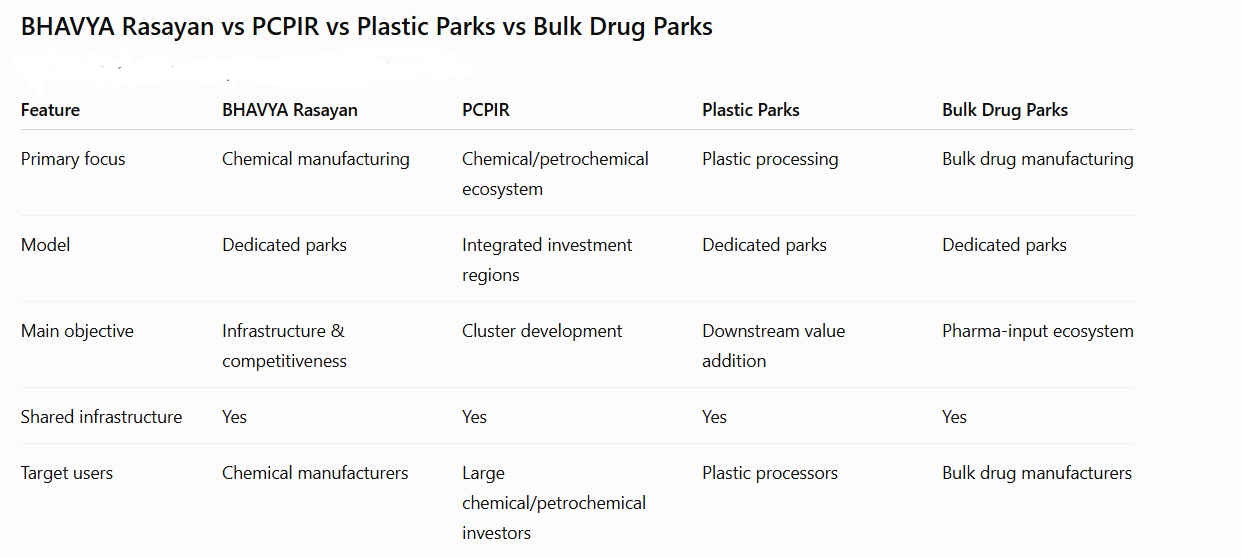
BHAVYA Rasayan is the clearest new example of this approach. Its shared infrastructure model can help address one of the industry's biggest problems: the cost and complexity of building a complete industrial ecosystem around every factory.
PCPIRs and Plastic Parks extend that cluster approach across the wider chemical and petrochemical value chain. FDI policy supports the flow of capital, while PLI and Bulk Drug Parks target specific pharmaceutical manufacturing needs.
The government's temporary customs relief in 2026 also showed how trade policy can respond to sudden supply disruptions. Meanwhile, the Rs 20,000 crore CCUS allocation points toward a longer-term focus on lower-emission manufacturing.
The larger strategy is therefore not based on one subsidy or one new scheme. It combines infrastructure, investment, production, supply security, technology, skills, and environmental support.
For chemical manufacturers, that creates more options. However, the best opportunity will depend on the company's product, location, supply chain, investment size, and eligibility for specific schemes. The government's role is to create a stronger manufacturing environment. The company's role is to determine whether that environment makes a particular project commercially viable.
The government supports chemical manufacturing through dedicated chemical parks, industrial clusters, FDI rules, production incentives, Plastic Parks, bulk drug infrastructure, research programs, and cleaner technology support.
BHAVYA Rasayan is a 2026 government scheme for establishing three dedicated chemical parks. It has a total outlay of Rs 3,030 crore and will run from FY 2026-27 to FY 2030-31.
India allows 100 percent FDI through the automatic route for most chemical-sector activities, subject to applicable laws and conditions. Government data shows chemical-sector FDI reached Rs 1,04,895 crore between 2014 and 2026.
Last Updated: 26-08-2026
Zeenat Parween is a Senior Correspondent with 2.7 years of editorial experience. She has written numerous articles and cover stories covering India’s manufacturing, business, and pharmaceutical industries. Her expertise includes industry news, business developments, manufacturing trends, and pharma-related content.






We use cookies to ensure you get the best experience on our website. Read more...