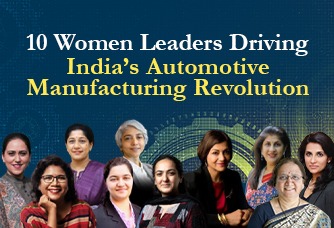
The automotive industry is being rebuilt, not just with electric motors and smarter software, but with the women driving that change from the inside out.
Female engineers and entrepreneurs are now leading breakthroughs in EV powertrain localization, battery storage, and sustainable manufacturing and even motorsports is opening up, with more women racers, engineers, and team managers breaking into F1, NASCAR, and endurance racing. From EV powertrain localization to sustainable battery innovation and motorsports, women are no longer just entering the automotive industry, they are transforming it.
For years, women made up just 10 per cent to 15 per cent of the workforce across traditional OEM infrastructure and Tier-1 suppliers, largely locked out of shop-floor automation and heavy engineering roles.
The EV revolution is flipping that script. On new EV assembly lines, battery plants, and component units, female representation has surged to 40 per cent to 60 per cent, powered by precision-driven electronics assembly, lean manufacturing, and Six Sigma operations. This shift extends well beyond the factory floor.
Technical apprenticeships, engineering scholarships, and mentorship networks have fueled a 30 per cent rise in female participation in automotive engineering programs, while the number of women in executive leadership across top automotive companies has doubled over the past decade.
.jpg) Often called the “Tractor Queen,” Mallika Srinivasan has built Tractors and Farm Equipment Limited (TAFE) into the world’s third-largest tractor manufacturer by volume and India’s second-largest.
Often called the “Tractor Queen,” Mallika Srinivasan has built Tractors and Farm Equipment Limited (TAFE) into the world’s third-largest tractor manufacturer by volume and India’s second-largest.
Under her leadership, TAFE has expanded product range, strengthened component localization, and scaled a lean manufacturing base that supports both domestic demand and exports to more than 100 countries.
“India is the largest tractor market in terms of tractor units. India’s farm mechanization has been a unique model because we have small farms, and the rest of the world is much larger. But the developing world is not so industrialized. Our industry is a story of solutions for India by India. It’s a self-reliance story,” says Mallika Srinivasan.
She has driven automation, supplier-base expansion, and deeper localization as strategic priorities while preparing electric tractor offerings for global markets.
Her focus on product and process development has turned a cyclical farm-equipment business into a resilient, technology-led manufacturer that continues to shape India’s heavy-machinery ecosystem.
Also Read: India Set to Cross 5 Million Car Sales in FY27: Auto Industry Growth Vision
1.jpg) Shradha Suri Marwah leads India’s largest automotive thermal management company, supplying air-conditioning and related systems to major OEMs including Maruti Suzuki and Tata Motors.
Shradha Suri Marwah leads India’s largest automotive thermal management company, supplying air-conditioning and related systems to major OEMs including Maruti Suzuki and Tata Motors.
She has steered Subros from conventional climate control into higher-value EV, hybrid, and CNG thermal systems, which now form a growing share of revenue and deliver significantly higher content per vehicle.
Localization of electric compressors and thermal components remains central to her strategy.
As a former President of ACMA, she has also pushed the wider component industry toward faster localization, export growth, diversity, and sustainable value chains, helping position Indian suppliers for the next phase of electrification.
“The talent is scarce, and it is not gender dependent, the organizations have to mature as they have no choice, as companies run on talent and not on men or women," said Shradha Suri Marwah.
1.jpg) Sulajja Firodia Motwani has led Kinetic’s decisive pivot from traditional ICE two-wheelers into mass-scale electric mobility.
Sulajja Firodia Motwani has led Kinetic’s decisive pivot from traditional ICE two-wheelers into mass-scale electric mobility.
Through Kinetic Green she has focused on indigenous EV chassis and affordable electric three-wheelers and utility vehicles, building manufacturing capability aimed at last-mile and commercial electrification.
Her work has helped demonstrate that Indian OEMs can design and scale purpose-built electric platforms rather than simply adapt existing ICE architectures, contributing to a broader shift toward locally engineered green mobility solutions.
“The automotive sector has traditionally been male-dominated, and women have been under-represented in this sector. I believe that the advent of electric vehicles presents a great opportunity to break down barriers and redefine the industry, making it more inclusive and diverse. As the industry undergoes a transformative shift towards cleaner and more efficient transportation solutions, there is a chance to reset the gender balance,” said Sulajja Firodia Motwani.
Also Read: How Advanced Filtration Driving the Future of Sustainable Mobility
1.jpg) Anjali Anand Singh chairs one of India’s most significant automotive component groups, with strengths in precision driveline, braking, and related systems.
Anjali Anand Singh chairs one of India’s most significant automotive component groups, with strengths in precision driveline, braking, and related systems.
She has emphasized customer satisfaction, deeper R&D, and a more global orientation while building on the group’s long record of joint-venture excellence.
She also chairs the ANAND Executive Board and the Group Supervisory Board, guiding partnerships, corporate governance, and strategic direction.
At the company level, she holds the position of Executive Chairperson of Gabriel India Limited, the group’s flagship publicly listed auto ancillary with over six decades of legacy, and Chairperson of Dana Anand India, the joint venture focused on precision driveline systems.
“We aim to further increase customer satisfaction, which is ultimately the key. R&D is going to be a serious focus area for us. We have been good at innovation and intend to draw on that strength. All this aside, we intend to be more global,” she said.
Her leadership continues to expand opportunities for women in high-precision manufacturing environments across the Anand ecosystem. Through partnerships such as Dana Anand India and other technical collaborations, she has strengthened the group’s capabilities in these high-precision domains while expanding manufacturing footprints and customer reach.
She continues to prioritize strategic partnerships and selective mergers and acquisitions to support the group’s ambition of exceeding Rs 50,000 crore in revenues by 2030, while maintaining a dual focus on localization for cost competitiveness and global expansion through existing JV networks.
1.jpg) Arathi Krishna has guided Sundram Fasteners from a strong component base toward higher-value sub-assemblies for EV players while expanding exports beyond pure automotive applications.
Arathi Krishna has guided Sundram Fasteners from a strong component base toward higher-value sub-assemblies for EV players while expanding exports beyond pure automotive applications.
“We are rapidly evolving from a component manufacturer to a supplier of sub-assemblies for EV players. We are working to increase our exports to non-auto sectors and to provide new and innovative parts in the auto sector to achieve scale,” she notes.
Her focus on operational excellence, including Total Productive Maintenance practices, and on securing global contracts for high-tensile fasteners and hot-forged parts has contributed to strengthening India’s position in critical mechanical supply chains.
1.jpg) Harshbeena Zaveri has transformed NRB Bearings into a company that designs its own intellectual property rather than relying solely on licensed technology.
Harshbeena Zaveri has transformed NRB Bearings into a company that designs its own intellectual property rather than relying solely on licensed technology.
“I am not an engineer, and perhaps because of that I have never understood why it is imperative for Indian companies to seek technology from other countries. So, I created fundamental technology at NRB.
We design our OEM products to global automotive brands at our own R&D center from scratch. This is what I took from my father’s legacy. I have turned my company into one that creates its own IP for its future launches,” she says.
Under her leadership, NRB supplies customized cylindrical and needle roller bearings that reduce friction across a vast share of vehicles on Indian roads, embedding Indian engineering deeper into the mobility value chain.
Also Read: India as a Global Manufacturing Hub in the New Mobility Era
1.png) With more than two decades of experience spanning traditional SUV design and now electric mobility, Kripa Ananthan leads design at Ola Electric.
With more than two decades of experience spanning traditional SUV design and now electric mobility, Kripa Ananthan leads design at Ola Electric.
She has shaped the visual and structural language of products emerging from one of India’s largest EV manufacturing campuses. Her work bridges emotional design, functional architecture, and the demands of high-volume electric production, helping define how Indian-made EVs look, feel, and scale.
An IIT Bombay design alumnus with a mechanical engineering foundation from BITS Pilani, she began her career in 1997 as an interior designer at Mahindra & Mahindra and rose to Head of Design, shaping some of India’s most iconic SUVs, including the XUV500, the modern Thar, XUV700, XUV300, and Marazzo.
“I can affirm that any workplace, particularly in design, becomes more enriched, innovative, and forward-looking when it welcomes a range of viewpoints. These diverse perspectives can arise from various sources, including one’s background. Certainly, a woman’s viewpoint differs from a man’s, just as someone from a foreign country would bring a distinct perspective. Undoubtedly, diversity offers a significant advantage by enhancing the comprehensiveness and distinctiveness of your ideas,” says Kripa Ananthan.
In 2022, she transitioned from conventional automotive design to electric mobility, first engaging with Ola Electric through her consultancy Krux Studio and then joining as Head of Design. At Ola, she oversees the visual and structural architecture of products emerging from one of India’s largest EV manufacturing campuses, working in sync with design centers in Bengaluru and the Coventry-based Futurefoundry.
Ananthan’s move from heritage SUV platforms to the electric ecosystem reflects a deliberate shift toward sustainable mobility while retaining her signature balance of bold aesthetics and real-world usability.
1.jpg) As the first woman to lead the Automotive Research Association of India (ARAI), Rashmi Urdhwareshe spent decades setting the technical standards that govern emission, safety, and testing regimes for Indian automotive manufacturing.
As the first woman to lead the Automotive Research Association of India (ARAI), Rashmi Urdhwareshe spent decades setting the technical standards that govern emission, safety, and testing regimes for Indian automotive manufacturing.
“As leaders, we must ensure that while delivering short-term goals, we do not lose sight of the purpose and long-term vision of the company,” she has said.
She also frames the larger shift the industry must make: “What are automotive professionals wanting to achieve? Is it an automotive product or an integrated transportation solution? When their focus aligns on providing a transportation solution, it will enable automobile users to choose any transport medium between 2W and the bus with the same convenience, safety, efficiency, and green mobility factors.”
Her standards work continues to shape how factories design testing beds and validate products for a multi-modal, lower emission future.
1.jpg) Hemalatha Annamalai was an early mover in affordable electric two-wheeler manufacturing, establishing production in Tamil Nadu’s Tier-2 industrial clusters.
Hemalatha Annamalai was an early mover in affordable electric two-wheeler manufacturing, establishing production in Tamil Nadu’s Tier-2 industrial clusters.
Ampere Electric Vehicles focused on practical, cost-sensitive electric scooters and built assembly capability outside the traditional auto hubs.
Her pioneering effort helped prove that EV manufacturing could take root in smaller industrial centers and serve price-conscious customers, laying the groundwork for wider geographic dispersion of e-mobility production.
“Women’s empowerment has been a strong driving force for Ampere since inception. Even inside our shop floor, we have engaged 30 per cent women as part of our workforce. We will be doubling that percentage soon,” says Hemalatha Annamalai.
By locating production in a Tier-2 manufacturing hub and prioritizing capital-light, technology-driven vehicles suited for short-range commuting, Hemalatha helped lay foundational manufacturing capacity for affordable electric two- and three-wheelers outside major metropolitan centers. Ampere carved a niche as an innovative technology creator in India’s early EV ecosystem before its acquisition, after which she fully exited the venture.
Also Read: How India's Tyre Industry Is Responding to a Changing Mobility Market
 Nishita Baliarsingh is tackling one of the hardest problems in electrification: sustainable, localized battery chemistry. Nexus Power develops bio-organic battery alternatives using agricultural waste, aiming to reduce dependence on conventional lithium-ion supply chains.
“We believe Nexus batteries have the potential to fasten the global shift towards e-mobility. Partnering with the right ecosystem enablers... shall enhance research and development and product development. With this round, we have rapid scalability and amplified operations in mind,” she has said.
She also highlights a practical barrier: “The EV industry lacks efficient batteries, as most take about four to six hours to charge… hence, only a strong charging infrastructure would quicken the adaptation.”
Her work sits at the deep-tech end of manufacturing, linking farm waste, battery innovation, and India’s EV localization goals.
Women leaders are reshaping India’s automotive manufacturing from within. Across OEMs, Tier-1 suppliers, design studios, standards bodies, and deep-tech battery ventures, they are driving the shift from conventional powertrains to electric platforms, higher localization, and more inclusive workplaces.
Where female participation once hovered at 10–15 per cent in traditional plants, new EV assembly lines, battery facilities, and precision component units now routinely see 40–60 per cent women on the shop floor. At the same time, these ten leaders have doubled executive representation, expanded technical talent pipelines, and proven that Indian engineering can deliver global-standard products from tractors and thermal systems to affordable electric two-wheelers and bio-organic batteries.
Their collective work shows that the EV transition is not only a technological change but also a structural one, as it opens space for diverse leadership, embeds Indian IP deeper into the value chain, and builds manufacturing capability beyond the traditional auto hubs. As the industry scales, the presence and influence of these women ensure that India’s automotive future is more innovative, more self-reliant, and more representative of the talent that powers it.
Fathimanoud is a Correspondent with experience covering the manufacturing and pharmaceutical sectors. She has written several articles on the pharma and manufacturing industries, with a particular focus on pharmaceutical developments and industry updates.

We use cookies to ensure you get the best experience on our website. Read more...