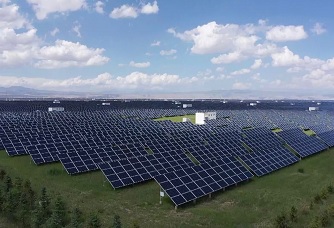
India’s solar sector is entering its most aggressive growth phase yet, with industry estimates indicating that the country is on track to become the world’s second-largest solar market by 2026.
Rapid capacity additions, strong policy backing, and rising demand across industries and households are driving this transformation at an unprecedented pace.
The country has already crossed around 150 GW of installed solar capacity, with nearly 50 GW added in just the last 14 months—marking the fastest expansion in its renewable energy history.
This sharp acceleration reflects a decisive shift from gradual adoption to large-scale deployment. Government-led initiatives such as rooftop solar schemes and rural electrification programs have played a crucial role, while private sector participation has strengthened significantly.
India’s solar journey began gaining momentum in the early 2010s with the launch of the National Solar Mission, which set ambitious targets and created a policy framework for growth. From just a few gigawatts of installed capacity a decade ago, the sector has scaled rapidly due to falling solar tariffs, improved technology, and increased investor confidence. Over time, solar energy has evolved from a supplementary power source into a central pillar of India’s energy transition strategy.
Also Read: How LiDAR, Thermal & UV Payloads Revolutionize Power Transmission
Key Market Data
Growth Drivers
The expansion has been supported by major domestic players such as Adani Group, Tata Power, and Reliance Industries, alongside renewable-focused firms like ReNew Energy Global, Waaree Energies, and Vikram Solar. These companies are investing heavily in large-scale solar parks, rooftop installations, and domestic manufacturing, contributing to the sector’s rapid growth and helping reduce dependence on imports.
Key Challenges
Future Outlook
India’s solar sector is expected to maintain strong momentum over the next decade, supported by policy continuity and sustained investment. Annual installations are projected to remain in the range of 45–50 GW, ensuring steady capacity expansion.
|
Metric |
Current (2025–26) |
Expected by 2030 |
|
Solar Capacity |
~150 GW |
280–300 GW |
|
Annual Additions |
~45–50 GW |
Stable high growth |
|
Renewable Energy Target |
~220+ GW |
500 GW (non-fossil) |
|
Global Position |
Top 3 |
Likely Top 2 |
As global markets such as the United States and parts of Europe experience relatively slower growth, India is expected to play a central role in driving global solar demand. With continued investments in infrastructure, manufacturing, and policy support, the country is positioned to emerge as one of the most influential solar markets worldwide.







We use cookies to ensure you get the best experience on our website. Read more...