Japanese investments are accelerating in Uttar Pradesh as the state steps up to attract companies across manufacturing, technology, and global supply chains.
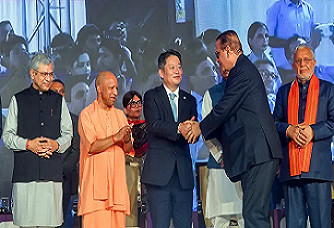
At the UP-Japan Investment Meet 2026 in New Delhi, Chief Minister Yogi Adityanath invited Japanese companies to make UP their “second industrial home.”
He positioned the state’s young workforce, infrastructure and large domestic market as a strong complement to Japan’s manufacturing expertise and technology.
This push comes as UP strengthens its electronics, semiconductor, logistics and industrial ecosystem while targeting a USD 1 trillion economy.
Yogi Adityanath urged Japanese companies to look beyond factory investments and establish technology centers, R&D facilities, skill centers and global supply-chain operations in Uttar Pradesh. He said Japan’s expertise in precision engineering, quality and manufacturing can complement UP’s young workforce, infrastructure and large domestic market.
The Chief Minister described the India-Japan relationship as one of “Shared Growth, Shared Technology and Shared Prosperity.” He also invited the Japan External Trade Organization (JETRO) to strengthen its partnership with UP and support efforts to bring more Japanese companies, technology and investment into the state.
The state’s pitch also focuses on advanced manufacturing practices. The Chief Minister highlighted robotics, precision engineering, and green manufacturing, along with Japanese methods such as Kaizen and 5S, as tools to help create an industry-ready workforce.
Also Read: India as a Global Manufacturing Hub in the New Mobility Era
The latest Japanese investments already have a manufacturing footprint in the state. Two Japan-backed projects worth Rs 3,191 crore received a virtual groundbreaking in the Yamuna Expressway Industrial Development Authority (YEIDA) region during the investment meet. The projects could create more than 10,000 jobs, strengthening UP’s case as a destination for Japanese industrial activity.
More than 200 Japanese business leaders, CEOs, industry representatives and policymakers are participating in the five-day UP-Japan Investment Meet 2026, which runs from August 18 to 23. The Japanese delegation includes representatives from sectors such as automobiles, advanced manufacturing, logistics, clean energy and technology.
UP is using its expanding electronics ecosystem to attract further Japanese investments. According to the state, Uttar Pradesh accounts for 55 per cent of India’s mobile phone production and nearly 60 per cent of electronic manufacturing. The state also has more than 75,000 acres of industrial land, while 27 manufacturing and logistics clusters are developing along expressways.
Its connectivity pitch includes 17 airports, metro networks in seven cities, two Dedicated Freight Corridors and the country’s first inland waterway. UP also accounts for around 60 per cent of India’s expressway network, according to the Chief Minister.
The state introduced its Plug and Play Industrial Sheds scheme in March 2026, while Noida International Airport is developing as a cargo, MRO and logistics hub. These infrastructure projects strengthen UP’s proposition for Japanese companies seeking integrated manufacturing and supply-chain locations.
The renewed push for Japanese investments could strengthen India’s manufacturing ecosystem by bringing Japanese technology, precision engineering and production expertise deeper into the country’s industrial base.
With UP expanding electronics, logistics, semiconductor infrastructure, and advanced manufacturing capabilities, greater Japanese participation could help connect Indian suppliers with global production networks.
For Indian industry, the development also highlights the growing importance of India-Japan manufacturing partnerships. Japanese companies can access India’s large domestic market and workforce, while Indian manufacturing clusters can gain access to Japanese technology, quality systems and industrial practices.
This makes UP’s Japan pitch relevant beyond the state, as it could contribute to India’s broader goals of manufacturing expansion, supply-chain localization and global industrial integration.
.jpg "Precise Fasteners: Committed To Fulfilling Client Expectations, Every Time!")

We use cookies to ensure you get the best experience on our website. Read more...