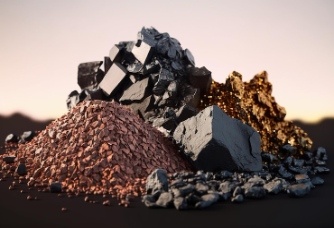
India is accelerating its push to secure critical mineral resources, combining fresh mining block allocations with rising industry interest in rare earth processing, as it looks to reduce dependence on imports and strengthen its position in global supply chains.
This momentum is reflected in the recent allocation of a critical mineral block containing vanadium, titanium, and aluminous laterite, marking a step forward in diversifying India’s resource base beyond conventional fuels.
At the same time, collaborative efforts are gaining traction, with research partnerships focusing on extracting rare earth elements from overburden and mining residues, an approach that signals a shift toward more sustainable and efficient resource utilization.
State-run NLC India Ltd has been declared the preferred bidder for a critical mineral block containing vanadium, titanium, and aluminous laterite, following auctions conducted by the Ministry of Mines on June 11.
The development marks a strategic shift for NLC India, traditionally focused on coal and lignite mining, as it expands into minerals that are increasingly central to clean energy systems and advanced manufacturing.
In parallel, the company has also signed an agreement with CSIR-Central Electrochemical Research Institute (CECRI) to explore extraction of rare earth elements from overburden and mine tailings, an approach aimed at unlocking value from secondary resources and improving resource efficiency.
At the same time, India’s critical minerals push is drawing strong interest from major industrial players. Companies including Reliance Industries, Vedanta Ltd, and Adani Enterprises are among nearly 10 firms that have expressed interest in setting up rare earth processing facilities.
This interest is centered around Andhra Pradesh, which holds an estimated 211 million metric tonnes of beach sand mineral resources across 16 identified coastal deposits. At the national level, India’s total rare earth resources stand at 482.6 million tonnes, according to official estimates.
The state is aiming to attract investments worth Rs 50,000 crore ($5.2 billion) in rare earth and titanium projects over the next decade, positioning itself as a key hub in India’s emerging mineral value chain.
Also Read: Reducing Mining's Carbon Footprint with Renewable Energy Solutions
These developments come as New Delhi intensifies efforts to reduce reliance on China, which dominates global rare earth processing and supply.
The government has already approved a Rs 7,300 crore program to boost rare earth magnet manufacturing and has identified multiple regions for developing integrated “rare earth corridors” covering mining, processing, and end-use manufacturing.
States are also stepping in with policy incentives. Andhra Pradesh, for instance, is preparing to roll out capital-linked incentives for projects with investments exceeding Rs 1,000 crore, alongside plans to invite tenders for large-scale processing facilities.
Despite having substantial reserves, India currently lacks industrial-scale capabilities to process rare earth minerals to high-purity levels. This gap has limited its ability to fully capitalize on domestic resources.
The growing alignment between government policy, public sector participation, and private sector investment interest indicates a shift toward building an integrated ecosystem from mining to processing and manufacturing.
The convergence of block allocations, policy support, and corporate interest signals that India is moving beyond exploration toward execution in its critical minerals strategy.
For sectors such as electric vehicles, renewable energy, and electronics, securing a stable supply of minerals like rare earths, vanadium, and titanium is becoming essential. These materials are key to technologies such as EV motors, battery storage systems, and advanced industrial components.
More importantly, this push reflects a broader geopolitical and economic recalibration. As countries compete to secure access to critical minerals, India is positioning itself not just as a resource holder but as a future processing and manufacturing hub.
What is emerging is not just a series of isolated developments, but a coordinated national effort to build mineral security.
By combining domestic mining expansion with downstream investment and policy incentives, India is laying the groundwork for a more resilient and self-reliant supply chain, one that could play a defining role in its energy transition and industrial growth trajectory.
.jpg "AR Enterprises: Building The Supply Networks Behind India's Construction Growth")
.jpg "Industrial Packers: Engineering Industrial Packaging for India's Manufacturing Future")




We use cookies to ensure you get the best experience on our website. Read more...