From Policy to Investment, Investment to Manufacturing, Manufacturing to Localisation—and Localisation to Global Competitiveness
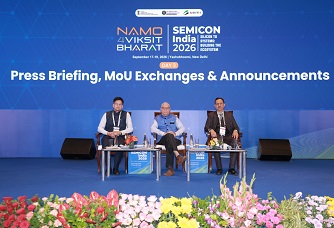
New Delhi, September 23, 2026: India’s semiconductor journey has entered a new phase, with Semicon 2.0 providing the policy architecture and SEMICON India 2026 demonstrating the growing industrial and commercial momentum behind it.
The fifth edition of SEMICON India, held from September 17–19 at Yashobhoomi, New Delhi, brought together the global and Indian semiconductor ecosystem at unprecedented scale, recording 51,656 registrations, around 40,000 cumulative visitors, 600+ exhibitors, around 300 international companies, participation from 52 countries, 54 MoUs and strategic announcements, more than 5,000 B2B discussions and around USD 7 billion in investment commitments and India’s semiconductor market projection of USD 200 billion by 2035, according to EY–IESA report, “Semicon India 2.0: From capacity creation to ecosystem leadership”.
The event demonstrated that India’s semiconductor story is moving decisively from policy to projects, from projects to production, and from individual investments to an integrated ecosystem.
The Government has simultaneously moved into the next phase through Semicon 2.0, with an outlay of Rs 1,27,500 crore, focused on design, machines and materials, fabs, advanced packaging, R&D and talent.
Commenting on SEMICON India 2026, Ashok Chandak, President, SEMI India and IESA, said:
“SEMICON India 2026 has demonstrated that India is moving from credibility to capability. Semicon 1.0 created the foundation; Semicon 2.0 is now deepening the ecosystem. What we witnessed over these three days is policy continuity meeting industrial commitment, global confidence meeting Indian capability, and investment beginning to translate into manufacturing, partnerships and commercialisation.”
Chandak added:
“The most exciting development is that the semiconductor story is no longer about individual fabs or packaging plants. It is becoming an ecosystem story—from design and IP to fabs, advanced packaging, equipment, materials, logistics, talent, electronics manufacturing and end products. This is the beginning of a positive spiral of growth to address the India’s projected semiconductor market demand of USD 200Bn by 2035”
Also Read: How to Build a Future-Ready Talent Pipeline for Electronics Component Manufacturing
The 54 announcements and strategic initiatives at SEMICON India 2026 spanned semiconductor design, fabrication, advanced packaging, equipment and materials, power electronics, AI, HPC, R&D, logistics, startups and workforce development.
The EY–IESA report titled Semicon India 2.0: From capacity creation to ecosystem leadership, projected India’s semiconductor market to grow threefold to USD 200 billion by 2035.
The MoUs also demonstrated the growing depth of India’s supply-chain localization agenda.
Tata Electronics announced partnerships covering wafer manufacturing, assembly and test, advanced packaging, critical materials, photoresists and advanced chemicals, high-purity gases, fab infrastructure and talent development, including a proposed large vendor park in Dholera to accelerate the semiconductor supplier ecosystem.
Further initiatives around high-purity gases and chemicals, lead-frame localization, indigenous critical materials, semiconductor logistics and advanced power electronics.
Several OSAT/ATMP companies signed MOU’s with customers with their capacities getting fully booked.
Fabless companies such as L&T Semiconductors, showcased the chips and customer’s MOUs.
Large number of MOU’s in talent development by NIELIT , SEMI , IESA and others.
These developments point to a powerful multiplier effect:
Investment creates manufacturing → manufacturing creates supplier demand → supplier demand drives localization → localization creates skills and technology → skills and technology generate innovation and IP → innovation creates products and new markets → new markets attract further investment.
This is the positive spiral that can enable India to progressively capture greater value across the semiconductor and electronics value chain.
The impact will extend well beyond semiconductor manufacturing.
A stronger domestic semiconductor ecosystem can support India’s broader electronics manufacturing ambitions by enabling greater localization of components, materials, substrates, modules, power electronics, embedded systems and semiconductor content.
The objective is therefore to move progressively from assembly to component manufacturing, from component manufacturing to semiconductor content, and from semiconductor content to Indian-designed products and IP.
As Chandak put it: “Semiconductors are not the destination; they are the foundation for the next generation of electronics manufacturing. The opportunity is to design in India, make chips in India, surround them with India components, integrate them into products made in India, increase domestic value addition and ultimately export those products to the world.”
SEMICON India 2026 also highlighted the growing importance of Indian semiconductor design, IP and deep-tech innovation.
The event saw the announcement of ChipIN Regional Centres, initiatives around open-source PDKs and EDA access, the Digital India RISC-V Grand Challenge and the Bharat AI-SoC Challenge.
The India Semiconductor Academy, being developed in collaboration with SEMI and the India Deep Tech Alliance, is another step towards building an industry-led talent ecosystem. The India Deep Tech Alliance also announced investment of USD 236 million across 56 deep-tech companies in the event program.
The talent pipeline is expanding rapidly. The SEMICON India Hackathon 2026 recorded 3,808 team registrations from 881 colleges and 1,053 idea submissions, while the Digital India RISC-V Grand Challenge attracted 1,236 teams and 5,045 participants.
IESA’s Start Up Mitra initiative led the Start Up pitching contest and Start Up MITRA Pavilion that inspired and showcased 50+ start up’s at the event.
IESA’s Workforce Development Pavilion motivated 1000+ students on semiconductor sector trainings and opportunities.
SID’s display conference and ELCINA’s Components and material track were also adding to ecosystem play.
Also Read: Future of Sustainable Electronics Manufacturing: Trends and Practices
One of the most significant milestones was the inauguration of commercial production lines at CDIL Semiconductor in Mohali and Suchi Semicon in Surat, taking the number of operational commercial semiconductor units among the projects approved under Semicon 1.0 to five.
The Government has described Semicon 2.0 as the next step from the foundational work of Semicon 1.0 towards a complete semiconductor ecosystem, with emerging investment indications of around Rs 1 lakh crore (USD 11–12 billion)and close to one lakh employment opportunities expected across the ecosystem.
For SEMI India and IESA, this convergence of policy and industry mobilisation is the defining message of SEMICON India 2026.
“The semiconductor story in India has moved from ambition to action, from announcements to commercial production—and from individual projects to an ecosystem,” said Chandak.
“Semicon 2.0 gives us the policy runway. SEMICON India gives the industry a platform to connect, invest, partner and execute. The next challenge is to convert this momentum into scale, global competitiveness and value creation”, Chandak added.
The three days also reinforced India’s growing engagement with the global semiconductor community, with 52 countries, six country pavilions, 12 state pavilions and 150+ speakers participating in the event. Country roundtables with Japan, the Netherlands, Singapore, South Korea, Malaysia and Sweden focused on investment, technology partnerships, equipment and materials, advanced packaging, supply chains, R&D and talent.
The message from SEMICON India 2026 is therefore clear:
And together, these elements can create a self-reinforcing positive spiral of semiconductor and electronics growth.
“India should not look at semiconductors as a race or a catch-up game. Our opportunity is to build trusted, globally competitive capability across the value chain and become an indispensable partner in the global semiconductor ecosystem,” Chandak said.
SEMICON India 2026 may have concluded—but India’s semiconductor momentum has only just begun.



We use cookies to ensure you get the best experience on our website. Read more...