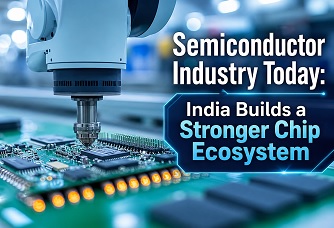
India’s semiconductor industry is entering a new phase, backed by government support, private investment and new manufacturing capabilities.
The latest developments show that the country is building more than just chip-making capacity. From a proposed investment of over Rs 5 lakh crore to advanced packaging and defense-focused technologies, several areas are gaining attention.
Indian companies are also expanding their presence in global semiconductor supply chains. Together, these developments point to a broader effort to build domestic capabilities, attract investment and reduce supply chain dependence. The focus is now moving across manufacturing, packaging, materials and specialized chip applications.
The government has notified the Rs 1.27 lakh crore Semicon 2.0 program to strengthen India’s semiconductor ecosystem. The India Electronics and Semiconductor Association, or IESA, expects the scheme to catalyze over Rs 5 lakh crore in investment. This investment could come across chip factories, packaging, equipment, materials, design and research. IESA also expects five to seven chip manufacturing units to be established over the next five to seven years. The program offers financial support for manufacturing projects and provides stronger incentives for advanced research and talent development.
Building a large chip factory requires billions of dollars and several years before commercial production begins. Advanced packaging could offer India a faster way to build capabilities and join the global semiconductor value chain. It allows multiple chips or components to work together inside one package, improving performance and efficiency.
India’s Semicon 2.0 program gives advanced packaging a specific focus, with projects eligible for support of up to 35 percent of capital expenditure. However, India still needs skilled workers, reliable infrastructure, suppliers and stronger local manufacturing support.
Also Read: India as a Global Manufacturing Hub in the New Mobility Era
izmo Microsystems, a subsidiary of IZMO Limited, has developed a semiconductor package for devices operating at frequencies up to 40 GHz. The package was designed, developed and manufactured entirely in India for high-frequency defense and secure communication applications.
The company has completed testing and started production shipments for its customer. The technology could support applications such as radar, electronic warfare, aerospace and secure communications. Dinanath Soni, Director of izmo Microsystems, said the company has developed the package from design through manufacturing and validation.
Acutaas Chemicals’ step-down subsidiary, Indichem Inc, has opened a semiconductor chemicals plant in Gongju, South Korea. The facility was completed within 11 months of its groundbreaking in September 2025. The plant creates a two-country model, with chemical synthesis taking place in India and high-purity refining and testing in South Korea.
Indichem was formed in 2025 by Acutaas Advance Material Limited and South Korea-based J & Materials Co Ltd. Naresh Patel, Chairman and Managing Director of Acutaas Chemicals, said the facility will support the company’s semiconductor materials growth.
These developments show how the semiconductor industry is expanding beyond traditional chip manufacturing in India. Government funding is helping create opportunities across manufacturing, packaging, research and supply chains. Advanced packaging could help Indian companies enter global markets without waiting for a large factory ecosystem.
At the same time, izmo Microsystems’ defense-focused development shows growing domestic capabilities in specialized electronics. Acutaas’ South Korean plant adds another link to India’s semiconductor materials supply chain. Together, these moves suggest that India’s semiconductor industry is gradually building a wider and more connected ecosystem.





We use cookies to ensure you get the best experience on our website. Read more...