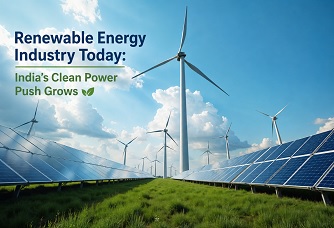
India’s renewable energy sector is seeing fresh momentum through new projects, investment plans, and major industry initiatives.
The latest developments include a national summit, a solar project, a major transmission order, and expansion plans from GAIL.
These moves show how companies and the government are building stronger support for clean power across India. From Rajasthan’s solar capacity to Maharashtra’s power network, the focus is expanding beyond generation.
The developments also highlight growing investment needs, stronger infrastructure, and wider use of clean energy. Together, these five updates offer a clear view of India’s changing energy landscape.
Union Minister for New and Renewable Energy Pralhad Joshi led the Mumbai roadshow for the Bharat Renewable Energy Summit 2026. He called for greater investment and collaboration across the clean energy sector. Maharashtra will participate as a partner state in the upcoming summit. The main event will take place at Bharat Mandapam in New Delhi from November 2 to 5, 2026.
Maharashtra Minister for Renewable Energy Atul Moreshwar Save said the state aims to reach 65 GW of renewable energy capacity by 2030. The state also has strong rooftop solar activity and has installed a high number of solar pumps. MNRE Secretary Santosh Kumar Sarangi and Joint Secretary JVN Subramanyam also addressed the event. The Mumbai roadshow is part of a nationwide series supporting the upcoming summit.
Tata Power Renewable Energy Limited (TPREL) has commissioned a 72.5 MW solar project at Kalasar in Rajasthan’s Bikaner district. The project has been developed to supply clean electricity to Tata Steel Limited through TP Vardhman Surya Limited. It is expected to support Tata Steel’s efforts to reduce its dependence on conventional power.
The project adds to Tata Power’s growing clean energy portfolio while supporting Tata Steel’s sustainability goals. TPREL currently has around 7 GW of operational renewable capacity. This includes about 5.7 GW of solar capacity and 1.3 GW of wind capacity. Another 5.3 GW is under development and expected to come online in phases.
Adani Energy Solutions has won a transmission project worth around Rs 4,700 crore in Maharashtra. The project will help move renewable energy generated in Karnataka to major power consumption centers in Maharashtra. It will also support the growing use of stored power in the Satara, Pune, and Mumbai regions.
The project will strengthen the power connection between southern and western parts of India. It includes a new substation at Satara and a transmission line connecting Kolhapur and Satara. AESL won the project through a competitive bidding process after emerging as the lowest bidder. The project also strengthens the company’s position in India’s growing renewable energy transmission market.
Also Read: Hybrid Power & Tech Solutions for Sustainable Manufacturing Growth
State-owned GAIL (India) Limited is planning expansion across natural gas, petrochemicals, LPG, and clean energy. Deepak Gupta, Chairman and Managing Director of GAIL, said the plans aim to improve energy security while supporting the shift toward cleaner fuels. The company is also looking to diversify its LNG supplies and shipping arrangements.
GAIL is also moving into gas-based fertilizer manufacturing through two proposed plants in Maharashtra and Chhattisgarh. The combined investment for these plants could reach around Rs 21,000 crore. The company imported 132 LNG cargoes during fiscal 2025-26 to maintain supplies amid global market uncertainty. Gupta said the company needs to balance energy security with the global move toward cleaner fuels.
The five developments point to a broader shift in India’s energy sector. Government initiatives are encouraging investment, while companies are adding solar projects and strengthening power networks. At the same time, traditional energy companies such as GAIL are preparing for a cleaner energy future. These developments show that the renewable energy transition involves generation, transmission, storage, financing, and industrial use.
The developments also show how clean power is becoming increasingly connected with industrial growth. Solar projects can support factories, while stronger transmission networks can move electricity between states. Gas companies are also adding cleaner technologies while continuing to meet existing energy needs. This wider approach could help India build a more reliable and diverse energy system.
India’s energy transition is moving ahead through projects, infrastructure, investment plans, and government-led initiatives. The latest updates from Tata Power, Adani Energy Solutions, GAIL, and the government highlight this growing momentum. The renewable energy sector is also creating opportunities across manufacturing, power transmission, finance, and industrial operations.
With the 2030 clean energy targets approaching, large investments and faster project execution will remain important. These developments suggest that India’s energy future will increasingly depend on a mix of clean power, stronger infrastructure, and new technologies.







We use cookies to ensure you get the best experience on our website. Read more...