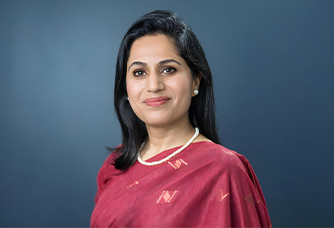
Shveta Arya is a dynamic business leader with over two decades of experience spanning strategy, operations, and transformational leadership across industries. Currently serving as Managing Director of Cummins India Limited, she also leads the Power Systems business while driving growth, customer success, and a culture rooted in diversity, equity, and inclusion. Her leadership has been instrumental in advancing sustainable innovation, including the launch of CPCB IV+ power generation products, among the most stringent emission standards globally.
Since joining Cummins in 2016, Shveta has held key leadership roles across strategy, distribution, and business operations, consistently delivering strong growth and building future-ready capabilities. Prior to Cummins, she led strategy and M&A at Thomas Cook India and held roles at Kearney and Infosys. Known for her empathetic and values-driven leadership, she is also a strong advocate for gender equity, actively supporting initiatives like Cummins Powers Women to drive meaningful impact beyond business.
In an insightful conversation on “Sustainable Manufacturing” with Thiruamuthan, Assistant Editor at Industry Outlook, Shveta Arya, Managing Director at Cummins India Limited, outlines India’s manufacturing sector’s rapid shift toward hybrid energy systems, as sustainability becomes a strategic priority. She highlights how integrated solutions enable cost efficiency, reliability, and long-term carbon reduction.
You've spent over two decades in leadership roles and nearly a decade with Cummins across strategy and business leadership. What has been the biggest shift in how you approach leadership and decision-making today?
As you move into larger leadership roles and are responsible for bigger businesses or more people, your focus must shift. It’s always about business growth, yes, but increasingly about people’s growth as well. That has been my biggest learning.
Over the years, I realized that leadership isn't about having all the answers. It's about creating clarity, earning trust, and empowering others to succeed. In line with Cummins' values, my leadership philosophy has also been shaped by integrity, accountability, and empathy - doing what you say you will do and always doing what is right. Even from my early experiences of guiding my siblings, I learned that the most effective leaders lead with humility and authenticity, inspiring people to come together and create something bigger than themselves.
If you enable people to grow, to learn, to find meaningful career paths within the organization, they stay motivated and become the ones solving the most critical problems. A lot of it helps people find the right roles and then giving them empowerment with a safety net, rather than solving problems yourself.
When you start out, you end up solving a lot of problems yourself. But as you grow into larger leadership roles, even if you feel you can solve it better, it's always more valuable to let your team work through it. You stay right behind them and are ready to step in when needed. That is the shift I have had to make through my journey.
Fit-for-market isn't about de-contenting a global product; it's about engineering for a different, equally demanding specification.
Having moved from leading strategy to now driving large-scale operations and business units at Cummins, how has that shaped the way you think about balancing growth, sustainability, and customer outcomes?
Running a business is like running on a treadmill every day. Strategy, on the other hand, gives you the luxury to sit back and decide what kind of exercise you want to do, and what you don't. The difference is that stark.
That said, if you lead a business, you still need a strategic mindset. A leader has to set the vision of where the organization is headed and ensure people see how that long-term direction creates value not just for the business, but for them as well.
From a business perspective, growth is also about making deliberate choices. At Cummins, we've consciously chosen to focus on areas where we can truly differentiate rather than trying to be everything to everyone. Whether it's power engines, power systems or the technology and service ecosystem around them, our focus allows us to build deep expertise while serving diverse sectors such as data centers, railways, mining and construction. Equally, we've continued to invest ahead of the curve in technology and emissions innovation, enabling us to lead transitions like CPCB IV+ rather than react to them.
But once you become a leader, you cannot stay at the strategic level at all times. Some days you operate at 30,000 feet. On other days, you have to go below ground to check if things are moving in the right direction. And you need the ability to shift between those modes, depending on what's in front of you. Knowing when to go deep and when to stay high, and that to me, is an experience of art.
Moving from strategy to business operations also reinforced one simple philosophy - starting with the customer. Customers don't just buy engines; they invest in reliability, uptime, and a trusted long-term partner. Spending time in the field, understanding how products are used and how teams operate gives you the insights needed to make better strategic decisions.
With India's push for sustainability, how are manufacturers integrating hybrid power systems to optimize operations and reduce carbon emissions?
The conversation has completely changed. A few years ago, manufacturers were asking: Is this worth doing? Can I afford it? Will it help me? Those questions are gone. Today, the questions are: What solutions are available? How do we make this work?
There's a clear understanding now that while some of these solutions may not be immediately affordable, they make sense in the long run, and the direction of travel is set.
That said, economics always comes first. If you've set up a warehouse near Gurgaon, you think about carbon goals, but first and foremost, you think about whether that warehouse is economically viable. The next set of questions is: Which solution works for my context? Is it easy to maintain? What happens if there's a flood? Will it hold? These are very practical, grounded questions. And that's a good sign; it means people are in a position to evaluate what makes sense for them. The market is also evolving, with more options available to support decision-making.
The shift has moved from do I need this? To what exactly do I need? That's why we believe there isn't a one-size-fits-all solution to the energy transition. At Cummins, we believe a multi-pathway approach will help manufacturers adopt the right mix of technologies whether it's diesel, natural gas, battery energy storage or emerging low-carbon solutions based on their operational needs, sustainability goals and infrastructure readiness. As energy demand continues to grow, the focus is increasingly on integrated power solutions that balance reliability, sustainability, and cost-effectiveness.
How are manufacturers leveraging hybrid systems to ensure cost-effective energy management while meeting sustainability targets and maintaining operational continuity?
In manufacturing spaces, which typically require a lot of power, there is a strong push to reduce dependence on the grid where possible, even though the grid has become significantly more reliable and affordable compared to a decade ago. People are aware that over 50 percent of grid power still comes from coal.
So, the approach is to bring renewables into the mix, largely solar, either on-site or through off-site arrangements that combine with battery energy storage systems, and a genset for backup. For manufacturing processes that cannot tolerate even a second of power fluctuation, a genset running on continuous power remains essential.
What we're trying to do at Cummins is help customers integrate all of this through a smart controller and essentially a microgrid. Grid power comes in. Solar comes in, but only for a few hours a day. The battery, charged via solar or grid, fills the gaps during peak demand or when the grid falls short. And the genset kicks in for backup or continuous processes.
The objective is to intelligently optimize energy use by drawing from the most appropriate power source based on the customer's operational requirements, sustainability goals and overall system efficiency. Customers don't have to think about whether to draw from solar now or charge the battery later. It works in the background. That integration is where a lot of our focus is and it's genuinely powerful, both as a solution and as a step towards sustainability.
How are tech-driven solutions like Battery Energy Storage Systems helping manufacturing sectors enhance energy reliability and reduce downtime?
The grid is unreliable compared to a decade ago, but now it's considerably better. India's economy is growing, power demand is growing, and the grid has kept pace to a meaningful extent.
That said, in peak periods, the grid can fall short. And for sensitive manufacturing processes, even minor voltage fluctuations are unacceptable. That's where the combination of solar, battery, and genset, integrated steps in intelligently.
The battery is a very good solution for managing peaks and providing steady, uninterrupted power. The limitation is that it needs to be charged. If the grid is down for four or five hours and solar isn't available either, the battery can't help, and that's when the genset becomes critical. These solutions work in sequence, not in isolation.
There are also practical constraints: batteries take up significant space, require power to charge, and the cells are still largely imported since lithium is not abundantly available in India. Players are importing cells and packaging them here. This space is still evolving, and we are all working to make batteries an even more reliable part of the energy mix.
Looking further ahead, large-scale batteries could also be used to improve grid reliability at a systemic level, but that is a different scale entirely and not yet deployed in India in any significant way.
What role is Cummins playing in enabling the energy transition for India's manufacturing sector?
Cummins already has the core technologies, such as diesel gensets, a battery energy storage system we have recently launched and continue to refine, and the ability to integrate natural gas-based solutions, should that become more viable for India.
But our primary focus right now is not on standalone technologies but rather on integration. Customers do not want to manage five different energy sources independently. They need one intelligent system that does it for them.
Every customer is different, and so is every operating environment. For India, the customer reality is distinct; total cost of ownership matters enormously, regulatory requirements are evolving rapidly, operating conditions are demanding, and infrastructure realities are unique. We don't need equipment engineered for minus thirty degrees; we need solutions engineered for Indian summers, Indian fuel, Indian duty cycles and Indian economics.
That's why we invest significant time in understanding local customer needs and designing solutions that are both world-class and fit for the Indian market. For us, fit-for-market isn't about de-contenting a global product; it's about engineering for a different, equally demanding specification.
How supportive has the policy ecosystem been for players like Cummins, and where do you see scope for further acceleration?
Our government's primary challenge is not just sustainability; it is energy security. We saw what happened during the LPG supply disruption. Countries with their own energy sources were far less affected than we were. The government sees that, and they are trying to find a path that fulfills carbon goals, sustains economic growth at 6–7 percent, and builds energy security simultaneously. That's a genuinely complex set of objectives to manage together.
Within that framework, the government has been thoughtful and supportive. They listen, they do come up with policies, and they engage with industry. Can they do more? Of course. There's always room. And in our country, states control a great deal, and they move at very different paces. If each state became genuinely savvy about energy security and sustainability, we'd be at a very different level.
But given the constraints, I believe we're moving in the right direction.
Looking ahead, what key trends or innovations in hybrid energy systems will redefine sustainable manufacturing in India over the next decade?
What I can say is that there's an enormous amount of research happening globally on battery chemistries to bring costs down, on improving solar efficiency, which currently sits between 18 and 25 percent. We engage with many startups and academic research institutions, both to share our technology expertise and to stay close to what's emerging.
It's a very dynamic space right now and predicting which direction it will land is genuinely difficult. That said, a few things feel real: battery energy storage will continue to evolve, different chemistries will emerge, and costs will come down. More battery packaging happening within India also feels like a near-certainty.
Beyond that, there are many startups working on sustainability solutions specifically for manufacturing environments, which will prove most successful.
The Values Driving Shveta Arya’s Leadership and Decision-Making



.jpg "Building EV Bus Ecosystems for India's Clean Mobility Goals")
We use cookies to ensure you get the best experience on our website. Read more...