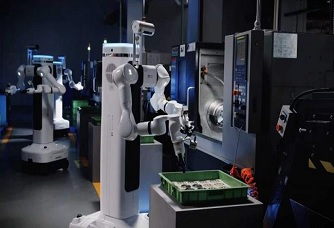
Mitsubishi Electric Corporation has developed a new system to advance smart manufacturing by connecting humanoid robots with computer numerical control (CNC) machine tools through physical AI. The technology aims to automate routine factory tasks and reduce dependence on manual labor.
Announced on October 21, 2026, the system enables humanoid robots to handle equipment setup, cleaning, finished-product removal, transportation, inspection, and troubleshooting. Mitsubishi Electric describes it as the industry's first machining system designed to enable seamless collaboration between humanoid robots and CNC machine tools through physical AI.
The development comes as manufacturers face labor shortages and growing pressure to improve productivity. The company plans to demonstrate the system at the 33rd Japan International Machine Tool Fair (JIMTOF 2026), which begins October 26 at Tokyo Big Sight in Japan.
The new system combines three main components that coordinate machining operations with minimal operator intervention.
Both the AI machining task planner and the physical AI integrated into the CNC machine tool use technology developed through Mitsubishi Electric's proprietary Maisart artificial intelligence platform.
By bringing these components together, the system allows machines and robots to coordinate their activities without requiring complex, robot-specific system integration. Operators can provide basic work instructions, while the system generates and manages the tasks needed to carry out machining operations.
This approach could make smart manufacturing more accessible to companies seeking flexible automation solutions. It may also reduce the time and investment required to integrate humanoid robots into existing production environments.
Also Read: Indian Commercial Vehicle Industry 2026: Trends and Opportunity
Conventional industrial robots often require substantial production-line modifications to perform tasks that depend on human movement and physical capabilities. Positioning workpieces inside machine tools and cleaning equipment are examples of activities that can be difficult to automate with traditional systems.
Humanoid robots offer an alternative because they can potentially perform a wider range of tasks in workspaces designed for people. However, connecting them with CNC machine tools has traditionally required dedicated communication functions and control sequences for individual robot models.
Mitsubishi Electric's system aims to address this challenge by enabling coordinated operations through physical AI, reducing the complexity of deployment.
The development supports the company's broader goal of advancing smart factories, where connected equipment, robotics, and intelligent software work together to improve production efficiency.
Mitsubishi Electric plans to continue improving the system and conducting verification experiments, with practical implementation targeted for 2030. The technology marks a step toward more autonomous manufacturing operations, although its wider industrial adoption will depend on further development and validation.
As manufacturers explore new ways to address workforce constraints, physical AI could play an important role in connecting robotics with existing industrial equipment and advancing the future of smart manufacturing.







We use cookies to ensure you get the best experience on our website. Read more...