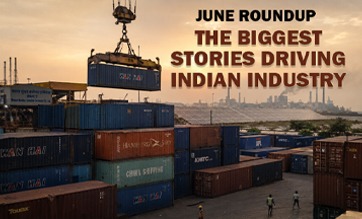
 A monthly review of the deals, policy decisions, investments, and global developments that shaped Indian industry during June 2026.
June was a month of steady progress for the Indian industry. Companies expanded manufacturing, invested in research, and entered new global markets.
Government policies focused on clean mobility, critical minerals, infrastructure, and domestic manufacturing. At the same time, the West Asia crisis reminded businesses of the need to build resilient supply chains and diversify energy sources.
Corporate activity remained strong across steel, renewable energy, aviation, logistics, and advanced materials. Several announcements also highlighted India's growing role in global manufacturing and engineering. Together, these developments reflected an economy preparing for long-term industrial growth rather than short-term expansion.
|
Company |
Development |
Why It Matters |
|
Reliance Industries |
Expanded into carbon fibre manufacturing |
Supports aerospace, EVs, renewable energy, and defense manufacturing |
|
Tata Steel |
Projected 9% domestic sales growth |
Signals strong demand from infrastructure and construction |
|
Suzlon Energy |
Launched "Suzlon 2.0" strategy with a 10 GW FY31 target |
Reflects confidence in India's renewable energy market |
|
HUL |
Opened a €100 million fragrance R&D hub in Mumbai |
Strengthens India's position in global product innovation |
|
Rolls-Royce |
Announced plans for an aircraft engine MRO facility |
Supports India's aviation maintenance ecosystem |
|
Siemens |
Completed the Rs 2,200 crore sale of its motors business to Innomotics |
Allows greater business specialization and operational focus |
|
Coca-Cola |
Exploring an IPO for its India bottling business |
Highlights confidence in India's consumer market |
|
Adani Ports |
Secured a 10-year LNG logistics contract in Argentina |
Expands India's logistics presence into South America |
|
Amazon |
Expanded EV charging infrastructure |
Supports sustainable logistics operations |
|
JEH Aerospace |
Won a global aerospace manufacturing contract |
Strengthens India's precision manufacturing capabilities |
Corporate announcements during June shared one common theme. Companies are investing in future-ready industries instead of simply increasing production capacity. Research, advanced manufacturing, clean energy, and global expansion received greater attention than conventional capacity additions.
Reliance Industries made one of the month's biggest announcements by entering carbon fibre manufacturing. Carbon fibre is widely used in aircraft, wind turbines, electric vehicles, and defense equipment. Domestic production could reduce India's dependence on imports while supporting high-value manufacturing.
The steel sector also remained optimistic. Tata Steel expects domestic sales to grow by nearly nine percent, supported by infrastructure spending and housing demand. The outlook reflects confidence in India's long-term construction pipeline despite global economic uncertainty.
Renewable energy continued to attract investments. Suzlon Energy introduced its "Suzlon 2.0" strategy and set a target of achieving 10 GW in renewable energy sales by FY31. The company also plans to strengthen manufacturing, technology, and service capabilities.
Research and innovation also featured prominently during June. Hindustan Unilever Limited (HUL) inaugurated a €100 million fragrance research center in Mumbai. The facility will develop products for both domestic and international markets. It also reinforces India's growing role as a global innovation hub.
Also Read: Hydrogen Storage Innovations Are Driving India's Clean Energy Push
The aviation sector witnessed another important announcement. Rolls-Royce plans to establish an aircraft engine maintenance, repair, and overhaul (MRO) facility in India. As Indian airlines continue expanding their fleets, local maintenance capabilities will reduce costs and improve turnaround time.
Industrial automation also remained in focus. Siemens completed the Rs 2,200 crore sale of its motors and large drives business to Innomotics. The transaction enables both businesses to sharpen their strategic focus while strengthening their industrial portfolios.
Meanwhile, Coca-Cola is considering an initial public offering for its Indian bottling operations by 2027. The proposed move reflects confidence in India's growing consumer market and the long-term potential of the country's beverage industry.
Several Indian companies also strengthened their international presence during June. Rather than limiting growth to domestic markets, businesses pursued overseas opportunities in logistics, engineering, and aerospace.
Adani Ports and Special Economic Zone entered South America after securing a 10-year LNG logistics contract in Argentina. The agreement expands the company's global operations while strengthening India's role in international energy logistics.
The logistics sector also moved toward cleaner operations. Amazon announced plans to expand EV charging infrastructure across its delivery network. While the investment supports the company's sustainability goals, it also contributes to India's growing commercial EV ecosystem.
Another notable achievement came from Jeh Aerospace, which secured a major global manufacturing contract from Hyderabad. The deal highlights the increasing confidence that global aerospace companies place in Indian suppliers for precision-engineered components.
June saw a series of policy announcements aimed at strengthening manufacturing, reducing import dependence, and supporting India's clean energy goals. Instead of focusing on individual sectors, the government continued building an integrated industrial ecosystem that connects mining, manufacturing, transport, and energy.
|
Policy/Initiative |
Key Announcement |
Business Impact |
|
Ethanol Blending |
India moved closer to achieving 20% ethanol blending |
Reduces crude oil imports and supports the biofuel industry |
|
Flex-Fuel Mobility |
Maruti Suzuki launched a flex-fuel vehicle |
Encourages alternative fuel adoption |
|
Battery Materials |
Rs 3,000 crore policy proposed for lithium and nickel processing |
Strengthens the domestic EV supply chain |
|
Coal Reforms |
New coal trading rules notified |
Improves fuel availability and market transparency |
|
Excise Duty |
Duty removed on 22–30% ethanol-blended petrol |
Makes higher ethanol blends commercially attractive |
|
Critical Minerals |
56 mineral blocks identified for auction |
Supports EV, electronics, and renewable energy sectors |
|
Hydrogen |
Progress on hydrogen-powered rail projects |
Accelerates clean mobility |
|
Railways |
New freight wagon rules proposed |
Encourages private investment and improves logistics |
Proposed support for lithium and nickel processing to reduce India's dependence on imported battery materials.
India's transition toward cleaner transport gathered pace during June. The government and industry focused on multiple technologies instead of relying solely on battery electric vehicles.
The country moved closer to achieving its 20% ethanol blending target ahead of schedule. The milestone reflects coordinated efforts by oil marketing companies, sugar mills, and policymakers. Higher blending levels can reduce fuel imports while creating an additional revenue stream for the sugar industry.
The government strengthened this effort by removing excise duty on petrol containing 22–30% ethanol. The decision improves the economics of higher ethanol blends and encourages wider adoption across the automotive sector.
The industry responded quickly. Maruti Suzuki introduced a flex-fuel vehicle capable of operating on higher ethanol blends. The launch signals that manufacturers are preparing for a broader fuel mix instead of placing all future investments behind one technology.
Another discussion gathered momentum during the month. The proposed transition toward E100-compatible vehicles could reshape India's passenger vehicle market over the next decade. Automakers, fuel suppliers, and component manufacturers will need to adapt their product strategies if the policy moves forward.
India is nearing its ethanol blending target, one of the world's largest biofuel programs.
Electric mobility remained a national priority. This time, however, the focus shifted from vehicle production to the supply chain behind it.
The proposed Rs 3,000 crore incentive for lithium and nickel processing addresses one of India's biggest challenges. Although EV adoption continues to grow, the country still relies heavily on imported battery materials. Local processing would reduce supply risks while attracting investments across the battery value chain.
The government also reviewed gaps in the battery ecosystem. Policymakers highlighted the need to strengthen refining, recycling, and component manufacturing. Closing these gaps will help Indian companies compete more effectively in the global EV market.
Critical minerals remained another major priority. The government's plan to auction 56 critical mineral blocks is expected to improve access to lithium, graphite, cobalt, and rare earth elements. These materials are essential for batteries, electronics, renewable energy systems, and advanced manufacturing.
Also Read: Hybrid Energy Systems: Shaping India's Industrial Power Landscape
Electrical steel also entered the policy spotlight. The government examined ways to reduce dependence on imported electrical steel, a critical material used in transformers, motors, wind turbines, and electric vehicles. Expanding domestic production would strengthen India's manufacturing ecosystem while reducing import bills.
June's announcements showed that India's manufacturing strategy is becoming more comprehensive. The focus has shifted from financial incentives alone to building complete industrial ecosystems.
One notable development was renewed attention on indigenous aircraft manufacturing. Discussions around a Made-in-India aircraft program gained momentum as the government explored ways to strengthen the domestic aerospace supply chain. Although commercial production remains a long-term goal, the initiative could create opportunities for component manufacturers and engineering firms.
The government also announced measures to improve safety in explosives manufacturing through greater automation. While the move received limited public attention, it could improve production efficiency and workplace safety across one of India's most critical industrial sectors.
Coal policy also evolved during the month. The notification of new coal trading rules is expected to improve transparency and encourage greater private sector participation. Better market access can help industries secure fuel more efficiently while supporting power generation.
Officials also renewed their push for coal gasification. The technology converts coal into cleaner fuels and industrial feedstocks. Wider adoption could reduce dependence on imported natural gas while supporting chemical, fertilizer, and steel industries.
Hydrogen continued to emerge as a major pillar of India's clean energy strategy.
One of the month's biggest developments was progress on an indigenous hydrogen-powered train. The project supports Indian Railways' decarbonization efforts while encouraging local technology development.
Another breakthrough came with plans for the world's first nuclear-powered hydrogen production facility. The project combines nuclear energy with hydrogen generation to produce low-carbon fuel for industrial applications. If successfully commercialized, the technology could benefit sectors such as steel, refining, fertilizers, and heavy transport.
Clean energy also remained high on the government's agenda. Union Minister Pralhad Joshi reiterated India's commitment to achieving 300 GW of non-fossil fuel capacity. Continued investment in renewable energy will be essential as electricity demand rises across manufacturing and urban infrastructure.
India's non-fossil fuel capacity target continues to drive investments in renewable energy and grid infrastructure.
Infrastructure remained one of the strongest demand drivers during June.
Indian Railways proposed new freight wagon rules aimed at attracting greater private participation. The reforms are expected to improve freight movement while reducing logistics costs for manufacturers.
High-speed rail also remained in focus. The government announced plans to evaluate seven additional bullet train corridors, expanding the long-term vision beyond the Mumbai-Ahmedabad route. Construction on the country's first bullet train project also continued during the month.
These announcements are expected to generate demand for steel, cement, heavy engineering equipment, signaling systems, and construction services over the coming years.
West Asia remained one of the biggest external factors influencing Indian businesses during June. Rising geopolitical tensions affected energy markets, shipping routes, and supply chains. While India avoided major disruptions, companies took several steps to reduce future risks.
FMCG companies were among the first to respond. Many diversified their supplier base to reduce dependence on a single region. The move reflects a broader shift across industries. Businesses are now placing equal importance on supply chain resilience and cost efficiency.
The aviation sector also felt the impact. To protect airlines from volatile fuel prices, the Union Cabinet approved a Rs 10,000 crore fund to stabilize aviation turbine fuel (ATF) costs. The decision provided relief to airlines at a time when geopolitical uncertainty was pushing crude oil prices higher.
India also chose to keep domestic jet fuel prices stable despite pressure from global markets. Stable fuel prices helped airlines manage operating costs and ensured smoother passenger and cargo operations.
June highlighted why energy diversification has become a strategic priority for India.
The India–Oman Comprehensive Economic Partnership Agreement (CEPA) gained importance as businesses explored trade routes that reduce dependence on the Strait of Hormuz. The agreement is expected to strengthen bilateral trade while improving access to West Asian markets.
Another significant development came from Oman becoming India's largest supplier of liquefied natural gas during the month. The shift reduced dependence on traditional suppliers and strengthened India's energy security.
Russia also remained an important energy partner. Continued imports of discounted Russian crude helped Indian refiners maintain stable fuel supplies despite uncertainty in global oil markets. Competitive crude prices also helped limit cost pressures across manufacturing and transportation.
Fresh discussions around Iranian oil also attracted attention. Although policy decisions remain uncertain, businesses are closely monitoring developments because any change could influence global crude supply and freight costs.
June also reflected India's growing influence in global engineering and manufacturing.
BEML Limited secured another export order from West Asia for heavy equipment. The deal strengthens India's position in international infrastructure and mining equipment markets while supporting the government's export ambitions.
The month also highlighted the importance of critical minerals. Discussions around sourcing minerals from Russia gained momentum as India seeks reliable supplies of lithium, cobalt, graphite, and rare earth elements. These materials are essential for electric vehicles, renewable energy, and electronics manufacturing.
Together, these developments show that Indian companies are becoming more integrated into global supply chains. At the same time, policymakers are working to secure the raw materials needed for future industrial growth.
|
Theme |
What June Revealed |
|
Manufacturing |
Companies continue investing in advanced materials, aerospace, electronics, and engineering. |
|
Energy |
Clean energy, hydrogen, ethanol, and energy security remain top priorities. |
|
Infrastructure |
Railways, logistics, and high-speed rail continue to drive industrial demand. |
|
Global Trade |
Businesses are diversifying supply chains and expanding overseas operations. |
|
Innovation |
R&D, automation, and technology partnerships are becoming core growth drivers. |
June's announcements have laid the foundation for several developments that could gather pace in the coming weeks.
June was less about headline-grabbing announcements and more about strengthening the building blocks of India's industrial economy. Companies invested in advanced manufacturing, research, renewable energy, and international expansion. At the same time, the government focused on policies that support clean mobility, critical minerals, infrastructure, and domestic production.
Global developments also reinforced the importance of resilient supply chains and diversified energy sourcing. Businesses responded by exploring new markets, expanding strategic partnerships, and reducing dependence on single-region suppliers.
Taken together, these developments point to a clear trend. Indian industry is steadily moving toward higher-value manufacturing, stronger global integration, and greater technological capability. As these investments and policy measures move from announcement to execution, they are expected to shape the country's industrial growth in the months ahead.





We use cookies to ensure you get the best experience on our website. Read more...