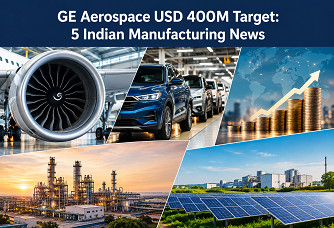
Indian manufacturing is witnessing developments across aerospace sourcing, automotive exports, foreign investment, and industrial decarbonization.
GE Aerospace plans to nearly double its spending with Indian suppliers by 2030, while Tata Motors and Stellantis have agreed to develop vehicles for more than 50 global markets.
Meanwhile, Finance Minister Nirmala Sitharaman has held discussions with global financial leaders in Singapore to encourage investment in India, and Japan has emerged as the leading source of foreign direct investment (FDI) equity inflows during the first quarter of FY27.
In the metals sector, Adani’s Kutch Copper is planning to integrate renewable energy into its expanding Mundra operations.
Together, these developments highlight emerging opportunities for Indian manufacturing, particularly in global supply chains, export-oriented production, industrial investment and sustainable infrastructure.
GE Aerospace plans to increase its annual spending with Indian suppliers to nearly USD 400 million by 2030, almost double the approximately USD 200 million spent in 2025.
The move could strengthen India's position in global aerospace manufacturing and create opportunities for domestic component makers.
The company works with major Indian suppliers across its manufacturing ecosystem. Potential areas of opportunity include:
However, the extent of new business for individual suppliers will depend on qualification requirements, technical capabilities and procurement decisions.
Also Read: How Women Leaders Are Shaping India's Electric Mobility Future
Tata Motors and Stellantis have signed an agreement to develop vehicles for more than 50 global markets, expanding their collaboration in automotive development and manufacturing.
The partnership could create opportunities for Indian engineering teams and component suppliers if vehicle development and production generate additional work for the domestic supply chain. The companies plan to manufacture vehicles at their Ranjangaon joint venture facility in Maharashtra.
The development also highlights the potential of Indian manufacturing to support global vehicle programs through platform engineering, component localization and export-oriented production.
Details of specific vehicle models and production schedules will determine how the agreement translates into manufacturing activity.
Finance Minister Nirmala Sitharaman has held discussions with global financial leaders in Singapore, encouraging greater investment in India.
The engagements covered areas including infrastructure finance, renewable energy, private credit, artificial intelligence and financing for small and medium-sized enterprises.
For manufacturers, access to long-term capital is important for expanding production capacity, modernizing equipment and establishing facilities.
Greater participation by international financial institutions could support industrial infrastructure and projects requiring substantial upfront investment.
However, discussions aimed at attracting investment should not be interpreted as confirmed funding commitments for individual manufacturing projects.
Japan recorded USD 5.71 billion in equity FDI inflows into India during April–June 2026, ranking first among source countries.
The figures point to Japan's continuing financial engagement with India. However, total FDI inflows do not necessarily represent new manufacturing investment, as acquisitions and transactions in other sectors can contribute significantly to the numbers.
For the manufacturing sector, the key indicator will be how much investment translates into new factories, expanded production lines, technology transfer, and deeper supplier relationships.
Automotive components, industrial equipment and other manufacturing segments remain relevant areas to monitor.
Adani's Kutch Copper plans to integrate 115 MW of renewable energy into its Mundra operations as the facility targets an increase in annual capacity from 500,000 tons to one million tons.
The plan highlights the importance of energy sourcing as energy-intensive industries expand. Renewable electricity could contribute to industrial decarbonization, although the actual emissions impact will depend on how the power is integrated into operations and the facility's overall energy mix.
Other sustainability priorities include water conservation and emissions management, particularly as copper production scales up.
For the Indian manufacturing sector, the project illustrates how capacity expansion and environmental sustainability increasingly need to be addressed together, particularly in energy-intensive industries such as metals.






We use cookies to ensure you get the best experience on our website. Read more...