Stainless steel has no single heat limit. A grade may resist oxidation at 900°C but still lose strength under load. For high temperature stainless steel, grade, atmosphere, exposure time and thermal cycling matter.
A simple way to explain whether stainless steel is heat resistant is to look at its alloy content. Chromium plays the main role: when the metal gets hot, it forms a thin oxide layer on the surface. This layer slows down further oxidation.
Nickel helps austenitic grades keep their structure and strength. Silicon improves scaling resistance. Grades 309 and 310 use more chromium and nickel.
The melting point is not a useful indicator of the temperature limits of stainless steel in real equipment. Most parts are used at temperatures far below the metal’s melting range of 1,375-1,530°C.
In dry air, Grades 304 and 316 can resist scaling at about 870°C during intermittent use and 925°C during continuous use. Grade 310 can resist scaling at about 1,035°C intermittently and 1,150°C continuously. These figures apply to use in dry air and mainly reflect oxidation and scaling resistance. In real conditions, stainless steel temperature limits may be lower because of load, sulfur gases, thermal cycling and welds.
Stainless steel heat resistance ratings are most useful when grades are compared under similar service conditions. The temperature range of stainless steel for continuous exposure can also differ from the limit for a short temperature spike.
|
Grade |
Family |
Intermittent |
Continuous |
|
304 |
Austenitic |
870°C |
925°C |
|
316 |
Austenitic |
870°C |
925°C |
|
309 |
Austenitic |
980°C |
1,095°C |
|
310 |
Austenitic |
1,035°C |
1,150°C |
|
430 |
Ferritic |
870°C |
815°C |
|
410 |
Martensitic |
815°C |
705°C |
|
420 |
Martensitic |
735°C |
620°C |
The grade with the highest oxidation limit is not automatically the right choice. A furnace support carrying a constant load has different requirements from a thin exhaust shield.
Austenitic Grades
Austenitic steels offer oxidation resistance, ductility and creep strength. Grades 309 and 310 are common in high-temperature furnace service, while 304 and 316 suit lower temperatures. They also expand more than ferritic steels.
Ferritic Grades
Ferritic steels expand less than austenitic grades but generally have lower creep strength at elevated temperatures. Grade 446 stands out for its strong scaling resistance at temperatures approaching 1,100°C.
Martensitic Grades
Martensitic grades such as 410 and 420 are chosen for hardness more than extreme heat. Their oxidation limits are lower, and prolonged exposure can alter the heat-treated structure.
Oxidation and Scale Formation
As the material gets hotter, the oxide layer on its surface grows thicker. Repeated heating and cooling can cause the same effect and make the scale crack, exposing fresh metal underneath.
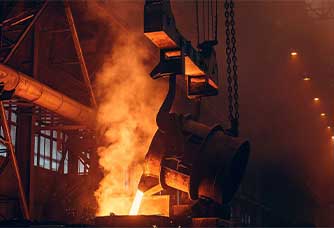
Loss of Corrosion Resistance Above 500°C
Corrosion resistance does not drop at one exact temperature. In some austenitic grades, long exposure at about 425-860°C can cause chromium carbides to form along the grain boundaries.
This can reduce the amount of chromium in nearby areas and increase the risk of intergranular corrosion when the steel is later exposed to a corrosive environment. Low-carbon and stabilized grades are used when this is a concern.
Thermal Expansion and Deformation
Stainless steel at high temperature expands, and its strength drops. Austenitic grades usually expand more than ferritic ones. If a hot part stays under load for a long time, it can slowly change shape. This gradual deformation is called creep.
Heat resistant stainless steel can still fail because of creep, thermal fatigue, embrittlement, carburization and sulfidation. Sulfur gases, reducing atmospheres, molten salts and combustion products also shorten service life.
Common Applications of Heat Resistant Stainless Steel
Furnaces, radiant tubes, burners, heat-treatment baskets, boilers, kilns, ovens and exhaust systems are typical uses. A high temp stainless steel grade used in this equipment needs to handle heat without oxidizing too quickly or losing too much strength.
Grades 309 and 310 are common around 900°C and above. Grades 304 and 316 are usually used at lower temperatures. Grade 446 is often used for its low thermal expansion and good scaling resistance when creep strength is not the main concern.
How to Choose Heat Resistant Stainless Steel for Your Application?
The choice starts with the temperature the part will actually see in service. Whether stainless steel can withstand high heat also depends on how long it stays hot and what happens under load. A short temperature spike is very different from hours of service under load. Repeated heating and cooling, along with the atmosphere around the part, can also affect performance.
Grades 304 and 316 are commonly used at moderate temperatures. Once temperatures move toward 900-1,000°C, 309 and 310 become more suitable. Grade 446 can be useful where oxidation is the bigger issue and the mechanical load is limited.
.jpg "Saksham Enterprises: Optimizing Mission- Critical HVAC Infrastructure For The High Precision Sector")

.jpg "JDS Group of Companies: Innovating Smart Solutions For Modern Power Transmission & Distribution Infrastructure")




We use cookies to ensure you get the best experience on our website. Read more...