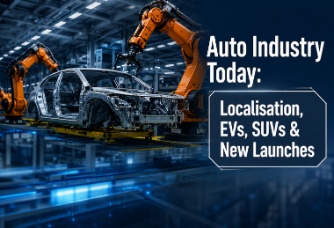
Today’s automotive developments were led by fresh momentum in localisation, electric mobility, advanced technologies and new vehicle launches, as automakers and policymakers outlined plans to strengthen India’s position in the global mobility industry.
Hisashi Takeuchi, MD & CEO, Maruti Suzuki India, called for deeper localisation across the automotive supply chain, while HD Kumaraswamy, Union Minister for Heavy Industries and Steel, highlighted fresh investments and job creation under the auto PLI scheme.
Tarun Garg, MD & CEO, Hyundai Motor India, outlined plans to expand SUVs and EVs and strengthen technology capabilities. Meanwhile, Mitsubishi Motors unveiled its new Pajero, and Vinod Sahay, President – Trucks & Buses, SML Mahindra, shared plans for commercial vehicle growth and electric buses.
Here’s a look at today’s biggest automotive stories.
Maruti Suzuki India MD and CEO Hisashi Takeuchi has called for deeper localisation across the automotive supply chain as global sourcing networks are being restructured.
Speaking at the 66th ACMA Annual Session, he said reliability and continuity have become increasingly important following semiconductor shortages and geopolitical disruptions.
India can use its domestic market, exports and government initiatives to build stronger local capabilities. He also stressed that localisation must extend to smaller suppliers, with Tier-2 and Tier-3 companies strengthening quality, technology and engineering capabilities to meet global standards.
The government’s PLI scheme for automobiles and auto components has attracted ₹45,477 crore in investment and generated more than 67,000 jobs as of June 30, 2026.
The government has also increased support for electric two-wheelers to ₹11,900 crore and allocated ₹4,391 crore for electric buses. Additional measures covering battery storage, charging infrastructure and rare-earth magnets are aimed at strengthening domestic capabilities and supporting India’s ambitions in advanced and green mobility technologies.
“India should help lead the mobility transition.” — HD Kumaraswamy, Union Minister for Heavy Industries and Steel
“Create, engineer and innovate in India.” — Vikrampati Singhania, President, ACMA
Mitsubishi Motors has unveiled the redesigned Pajero, marking the nameplate’s biggest overhaul in two decades.
The new SUV gets a 2.4-litre clean diesel engine producing 480 Nm of torque, paired with an eight-speed automatic transmission. It also introduces upgraded off-road technology, including Super-All Wheel Control and seven selectable drive modes.
The three-row SUV features an eight-airbag package, new driver-assistance systems and a more premium interior. The model will launch first in Thailand, followed by Japan and Australia, before Mitsubishi expands it to nearly 100 countries from fiscal 2027.
“The all-new Pajero brings our 2030s vision to life.” — Keisuke Kishiura, President & COO, Mitsubishi Motors
India’s auto component industry is being urged to move beyond manufacturing scale and strengthen technology ownership. At the ACMA convention, Hisashi Takeuchi said deeper localisation can reduce exposure to global disruptions, while Tarun Garg called for domestic capabilities in semiconductors, EV battery cells, rare-earth magnets and power electronics.
SIAM President Shailesh Chandra stressed that India needs a wider approach covering raw materials, processing and final systems. India needs greater participation from smaller suppliers as India seeks a stronger position in global automotive supply chains.
“We need a comprehensive approach across the value chain.” — Shailesh Chandra, President, SIAM & MD, Tata Motors Passenger Vehicles
Hyundai Motor India is preparing two new SUVs, including a dedicated EV, as it seeks to regain the number-two position in India’s passenger vehicle market. Hyundai Motor India, MD and CEO Tarun Garg, said the new models should help the company maintain momentum despite a high base effect in the second half of the fiscal year.
Hyundai plans to launch a new mid-sized SUV during the festive season, followed by a sub-four-metre electric SUV. The company is also expanding manufacturing capacity, while its SUVs continue to gain traction in rural markets, where penetration reached a record 26% last quarter.
SML Mahindra is targeting a 10–12% share of India’s commercial vehicle market by FY31, up from around 7.2% currently. The company also aims to cross 20% by FY36.
The company is also preparing to increase electric mobility in its bus portfolio. SML Mahindra and Mahindra & Mahindra together sold around 16,000 buses last year.
“At least 10% of our buses can become electric in a couple of years.” — Vinod Sahay, President – Trucks & Buses and Executive Chairman, SML Mahindra

We use cookies to ensure you get the best experience on our website. Read more...