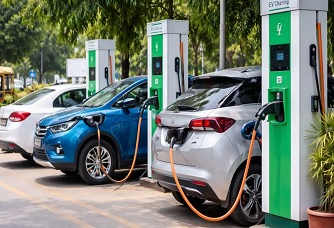
Facing one of the worst air pollution crises in the world, the Delhi Government has unveiled the Draft Electric Vehicle (EV) Policy 2.0, aiming to accelerate the shift to clean mobility while directly addressing the capital’s declining air quality.
The draft marks a decisive shift in approach—from incentivizing electric vehicles to enforcing their adoption through phased restrictions and regulatory mandates.
Delhi’s air quality continues to remain in the “poor” category for much of the year. The city recorded an average Air Quality Index (AQI) of around 191 in 2025, while winter levels frequently cross 300, entering the “very poor” zone.
Vehicular emissions account for nearly 23 percent of total air pollution, making transport one of the largest contributors. Despite seasonal relief from rainfall or wind, pollution levels rebound quickly, pointing to deep structural issues.
The earlier EV policy (2020–2023) focused on subsidies and awareness, with a target of 25 percent electric vehicle adoption in new registrations. The new draft significantly raises ambition, aiming for up to 95 percent of new vehicle registrations to be electric by 2027. This places Delhi among the most aggressive jurisdictions globally in terms of EV transition.
At its core, the policy seeks to link transport reform with air quality improvement. By targeting high-emission vehicle segments and expanding infrastructure, it attempts to create a system-wide shift that could have a measurable impact on AQI levels over time.
Also Read: Top Industrial Automation Companies in India
Key Provisions of Draft EV Policy 2.0
New petrol two-wheelers to be banned from 2028
Gradual phase-out of CNG auto-rickshaws
Up to 95 percent of new vehicle registrations to be electric by 2027
Continued support for electric two-wheelers, e-autos, and commercial EVs
Subsidies linked to battery capacity and efficiency
100 percent road tax exemption for EVs (up to INR 30 lakh)
Additional incentives for women buyers and scrapping old vehicles
Up to INR 50,000 support for retrofitting petrol/diesel vehicles
Incentives limited to Delhi residents to prevent misuse
E-commerce and delivery companies required to transition to EVs
Ride-hailing aggregators to electrify fleets in phases
Charging stations at regular intervals across the city
Mandatory charging points in new buildings
Expansion of battery swapping networks
Dedicated framework for EV battery recycling and disposal
Acknowledging the policy’s focus on structural change, industry leaders have welcomed the draft as a necessary intervention in Delhi’s pollution crisis. Raman Bhatia, Managing Director of Servotech Renewable Power System, said the policy reflects a long-overdue shift in approach.
“Servotech gladly welcomes the Delhi EV Policy 2.0, which has been a long-overdue emergency response to the toxic air our national capital breathes. For years, we’ve treated air pollution as a seasonal headline, but as someone deeply embedded in the green energy sector, I see it as a systemic failure of our mobility habits. The true hero of this policy isn’t the subsidies but the mandatory transition for two-wheelers and commercial fleets. We are finally moving past the choice of going green to the necessity of being clean.”
He further added, “We’ve realized that range anxiety is just a symptom of infrastructure apathy. As an EV charger manufacturer, I believe that by mandating chargers at every dealership and pushing for 18,000 points and introducing attractive EV schemes like no road tax and registration fee, the government is finally aligning the hardware with its long-term vision for the capital.”
“Furthermore, this policy will significantly benefit the cab and 3 wheeler fleet industry, an integral part of the state's mobility ecosystem by significantly reducing their daily operating costs after transitioning to electric. Moreover, the scrapping incentives will be another great catalyst in purging the capital's oldest polluters. We can no longer afford to let internal combustion engines turn our capital into a gas chamber. This policy shifts the burden from the individual to the ecosystem. The era of fossil fuels is over, we are now building a Delhi that breathes clean and green,” he said.
.jpg "Precise Fasteners: Committed To Fulfilling Client Expectations, Every Time!")


We use cookies to ensure you get the best experience on our website. Read more...