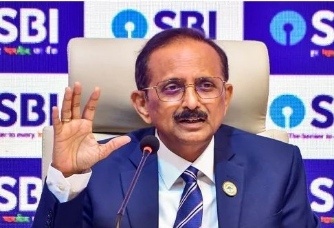
State Bank of India (SBI), the country’s largest lender, has outlined a forward-looking strategy that positions the banking sector as a central enabler of India’s Viksit Bharat vision. SBI, Chairman C S Setty emphasised that the bank is not only witnessing an inflection point in growth but also carrying the responsibility of supporting national economic transformation through capital mobilisation, financial inclusion, and infrastructure financing.
Setty highlighted that SBI’s strategic direction will remain anchored in a “Digital First, Customer First” approach—an articulation that reflects the bank’s intent to deepen its technology-led transformation while preserving its relationship-driven legacy.
The bank plans to continue investing heavily in artificial intelligence, data analytics, cybersecurity, and digital infrastructure, aiming to build a more agile and intelligent banking ecosystem capable of responding to evolving customer expectations.
The statement comes on the back of what SBI described as a landmark financial year, where it strengthened its leadership across key segments while accelerating its shift into a technology-driven financial institution. While the report does not dwell on short-term metrics alone, it signals a structural pivot in how India’s largest bank is preparing for the next decade.
Also Read: Is Digital Lifeline of India at Risk? The Undersea Cable Chokepoints
One of the defining elements of SBI’s roadmap is its attempt to strike a balance between digital acceleration and physical presence. Even as digital banking gains momentum, Setty acknowledged that branch networks will continue to play a critical role, particularly in a country like India where trust and accessibility remain key determinants of banking relationships.
The bank’s approach is to integrate both ends—leveraging the speed and convenience of digital platforms while retaining the credibility and reach of physical branches. This omni-channel model is expected to deliver more seamless and intuitive customer experiences, especially as the bank scales its services across diverse demographic segments.
Initiatives such as Project SARAL are central to this transformation. By focusing on process re-engineering, standardisation, and automation, the bank aims to reduce turnaround times, simplify operations, and improve service quality. The emphasis here is not just on digitization, but on operational efficiency as a competitive differentiator.
Beyond technology, SBI’s growth blueprint places significant emphasis on strengthening its liability franchise. The bank is targeting a more granular and stable deposit base, which remains critical in a rising interest rate and competitive liquidity environment.
Setty pointed to emerging opportunities in digital onboarding, transaction banking, SME ecosystems, and relationship-led solutions. These segments are not only high-growth areas but also align with India’s broader economic priorities—supporting small businesses, expanding credit access, and deepening financial penetration.
At the same time, SBI is looking to scale its wealth management and advisory services, leveraging technology-enabled engagement models to build deeper, long-term relationships with customers. This reflects a shift from transactional banking to lifecycle-based financial engagement, where customer retention and value creation become as important as acquisition.
Also Read: 8 Global Trends Shaping the Asset Management Industry
SBI’s strategy signals a broader shift in India’s banking landscape—where scale, while still important, is no longer sufficient on its own. The competitive edge is increasingly defined by how effectively banks can combine technology, trust, and execution.
What stands out in SBI’s roadmap is the recognition that digital transformation is not just about adopting new tools but about restructuring the operating model itself. The integration of AI, data analytics, and automation into core processes indicates a move toward predictive and personalised banking—areas where global benchmarks are rapidly evolving.
However, the challenge lies in execution at scale. Managing a vast customer base while delivering personalised experiences requires not just technology investment but also organisational agility. This is where SBI’s focus on human capital, governance, and risk management becomes critical. The bank has acknowledged that transformation is as much about people and processes as it is about platforms.
Importantly, the alignment with the Viksit Bharat vision adds a macroeconomic dimension to SBI’s strategy. As India pushes toward becoming a developed economy, the role of large financial institutions will extend beyond profitability to include nation-building functions—from funding infrastructure to enabling entrepreneurship.





.jpg "Building EV Bus Ecosystems for India's Clean Mobility Goals")
We use cookies to ensure you get the best experience on our website. Read more...