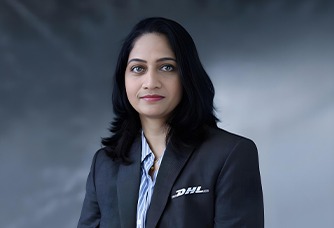
Anjali Bhadbhade, Chief Financial Officer of DHL Express India, in an exclusive interaction with Thiruamuthan, Assistant Editor at Industry Outlook, discusses how CFOs in logistics balance technology adoption with compliance and governance controls. She also highlights strategies for enhancing cash flow visibility, leveraging ESG-linked financing for sustainability, and building financial models to anticipate disruptions, ensuring resilience in a rapidly evolving landscape. With over 20 years of experience, Anjali Bhadbhade specializes in financial strategy, governance, and operational efficiency. She is highly skilled in cash flow optimization, risk management, and ESG-linked financing, with a proven track record of driving financial growth and sustainability.
With automation and digital tools disrupting transaction-heavy logistics finance functions, how are CFOs prioritizing technology adoption without compromising on compliance and governance controls?
As CFO, my role is to strike the right balance between embracing disruption and safeguarding financial discipline. For us, technology adoption is not just about efficiency it is about building resilience and enabling smarter decision-making without compromising on compliance and governance controls.
For example, under DHL Group’s Strategy 2030, profitability will be driven through disciplined execution and yield management, while strong free cash flows are channeled into value-creating investments with healthy ROIC, ensuring that the group not only grows but does so in a way that is financially sound, resilient, and aligned with long-term shareholder value. Globally, DHL Group is also focusing on 20 priority markets that stand to benefit from supply chain diversification and increased investments, and India is one of them.
We are strengthening our digital platforms, rolling out AI-driven route optimization, and exploring automation tools to enhance productivity. In the finance function specifically, these tools help us manage transaction-heavy processes with far greater accuracy, transparency, and speed, but always within a framework of robust governance. For me, the key is to enable our teams with the right tools, infrastructure, and financial flexibility so they can deliver excellence every single day.
The logistics industry in India is entering a phase where speed, transparency, and sustainability will be the differentiators. My focus is on making sure we stay ahead of that curve leveraging digital disruption to build competitive advantage while keeping compliance and governance at the heart of everything we do.
Technology adoption is not just about efficiency; it’s about building resilience and enabling smarter decision-making without compromising on compliance and governance controls.
Since working capital cycles are critical in logistics, especially with extended receivables from large clients, how are CFOs driving cash flow visibility and liquidity optimization?
Given the extended receivable cycles and high working capital intensity typical of the logistics sector, CFOs are strengthening cash flow visibility and liquidity discipline through a combination of digital tools, governance, and cross-functional alignment. Real-time dashboards integrated with ERP/TMS systems now enable daily monitoring of collections, payables, and liquidity positions, while AI-enabled forecasting models enhance predictability by analyzing customer payment behavior and operational volume patterns.
To reduce DSO, CFOs are implementing tighter receivables governance, automated aging alerts, and faster dispute resolution through accelerated billing. Collection strategies are increasingly segmented, with structured engagement for strategic accounts and automation for mid-tier customers, complemented by early payment incentive programs. On the payables side, supply chain financing and improved vendor term negotiation are helping to synchronize cash outflows with inflows.
Centralizing treasury operations allows organizations to pool liquidity, optimize FX management, and reduce borrowing costs. Multibank digital connectivity further enhances visibility, enabling informed intraday decisions. Alongside this, pricing and contract governance—supported by cost to serve analytics—ensure commercial decisions protect margin and cash generation. Finally, regular scenario planning and stress testing provide CFOs with a forward-looking view of liquidity needs, helping establish robust buffers in a volatile operating environment.
Also Read: How the China+1 Shift Is Redefining Indian Logistics Networks
Given that ESG-linked financing is gaining traction in India, how are CFOs in logistics preparing to align financial decisions with sustainability metrics and reporting obligations?
As CFO, I see it as my responsibility to ensure that our financial decisions not only deliver value to the business but also align with our long-term commitments to the society. At DHL Express, sustainability is not an afterthought, it is built into the Group’s Strategy 2030, where we aspire to be the “green logistics of choice”. This is one of our four bottom lines, and we are proud to be the first logistics company in the world to set a target of reducing our greenhouse gas emissions to net zero by 2050.
In the year 2021, we have committed to reducing our greenhouse gas emissions from 40 million metric tons to under 29 million metric tons by 2030. We are also targeting to achieve at least 30 percent blending of Sustainable Aviation Fuels (SAF) by 2030, electrify 66 percent of our last-mile delivery vehicles within the same timeline, and ensuring that all new facilities are designed to be carbon neutral. These are not just environmental goals they are financial imperatives as well, because the capital allocation, investment decisions, and financing structures we choose today must support this transformation.
From a CFO’s perspective, ESG-linked financing plays an important role in enabling this journey. Decisions on investing in sustainability are always given priority whenever the solution is viable and commercially sensible. More importantly, tying financing to measurable ESG outcomes creates the accountability and transparency that stakeholders increasingly expect. For us, it means embedding sustainability metrics into our reporting, making them as central to our performance evaluation as revenue or profit.
In many ways, DHL has been prioritizing sustainable logistics long before it became the necessity it is today. Now, with ESG-linked financing gaining traction in India, we see an opportunity to further integrate sustainability into the way we fund and grow our business making sure every rupee invested today contributes to building a cleaner, more resilient future for logistics tomorrow.
As risk exposure grows with global supply chain interdependencies, how are CFOs building financial models that anticipate disruptions rather than just reacting to them?
Risk management today goes far beyond protecting the balance sheet it is about building financial models that anticipate disruption, safeguard trust, and create resilience for the long term. At DHL Express India, compliance is not just a regulatory requirement; it is the cornerstone of our operational integrity and customer confidence.
The risks we navigate are increasingly multi-dimensional. On one hand, there are complexities in developing processes and systems while remaining compliant. On the other hand, risks extend into data privacy, trade documentation, and cybersecurity. For us, anticipating disruption means embedding these risks directly into financial planning and governance models, so that we do not simply react to issues but remain prepared for them.
We remain fully compliant with India’s Digital Personal Data Protection (DPDP) Act, and as a Europe-headquartered company, we have long adhered to GDPR standards. This dual compliance framework ensures consistency across borders and reassures our customers that we handle their data in a compliant manner. To support this, we have a global, regional, and country-level Data Protection Organization, and a dedicated Data Protection Council made up of cross-functional representatives from commercial, HR, customer service, and other teams. These members are trained to process data responsibly, ensuring privacy norms are upheld across every interaction.
From a security perspective, our early adoption of electronic customer solutions allowed us to build robust safeguards like data encryption, firewalls, and ISO-certified global data centers. Beyond systems, we embed security into culture: every DHL Group employee undergoes regular mandatory training on data security and privacy, while compliance and data protection modules are integrated into our Certified International Specialist program. This ensures our workforce stays aligned with global best practices.
Also Read: How Integrated Logistics Hubs Are Reshaping Regional Trade
Looking ahead, with data-driven finance expected to dominate decision-making, what new priorities will define the role of the logistics CFO over the next five years?
The next five years will be a defining period for finance leadership in logistics. The role will be shaped not just by capital efficiency but also by our ability to embed sustainability and data intelligence into every financial decision. CFOs are increasingly leveraging domestic credit, synthetic derivatives, and green financing tools such as ESG-linked loans to lower capital costs.
This becomes even more critical as India strengthens its role in global supply chains. Interestingly, according to a DBS report, 63 percent of Indian businesses view enabling ‘green initiatives and complying with green standards’ as a high priority. Additionally, in the same report, 63 percent also place equal emphasis on capital cost optimization. For us, these are not competing priorities; they go hand in hand.
The shift towards enabling ESG and sustainability compliance is another defining trend. Nearly 80 percent of Indian finance leaders today are tapping instruments like green bonds and ESG-linked loans, particularly in consumer and tech sectors where rising energy needs and investor scrutiny are high. India’s ESG debt market itself has reached cumulative issuance of USD 55.9 billion by the end of 2024, supported by stronger regulatory standards and improved disclosures. This creates a more credible, transparent landscape for sustainable finance, which directly supports DHL’s Strategy 2030 goals of decarbonization and sustainable growth.
The other change will be driven by data. As logistics CFOs, we are increasingly relying on data visualization, real-time monitoring, and predictive analytics to guide capital allocation and working capital efficiency. For me, this is about shifting finance from being backward-looking to being proactive and forward-looking anticipating risks, optimizing liquidity, and ensuring financial flexibility to support both growth and resilience.




.jpg "Building EV Bus Ecosystems for India's Clean Mobility Goals")
We use cookies to ensure you get the best experience on our website. Read more...