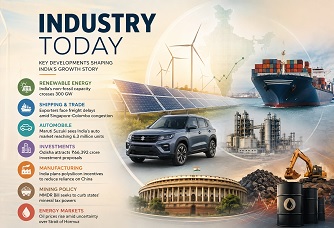
India’s industrial landscape begins the day with developments across energy, manufacturing, automobiles, trade, mining, and investment.
Renewable energy continues to expand, while policy measures target domestic manufacturing and resource security. The automobile sector is preparing for stronger demand, led by small cars and SUVs.
Meanwhile, global shipping disruptions and oil market uncertainty are creating fresh challenges for businesses. Here are the key industry developments shaping business priorities and market conditions today.
India’s non-fossil power capacity has crossed 300 GW, reaching 60% of its 2030 target. Solar leads the transition with 164.59 GW, followed by wind and hydropower. Non-fossil sources now represent more than 54% of India’s total installed generation capacity. The country added 55.29 GW of non-fossil capacity during 2025-26.
Congestion at Singapore and Colombo is creating delays for Indian exporters and disrupting transshipment schedules. A surge in China-US trade has also reduced container availability across several global routes. Freight rates have risen sharply, adding pressure on exporters facing longer transit times. Some containers are reportedly waiting 15-20 days at Singapore before reaching Indian ports.
Maruti Suzuki expects India’s passenger vehicle market to reach 6.1-6.3 million units annually by FY31. The company expects renewed small-car demand alongside continued growth in SUVs. Maruti is expanding production capacity across its Haryana and Gujarat facilities. Its new Sanand plant involves a planned investment of ₹35,000 crore.
Odisha has attracted investment proposals worth ₹66,392 crore during its two-day business outreach in New Delhi. The proposals could generate around 54,135 jobs across several industrial sectors. The state signed 38 MoUs involving investments worth ₹64,703 crore. Investment intention forms worth another ₹1,689 crore were also received.
India is preparing incentives to strengthen domestic polysilicon manufacturing and reduce import dependence. Polysilicon is a critical raw material used in solar photovoltaic cells and modules. The initiative aims to strengthen India’s upstream solar manufacturing capabilities. It also supports broader efforts to build a more resilient domestic clean-energy supply chain.
Also Read: From Mining to Metals: Strengthening India's Steel Value Chain
The Centre is set to introduce the Mines and Minerals Development and Regulation Amendment Bill, 2026. The proposed legislation seeks to restrict state taxes and levies on mineral rights and mineral-bearing lands. It would bring the regulation of mineral-bearing lands under greater Union government control. The move follows a wider debate over state powers to tax mineral resources.
Oil prices rose as uncertainty continued over the reopening of the Strait of Hormuz. Iran has indicated progress toward a deal with Oman but has attached additional conditions. Brent crude rose 1.09% to $84.46 per barrel, while WTI gained 0.78%. The waterway previously carried about one-fifth of global oil supplies.
The latest industry developments highlight both expansion opportunities and emerging operational risks. Renewable capacity and manufacturing investments continue to strengthen India’s industrial base. Automobile demand also shows signs of broader recovery, supported by changing consumer preferences. However, shipping disruptions, mineral policy changes, and energy market volatility remain key factors. Businesses will need to monitor these developments closely while assessing costs, supply chains, and investment plans.
.jpg "Industrial Packers: Engineering Industrial Packaging for India's Manufacturing Future")





We use cookies to ensure you get the best experience on our website. Read more...