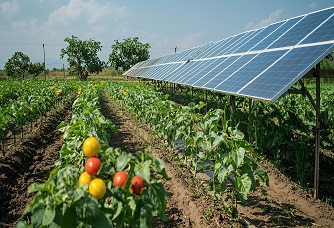
India is preparing a new policy to expand agrivoltaics capacity and help farmers earn additional income. The government aims to combine farming with solar power generation on the same land. It is initially targeting 5 gigawatts (GW) of capacity over the next few years.
Union Minister for New and Renewable Energy Pralhad Joshi announced the government’s plans at the Agrivoltaics World Conference 2026 in New Delhi on October 21. The proposed policy will support the adoption of agrivoltaics, which allows farmers to continue cultivation while generating electricity from elevated solar panels.
Ministry of New and Renewable Energy (MNRE) Secretary Santosh Kumar Sarangi said the policy draft would be made available for public consultation. States and other stakeholders will be invited to submit suggestions before the government makes further changes.
According to the government, around 30 percent of India's 160 million hectares of cropland could be suitable for agrivoltaic projects. The technology could also address land constraints as India expands its renewable energy infrastructure.
Joshi highlighted that nearly 85 percent of Indian farmers are small and marginal farmers. Many cannot afford to stop cultivation and dedicate their land entirely to solar power generation.
Agrivoltaics offers a potential solution by allowing both activities to continue. However, the government will need to address project costs to make the technology commercially viable.
The government is also working on a support mechanism to encourage states to adopt the technology. The final structure and implementation details will determine how quickly projects move forward.
Also Read: Decarbonizing Lignite-Based Power Generation in India
Despite its potential, agrivoltaics faces a cost disadvantage compared with conventional solar projects. Elevated structures are needed to keep panels above crops and allow farming activities to continue underneath.
Joshi said agrivoltaic plants cost around 25–30 percent more than conventional ground-mounted solar projects. He estimated that electricity from agrivoltaic installations could cost Rs 3.20 per unit, compared with Rs 2.60 per unit for ground-mounted projects.
The government wants to reduce this cost gap through wider adoption and improved project economics. A proposed central support scheme could help states encourage investment and make projects more commercially viable.
India can also draw lessons from international markets. The global agrivoltaics market had surpassed 18.4 GW of installed capacity, according to Joshi.
Germany has also expressed interest in supporting joint research in India. German Ambassador to India and Bhutan Jasper Wieck said collaborative research at pilot sites would examine how farming and solar power generation can be combined economically and sustainably.
With the proposed policy and the next phase of PM-KUSUM, India is seeking to expand clean energy generation without sacrificing agricultural land use. The success of the initiative will depend on state participation, suitable project designs, and measures to make agrivoltaics affordable for farmers.







We use cookies to ensure you get the best experience on our website. Read more...