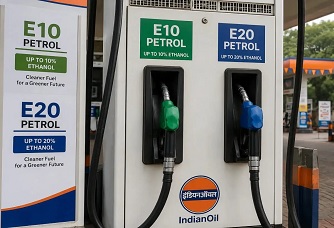
The government has admitted that E20 petrol is currently costlier to produce than pure petrol. The higher production cost is linked to current global crude oil prices.
However, the Centre said E20 petrol remains an important part of India's energy strategy. It believes the fuel will reduce oil imports, improve energy security, and protect consumers from future crude price shocks.
The clarification came from the Ministry of Petroleum and Natural Gas through a detailed set of frequently asked questions on the Ethanol Blended Petrol Programme. The ministry explained that the economics of ethanol depend on global crude oil prices. It said the current price of crude makes E20 more expensive. However, that situation can change if crude prices rise sharply.
"Therefore, if international crude oil is trading at around USD 70 per barrel, E20 is actually costlier to produce than pure petrol. If crude rises to USD 120-130 per barrel, the economics naturally reverse and ethanol becomes even cheaper," the ministry said.
The ministry said maize-based ethanol is currently procured at around Rs 71.86 per litre. This price excludes GST, transportation, storage, and depot handling charges.
According to the ministry, if international crude oil prices remain around USD 70 per barrel, E20 costs more to produce than pure petrol.
However, the calculation changes when crude becomes expensive.
The ministry said if crude prices rise to around USD 120-130 per barrel, ethanol becomes the cheaper option. That would make E20 more economical than pure petrol.
Officials stressed that current costs should not be viewed in isolation. They said the blending program offers long-term benefits that go beyond today's fuel prices.
Also Read: Ethanol Epidemic in India: Factory Pollution, Vehicle Problems & More
The government said nearly 20 percent of every litre of petrol sold today contains domestically produced ethanol.
This has reduced India's dependence on imported crude oil. It also shields part of the fuel cost from sudden movements in global oil markets.
The ministry said the key question is not whether E20 is currently costlier. Instead, it is how India managed to reduce the impact of volatile global oil prices on consumers.
The government believes the ethanol blending program has already delivered significant benefits.
Some major achievements include:
Officials said these gains support India's long-term energy and economic goals.
The ministry said the shift to E20 did not happen overnight.
India has followed a phased approach for more than two decades. During this period, the government held consultations with automobile manufacturers, oil marketing companies, testing agencies, and other stakeholders.
The ministry said these discussions helped ensure a smooth transition before wider implementation.
Looking ahead, the government expects energy security to improve further through higher ethanol blending.
It believes the program will:
The clarification comes amid questions over the cost of E20 fuel. While the government accepts that E20 is currently more expensive than pure petrol, it maintains that the program offers strong long-term economic and strategic benefits. Officials believe those benefits will become even more visible if global crude prices rise in the future.







We use cookies to ensure you get the best experience on our website. Read more...