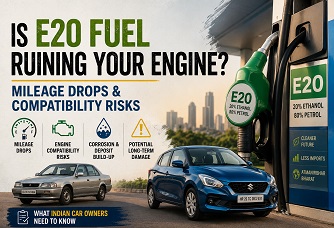
E20 fuel is now the default petrol at Indian pumps, and it has split opinion sharply. This ethanol-petrol blend contains 20% ethanol and 80% petrol.
India has hit this target in 2025-26, which is five years early. The rollout promises cleaner air and lower oil imports, but it has also triggered a wave of E20 fuel problems reported by everyday drivers.
Owners of older cars and bikes describe rough idling, stalling, and rusted fuel components, while automakers insist their vehicles are running fine.
Mechanics in several states tell a different story, describing a steady rise in ethanol-linked complaints at their workshops. Hence, this has created a genuine consumer dilemma.
With all this, real environmental gains sit on one side and real mechanical uncertainty on the other. That uncertainty is sharpest for vehicles built before April 2023.
"Modern ethanol producing facilities have adopted strict environmental mandates to curb pollution such as zero liquid discharge among other pollution control measures. However, older facilities must ensure required upgrades are made to achieve compliance. Govt. Should incentivize retrofit upgrades where return on capex spend is an issue but ultimately, environmental performance will depend on operational discipline and regulatory oversight." - Vinayak, Former Director - Cairn Energy and Advisor - Pinaka Green.
This article breaks down what E20 actually does to your engine and your fuel bill. It covers compatibility risks, mileage math, and practical protection steps. It also looks at where ethanol blending issues in India are headed next.
Ethanol is hygroscopic, meaning it actively absorbs moisture from the air rather than staying inert like petrol. That absorbed water can settle inside a fuel tank over time, especially in vehicles that sit idle for days.
The moisture that builds up corrodes aluminum components and hardens rubber gaskets over repeated cycles. It also degrades older fuel lines that were never designed with ethanol contact in mind. E20 engine compatibility depends heavily on when a vehicle was built, and what materials went into it.
The clearest dividing line is April 2023. Vehicles manufactured after this date fall under BS6 Phase 2 rules and arrive factory-tuned for E20 from day one. They use ethanol-resistant seals, coated fuel lines, and recalibrated engine control units built in at the factory.
Hero MotoCorp's Chief Business Officer Ashutosh Verma, points to the company's own service records as proof. He cites "no incidence whatsoever" of higher damage linked to E20.
Former Indian Oil Corporation Chairman B Ashok has made a similar argument. He notes that scientific studies so far have found no evidence that E20 meaningfully shortens engine life.
Not everyone on the ground agrees the picture is this clean, though. Workshop owners in Tamil Nadu and Kerala describe a noticeably different reality. Older cars are arriving for service with corroded rubber parts and rusted fuel components. BS6 E20 compliance on paper, in short, does not always match what mechanics see in their bays.
Ethanol carries roughly 33% less energy density 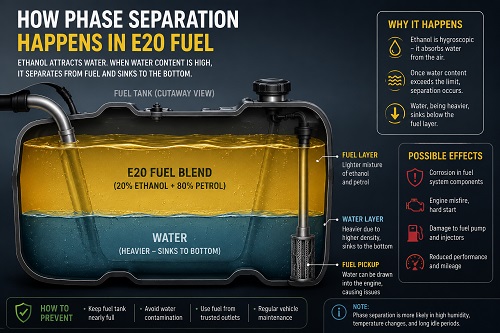 than pure petrol, which is basic fuel chemistry rather than speculation. Burn equal volumes of ethanol and petrol side by side, and ethanol simply releases less usable energy per litre.
That gap is the root cause behind every reported E20 fuel mileage drop. The exact size of the drop, though, remains fiercely contested depending on who is measuring it.
SIAM's controlled studies point to a modest 2% to 4% dip. Some carmakers privately cite a steeper 7% to 8% figure instead. The government's own official estimate settled somewhere in between, at 3% to 5% for most cars.
A NITI Aayog explainer breaks this down further by vehicle type. Four-wheelers calibrated from petrol to E20 lose roughly 6% to 7%, while two-wheelers lose a smaller 3% to 4%.
|
Source |
Reported Mileage Drop |
Vehicle Type |
|
SIAM (controlled testing) |
2% to 4% |
Mixed fleet |
|
Government of India (official estimate) |
3% to 5% |
Cars, pre-2023 |
|
Carmaker estimates (industry-cited) |
7% to 8% |
Petrol cars |
|
NITI Aayog explainer |
6% to 7% |
Four-wheelers |
|
NITI Aayog explainer |
3% to 4% |
Two-wheelers |
|
Consumer survey (LocalCircles) |
Up to 20% (self-reported) |
Mixed fleet |
The financial impact adds up quietly but steadily over the years. A car doing 20 km per litre, covering 10,000 km a year, burns roughly 500 litres of petrol. At a 3% mileage loss, that owner pays roughly Rs 1,580 more each year. Over a decade, that gap climbs close to Rs 15,800. At a 5% loss, it crosses Rs 26,000. This is why mileage sits right at the centre of the E20 fuel mileage drop debate, alongside safety.
Also Read: How LiDAR, Thermal & UV Payloads Revolutionize Power Transmission
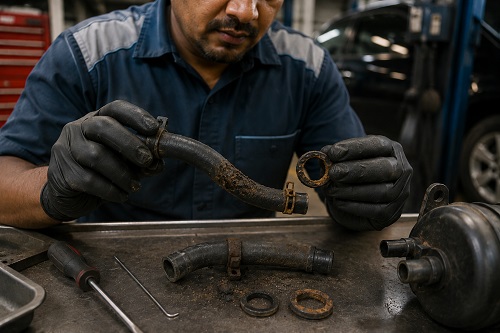 Beyond mileage, drivers across India describe a fairly consistent set of symptoms. Not every mechanic sees the exact same pattern. Manufacturers often trace complaints back to vehicle age or contaminated fuel instead. Still, the frequency of similar reports across unrelated cities is hard to dismiss outright. Commonly reported symptoms include:
India's most-followed daily vlogger, Sourav Joshi, set off a fresh wave of debate on 13 July. He claimed his Mercedes-Benz GLC 300's mileage had crashed from 17 kmpl to just 5 kmpl within two days. He linked the drop directly to E20 petrol, saying the experience had made him wary of refuelling altogether. The clip went viral within hours and reignited the wider argument over ethanol's real-world impact on premium engines.
Mercedes-Benz India responded quickly, confirming that all its BS VI petrol vehicles are certified as E20-compatible. It urged customers not to draw conclusions without a proper technical check first. Joshi took his car to an authorized service centre soon after. Within a day, he issued a public clarification. The mileage drop, he said, had come from an unrelated engine fault, not from E20 fuel. He apologized for the confusion.
A separate viral video showed a Toyota Innova Hycross stalling shortly after a fill-up. The owner blamed E20 petrol for the sudden malfunction, and the clip spread quickly online. Toyota Kirloskar Motor investigated the vehicle and found the fuel system itself was undamaged. Its technical assessment instead pointed to contaminated fuel at the pump as the real cause. Once the tank and fuel lines were drained, cleaned, and refilled, the car ran normally again.
Cases like this cut both ways in the wider debate. They show some E20-linked complaints trace back to fuel quality at the pump rather than the ethanol blend itself. They also explain why owners with real breakdowns get frustrated by blanket dismissals of every complaint.
Owners of pre-2023 vehicles are not 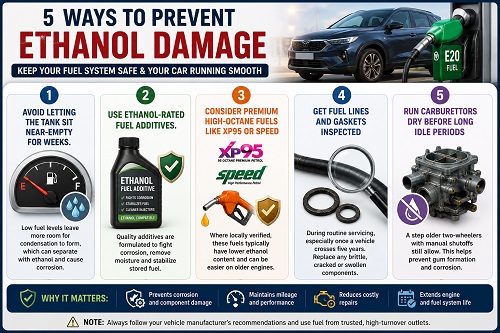 without options here. A few practical habits can meaningfully reduce ethanol-related wear over time. These steps mostly focus on limiting moisture buildup and catching early warning signs before they turn costly.
R. Ramachandran, former Director (Refineries) at BPCL, backs a maintenance-first approach over a fuel-first one. He argues mileage variation often owes more to upkeep, tyre pressure, and driving habits than to ethanol content alone. Regular servicing, in his view, may matter just as much as the fuel choice itself.
India's ethanol push shows no sign of slowing down despite the ongoing arguments. In June 2026, the government formally legalised E85 and E100 as vehicle fuels. Union Minister Nitin Gadkari signed the amended rules on June 13. Maruti Suzuki responded quickly with the WagonR Flex-Fuel, India's first passenger car built to run on up to E85. Hero MotoCorp rolled out flex-fuel versions of the Splendor+ around the same time.
Flex-Fuel Vehicles, or FFVs, use corrosion-resistant fuel systems and ethanol-blend sensors that adjust automatically to whatever blend is used. This lets them run safely on anything from pure petrol to E100. Maruti Suzuki's MD and CEO, Hisashi Takeuchi, ties this shift to national priorities and cutting oil imports. SIAM estimates this hardware adds Rs 17,000 to Rs 25,000 per car, less for a bike.
For existing E20-compliant vehicles, nothing changes immediately. But the direction of travel is unmistakable, with India moving from blended petrol toward a genuine multi-fuel ecosystem. E85 pump infrastructure is targeted to reach 5,000 outlets by December 2027.
Is E20 fuel safe for cars made before 2023?
Most manufacturers say pre-2023 vehicles can run on E20 without immediate failure. Some owners may see reduced mileage and should monitor fuel-system components more closely.
Does E20 fuel void my car's warranty?
No. SIAM and insurers like ICICI Lombard confirm that compliant E20 fuel does not affect warranty or insurance validity.
Was the Sourav Joshi mileage claim about E20 true?
No. Joshi later confirmed an authorized service check traced the drop to an unrelated engine fault, not E20 fuel.
Editor's Note: This article draws on government statements, SIAM and NITI Aayog data, and named quotes and cases involving automakers, fuel-industry professionals, and consumers. Mileage-drop figures vary by source and have not been settled through independent, long-term government testing.
The Sourav Joshi and Innova Hycross cases were both publicly clarified or investigated, but readers should treat viral vehicle-breakdown claims with caution until manufacturers or service centres confirm the cause.





We use cookies to ensure you get the best experience on our website. Read more...