Five million new cars entering Indian roads in a single year sounds like a fuel demand surge and an emissions problem waiting to happen. The arithmetic appears simple: more vehicles mean more petrol and diesel demand, more tailpipe CO₂, and a harder road to India's climate commitments under its Nationally Determined Contributions. The reality, however, is more complex.
According to a report by Finance Outlook India magazine, passenger vehicle sales surged 36.4% YoY to 4.5 Lakh Units in August - and a growing share of those units no longer run on conventional fuels. For the first time in June 2026, over 40% of all passenger vehicles sold were powered by CNG, hybrid or all. India's EV penetration reached 8.5% in FY2025-26, with total EV sales crossing 24.5 lakh units - up 24.6% year-on-year. The number of new registered electric passenger vehicles sales rose 79% YoY to 148,032 in H1 CY2026.
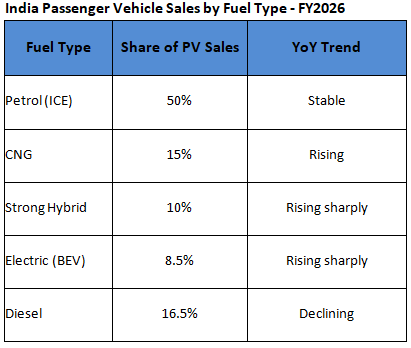
Among conventional fuels, petrol demand is expected to remain broadly stable through 2030, while diesel demand faces structural decline - driven by tightening urban emission norms and the rapid cost competitiveness of CNG and hybrid alternatives. The forthcoming BS7 emissions standard will accelerate this shift further across all price points.
India's Vehicle Scrappage Policy adds another variable. Designed to phase out high-emission older vehicles, implementation has been uneven - Registered Vehicle Scrapping Facilities remain concentrated in select urban centres, and older pre-BS4 vehicles continue operating in semi-urban and rural India, partially offsetting the emissions benefit of cleaner new vehicle sales.
The net assessment: India's 5 million-car milestone does not translate to proportional growth in oil demand and emissions. But decarbonisation goals depend critically on charging infrastructure scaling, scrappage policy execution, and whether the EV vs petrol car sales India ratio keeps improving at FY2026's pace.
.jpg "Energy Industry")
.jpg "Aditya Energy Services: Powering India’s Industrial Transition to a Sustainable Future")

We use cookies to ensure you get the best experience on our website. Read more...