A bigger car market also raises a concerning question: can India’s current infrastructure pace cope up with the growth in personal mobility?
The answer simply lies in a normal response, which means more cars mean greater pressure on road space, parking, highways and urban planning. The challenge becomes even more visible when EVs enter the equation because charging has to be planned alongside homes, offices, commercial centres and highways rather than treated simply as another fuel station. The urban and rural settings also play a real role here.
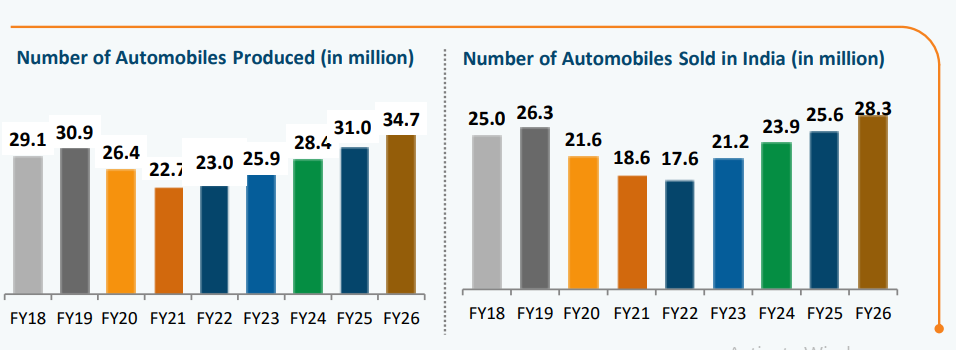
(Source: IBEF)
With that said, the government’s own charging infrastructure push indicates the importance of the requirement. Under the PM E-DRIVE scheme, the Ministry of Heavy Industries has allocated ₹2,000 crore for public EV charging infrastructure, while government data reported 8,414 fast EV chargers for cars as of December 2025, mentioned in the PIB.
So, this is where the India automobile industry growth drivers become much broader than vehicle sales. Manufacturing capacity, components, charging networks, roads and urban mobility systems will all have to develop alongside demand.
The India automotive manufacturing outlook may therefore become strong, but the real challenge will be whether India can build the supporting infrastructure at the same pace as it builds and sells the cars.
.jpg "Energy Industry")
.jpg "Aditya Energy Services: Powering India’s Industrial Transition to a Sustainable Future")





We use cookies to ensure you get the best experience on our website. Read more...