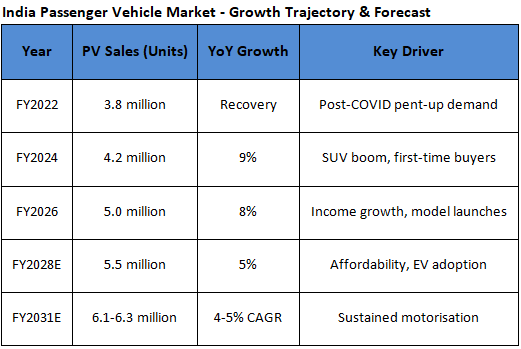
The 5 million-car milestone is remarkable. But headline forecasts invite scrutiny. The path from 5 million to 6 million carries specific structural requirements that are not all guaranteed. Reaching 6.1-6.3 million units by FY31 requires a compound annual growth rate of roughly 4–5% per year - conservative relative to India's recent automotive CAGR of 7–9%. The India car market growth forecast is backed by demographic and income momentum that few markets can match, making this an achievable rather than optimistic projection.
India's car ownership density of approximately 32 cars per 1,000 people - versus roughly 175 in China and 800-plus in the United States - represents the structural demand runway underpinning this outlook. India's vehicles per 1,000 people grew at approximately 10% annually between 2015 and 2020, a pace expected to accelerate with rising GDP per capita. This fundamental underpenetration keeps the India passenger vehicle market outlook 2026 strongly positive and supports the India car sales forecast FY27 and beyond.
Vehicle affordability is the primary risk. Car prices have risen materially due to mandatory safety regulations, BS6 Phase 2 compliance costs, and input cost inflation in semiconductors and battery materials. Entry-level hatchbacks - historically India's volume driver - face substitution pressure from used cars and two-wheelers as aspirational buyers find price points stretched.
The SUV segment, now over 55% of passenger vehicle sales, will continue leading growth - driven by the sub-Rs 15 lakh compact SUV category where Maruti Brezza, Hyundai Venue, Tata Nexon, and Kia Sonet compete intensely. India auto industry capacity expansion - including Maruti's Kharkhoda plant adding up to 1 million units of eventual capacity - and India auto component industry growth in EV and ICE parts will be prerequisites for delivering the 6 million target on schedule.
.jpg "Energy Industry")
.jpg "Aditya Energy Services: Powering India’s Industrial Transition to a Sustainable Future")

We use cookies to ensure you get the best experience on our website. Read more...