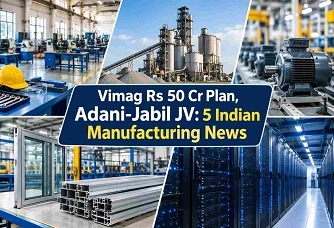
Indian manufacturing is seeing developments across industrial skills, building materials, specialized motor systems and emerging technology hardware.
India’s manufacturing modernization is taking shape through ArcelorMittal Nippon Steel India’s Rs 440-crore initiative to revamp government Industrial Training Institutes (ITIs) and Vimag Labs’ planned Rs 50-crore manufacturing expansion.
Shree Cement has commissioned an additional grinding capacity in the UAE, while LIXIL plans to strengthen its aluminium window production in Hyderabad.
Meanwhile, Adani Enterprises and Jabil have signed a memorandum of understanding for a proposed AI and data center equipment manufacturing joint venture.
Here are five manufacturing developments and their implications for production capabilities and supply chains.
ArcelorMittal Nippon Steel India (AM/NS India) will lead the modernization of nine government ITIs across Gujarat and Andhra Pradesh under the PM-SETU program. The approved investment is Rs 440 crore, with five institutes in Surat and four in Visakhapatnam covered by the initiative.
The project aims to strengthen industrial training infrastructure and align vocational education with the growing manufacturing sector requirements.
For factories, improved practical training can help develop skills in welding, equipment maintenance, machining, industrial safety and quality inspection.
The initiative also highlights the role of industry participation in preparing a workforce capable of operating in an increasingly automated production environment.
Its impact will depend on how effectively the workshops, laboratories and training programs address employers’ actual skill requirements.
Strengthening technical skill development programs can help the Indian manufacturing sector develop a workforce capable of operating modern machinery and maintaining production equipment.
Also Read: How Battery Economics Will Shape Electric Two-Wheeler Profit Margins
Shree Cement has commissioned a 3-million-tonne-per-annum (MTPA) grinding facility at its UAE subsidiary, Union Cement Company, in Ras Al Khaimah, following an investment of around Rs 300 crore. The expansion increases its UAE cement manufacturing capacity from 4 MTPA to 7 MTPA.
The plant uses Gebr. Pfeiffer’s MVR 6000 vertical roller mill technology, which integrates grinding and separation systems. It also incorporates material-handling infrastructure and dust-collection systems intended to improve operational efficiency and reduce energy consumption.
Grinding units process clinker and other constituents into finished cement. Unlike an integrated plant that also produces clinker, a grinding facility can expand downstream production capacity without adding an entire clinker-production line.
Vimag Labs has started manufacturing at its first facility in Jhajjar, Haryana, and has already completed and exported its first production batch. The company plans to invest around Rs 50 crore in a phased manufacturing build-out.
The facility manufactures and assembles motor, control and propulsion systems, including the company's magnet-free motor technology.
Its initial focus is on mid-power motor and control systems, with expansion into higher-power systems planned as customer programs mature.
Vimag has outlined a manufacturing network designed to scale towards 10,000 motor and control systems monthly as customer volumes grow.
The development adds a specialized component manufacturing capability to India's industrial ecosystem, with production scale-up dependent on demand, process validation and supplier development.
LIXIL has announced a 500,000-square-foot window manufacturing facility in Hyderabad, scheduled to begin operations in 2028. The plant will complement the company’s existing manufacturing facility in Manesar, Haryana.
The expansion is expected to increase the local production ratio of its TOSTEM brand from 30 percent to more than 60 percent. The company plans to manufacture pre-engineered aluminium window systems and sliding-door profiles for the Indian market.
Higher local production could improve supply-chain responsiveness and reduce reliance on finished-product imports. Manufacturing these products requires precision cutting, machining, assembly and quality checks to ensure consistent dimensions, fit and performance.
Adani Enterprises and Jabil have signed a non-binding MoU to establish a proposed 50:50 joint venture for AI and data center equipment manufacturing in India.
The agreement remains subject to definitive agreements, approvals and customary conditions.
The planned product portfolio includes AI racks, servers, storage systems, networking equipment, power distribution units, liquid-cooling systems and transformers. The proposed venture is intended to fulfill domestic as well as export markets.
For Indian manufacturing, the opportunity extends beyond just assembling server racks.
It could create demand for precision fabrication, electrical systems integration, thermal management equipment and component suppliers. However, the extent of domestic sourcing and the final production timeline remain to be established.






We use cookies to ensure you get the best experience on our website. Read more...