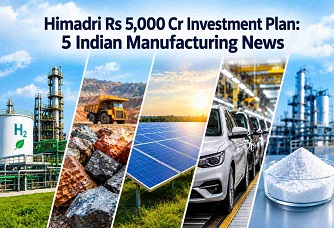
Indian manufacturing sector is seeing developments across clean chemicals, strategic mineral security, renewable energy, automobiles, and advanced materials.
The latest Indian manufacturing news highlights how companies and policymakers are addressing the infrastructure and supply-chain requirements of industrial growth.
Gujarat State Fertilizers and Chemicals (GSFC) is seeking a partner for a large green ammonia facility, while the Centre is preparing a critical minerals stockpiling policy to strengthen supply security.
Meanwhile, Prozeal Green Energy’s proposed solar project divestment signals activity in renewable energy assets, and rising input costs threaten to offset festive-season momentum for automobile manufacturers.
Himadri Speciality Chemical’s planned Rs 5,000-crore investment in Andhra Pradesh adds another dimension to the country’s industrial expansion.
Gujarat State Fertilizers and Chemicals is seeking a joint-venture partner to establish a green ammonia plant with an annual capacity of at least 500,000 tons at its Sikka facility in Jamnagar, Gujarat.
The project is targeting commissioning by December 2030, with potential export markets including Europe, Japan, and South Korea.
The proposed facility reflects the growing role of green ammonia in reducing dependence on fossil fuel-based production.
Key considerations include:
The project highlights the infrastructure requirements behind scaling up low-carbon chemical manufacturing in India.
Also Read: Commercial EV Charging Hub Installation Guide in India 2026
The government is expected to finalize its critical minerals stockpiling policy within a month, according to Mines Secretary Keshav Chandra. The proposed reserve aims to protect strategic industries against supply disruptions and reduce vulnerabilities associated with import dependence.
Critical minerals support battery manufacturing, electric vehicles, renewable energy equipment, electronics and defense production.
However, stockpiling alone cannot address every supply-chain challenge. Manufacturers also need reliable processing and refining capacity, since access to raw minerals does not automatically guarantee the availability of manufacturing-grade materials.
The policy’s release procedures, eligible users, and allocation rules will therefore be important in determining how effectively the reserve supports industrial operations. The government is also pursuing critical mineral processing parks to strengthen domestic value addition.
Prozeal Green Energy has signed a framework agreement with a European independent power producer (IPP) for the proposed divestment of a 100 MW solar project in Gujarat, valued at approximately Rs 460 crore.
The transaction remains subject to necessary approvals, and the project is scheduled to become operational in 2027.
The deal illustrates how renewable energy developers can potentially recycle capital through asset sales and redirect resources towards new projects.
For buyers, acquiring projects can provide an alternative to developing renewable capacity from the beginning.
The indicative transaction value of Rs 4.6 crore per MW should not be treated as a universal valuation benchmark, as project economics depend on factors such as development costs, power purchase agreements and operational status.
The transaction also reflects the continuing interest of international power producers in India's commercial and industrial renewable energy market.
Festive demand is supporting India's automobile industry, but higher input costs could weaken manufacturers' profitability.
According to credible sources, revenues of most automakers are expected to increase by around 29 percent year-on-year in the September quarter of FY27, while operating margins could decline by approximately 200 basis points.
Steel, rubber and crude-linked inputs are among the cost pressures affecting manufacturers.
Tyre makers face particular exposure because rubber and petroleum-linked materials are important production inputs. Operating margins of major domestic tyre manufacturers are expected to decline by 400–480 basis points year-on-year during the quarter.
Manufacturers may respond through pricing adjustments, product-mix improvements and procurement efficiencies. However, the extent to which these measures offset higher material costs will vary across companies.
The trend demonstrates why strong vehicle sales do not necessarily translate into equivalent improvements in manufacturing profitability.
Also read: Zero-Emission Mobility: India's Path to Cleaner Urban Transport
Himadri Speciality Chemical plans to invest Rs 5,000 crore in Andhra Pradesh, adding to the state's manufacturing investment pipeline.
The development is relevant to India's specialty chemicals and advanced materials landscape, where domestic production capabilities can support industrial diversification and supply-chain resilience.
Himadri has separately been expanding its advanced materials portfolio, including lithium iron phosphate (LFP) cathode materials and carbon nanotubes.
These activities provide context for the company's broader growth ambitions. The project's eventual manufacturing scope, implementation schedule, and capacity will determine its contribution to the state's industrial ecosystem.
For India's manufacturing sector, the key consideration is whether large investment announcements translate into operational facilities, local supplier opportunities and sustained domestic production.






We use cookies to ensure you get the best experience on our website. Read more...