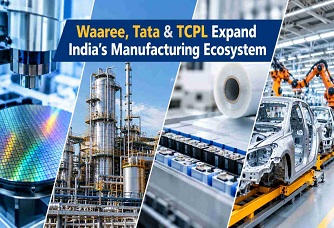
In Industry News Today we see India’s manufacturing expansion is increasingly moving beyond finished products into the specialized inputs that make factories viable.
The latest developments span semiconductor gases and chemicals, battery separator films, specialty chemicals and automotive components.
In the semiconductor sector, new capacity is creating demand for high-purity gases and chemicals, while battery manufacturing is opening opportunities in components such as separator films.
Specialty-chemical producers are simultaneously adding domestic capacity, and automotive suppliers are investing in new plants equipped with increasingly automated production systems.
The latest developments involving Waaree, Tata Electronics, Sumitomo Chemical, TCPL Packaging, Balaji Amines and Toyoda Gosei therefore point to a broader change in India’s manufacturing ecosystem—one where supply-chain depth, component localization and production technology are becoming as important as the size of the factory itself.
India’s semiconductor manufacturing push is beginning to create demand for a domestic ecosystem of gases and chemicals that receives less attention than fabs themselves.
Waaree Clean Energy Solutions, a Waaree Energies subsidiary, is entering the specialty gases market with a plant at GIDC Saykha in Dahej, Gujarat. The business will include ultra-high-purity ammonia purification, phosphine/hydrogen mixing and ultra-high-purity oxygen facilities.
Semiconductor fabs cannot operate on imported equipment alone; they also require a reliable domestic supply of tightly controlled process gases and chemicals.
Waaree’s entry into high-purity specialty gases therefore adds another layer to India’s semiconductor supply chain, creating local capabilities in the consumables required to maintain production continuity as domestic chip manufacturing scales.
Also Read: India Set to Cross 5 Million Car Sales in FY27: Auto Industry Growth Vision
The collaboration between Tata Electronics and Sumitomo Chemical extends this broader effort to strengthen domestic capabilities across the semiconductor value chain.
The companies will explore supplying materials for Tata Electronics upcoming Dholera fab, including photoresists, functional chemicals and high-purity chemicals such as hydrogen peroxide, isopropyl alcohol, ammonia water and sulphuric acid.
They will also explore local manufacture of semiconductor materials in India. The manufacturing significance lies in developing an India semiconductor materials ecosystem alongside wafer fabrication.
Local availability of high-purity inputs could eventually reduce supply-chain dependence and improve resilience as domestic chip production scales.
TCPL Packaging has incorporated TCPL Energy Materials to manufacture lithium-ion battery separator films for EVs and energy-storage applications. The subsidiary has Rs 10 crore of authorized share capital but has not yet commenced operations.
India’s battery manufacturing ambitions require localization beyond cell-assembly capacity. Separators are critical components inside lithium-ion and ACC batteries, making their domestic production relevant to the broader EV battery supply chain.
TCPL’s move therefore represents an early-stage diversification into a specialized battery material rather than an immediate large-scale capacity announcement.
Balaji Amines commenced commercial production at its expanded acetonitrile (ACN) plant in Solapur on September 24, increasing installed capacity to 1,440 tons per month.
The facility forms part of the company’s Unit III operations at Chincholi MIDC and has been upgraded as part of its expansion and modernization program. The company said the production will cater to both domestic and international markets.
The development strengthens India's specialty chemical manufacturing base by adding production capacity for a chemical used across industrial and pharmaceutical applications.
For India’s manufacturing sector, additional domestic capacity in specialized chemicals can support downstream industries that depend on consistent supplies of chemical intermediates.
It also strengthens the country’s broader effort to develop a deeper specialty chemicals ecosystem rather than relying predominantly on imported inputs.
Toyoda Gosei is investing approximately Rs 575.8 crore to establish a new plant in Maharashtra’s Bidkin Industrial Area, with production planned for the first half of 2029.
The facility will manufacture large automotive interior and exterior products such as bumpers and instrument panels, along with safety systems including airbags and steering wheels. The company expects around 570 employees at the plant by 2030.
The location is also relevant to automotive supplier localization. Toyoda Gosei says the new facility is being established to support increasing production capacity among its Japanese automaker customers.
Toyota has separately announced a new vehicle plant in the same Bidkin Industrial Area, planned to begin production in the first half of 2029 with an annual capacity of 100,000 vehicles.





We use cookies to ensure you get the best experience on our website. Read more...