Indian manufacturing is increasingly being shaped by investments that go beyond individual factories and extend into energy, materials, technology and specialized supply chains.
Recent developments around Uttar Pradesh's green-energy pipeline and EV manufacturing ambitions, Embraer-Mahindra and Embraer-Adani partnerships and India's semiconductor ecosystem show this shift clearly.
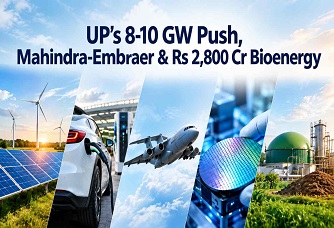
From an 8-10 GW green-energy pipeline and EV clusters to a Rs 2,800 crore bioenergy investment opportunity, the focus is moving towards building the infrastructure that supports industrial capacity.
The deeper question is whether these initiatives can also create stronger domestic supply chains, improve value addition and bring more MSMEs and equipment manufacturers into emerging manufacturing ecosystems.
Uttar Pradesh has identified an 8-10 GW pipeline of renewable-energy opportunities, alongside plans for battery energy storage systems (BESS), green hydrogen, transmission infrastructure and clean-energy manufacturing, at UPITS 2026.
Uttar Pradesh's proposed green-energy pipeline and EV clusters point to an opportunity beyond renewable-power generation: using energy availability to support domestic manufacturing.
The state's EV ambitions will require battery components, motors, power electronics, charging equipment and supporting auto-component suppliers. The less-explored issue is whether these clusters can develop into integrated manufacturing ecosystems rather than simply locations for vehicle assembly.
Renewable power, battery storage, industrial infrastructure and supplier networks will determine how deeply EV manufacturing can be localized.
Also Read: Manufacturing in Maharashtra 2026: Industries, Hubs & Investments
At ALUMINIUM BHARAT 2026, the Aluminium Extrusion Manufacturers Association of India (ALEMAI) called for tariff rationalization, lower energy and financing costs and measures to strengthen domestic demand.
The association also sought safeguards against downstream aluminium products entering India at preferential or concessional rates under free-trade agreements.
India's aluminium extrusion industry has around 30 lakh tons of installed capacity, but domestic production is estimated at only 10–12 lakh tons, while downstream aluminium imports are estimated at 12–15 lakh tons annually.
ALEMAI also cited 2025 aluminium and aluminium-product exports of USD 6.8 billion against imports of about USD 9.9 billion. This points to a manufacturing localization gap: primary aluminium availability does not automatically translate into higher domestic value addition.
Lower input costs and a more competitive tariff structure could influence capacity utilization in sectors such as EVs, automotive components, electrical equipment, infrastructure and machinery.
Embraer has partnered with Mahindra Group to bid for the Indian Air Force's 60-aircraft Multi-Role Transport Aircraft program, offering the KC-390 Millennium.
Separately, Embraer is working with Adani Group on its civilian aircraft business as it seeks to address demand for regional connectivity.
The company has also identified India as strategically important to expanding its global supply-chain and MRO network. The manufacturing opportunity therefore extends beyond the aircraft procurement itself.
A larger Embraer presence could create demand for precision components, engineering, maintenance, aerospace tooling and specialized suppliers.
Finance Minister Nirmala Sitharaman has identified AI, semiconductor chips and quantum technology as the next major areas of infrastructure investment, while calling for greater investment in AI hardware, training and skills.
She also highlighted the need for AI solutions and trainers for MSMEs and invited ideas around patient capital for deep-tech hardware companies with long development cycles. For manufacturing, this means the semiconductor opportunity goes beyond establishing fabs.
India's semiconductor ecosystem will also need cleanroom infrastructure, specialty gases, chemicals, water-treatment systems, testing and packaging facilities and specialized manufacturing equipment.
Similarly, expanding AI infrastructure can generate demand for servers, power systems, cooling equipment and advanced electronics. Building these supporting industries could determine how much domestic value is created around India's technology investments.
Also Read: India as a Global Manufacturing Hub in the New Mobility Era
The Indian Biogas Association expects Renewable Energy India Expo 2026 to unlock more than Rs 2,800 crore in fresh bioenergy investment. The opportunity comes alongside the Rs 23,731 crore GOBARdhan National Circular Bioenergy Scheme, which took effect on September 1, 2026.
The scheme is intended to support the expansion of CBG production, while REI 2026 will bring investors, developers, technology providers and policymakers together.
CBG expansion requires digesters, waste-processing systems, gas purification and compression equipment, storage, monitoring technologies and related infrastructure.
Feedstock collection and logistics are equally important. This creates an opportunity for Indian equipment manufacturers and MSMEs to participate in a growing bioenergy manufacturing ecosystem, rather than limiting the opportunity to project development alone.





We use cookies to ensure you get the best experience on our website. Read more...