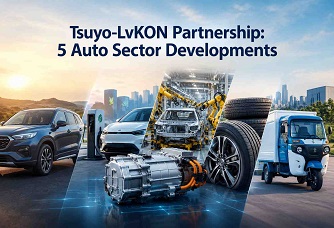
The Indian auto sector is seeing developments across manufacturing, electric mobility, component demand and investment strategies.
Automakers and suppliers are adapting to changing market preferences while exploring new technologies and production opportunities.
The Tsuyo-LvKON agreement to develop electric powertrains for commercial vehicles comes as manufacturers explore ways to strengthen engineering, testing and component production in India.
Other developments reflecting this transition: JK Tyre is benefiting from rising demand for larger tyre profile, Volkswagen has paused further EV investment pending clarity on its potential partnership with JSW Group.
European automakers are exploring manufacturing opportunities in India, and Youdha has introduced an electric cargo three-wheeler.
Together, these developments underline the importance of localization, cost competitiveness and evolving demand across India's automotive value chain.
Tsuyo Manufacturing has entered a technical collaboration with China's Suzhou LvKON Transmission Technology to develop electric drive systems for commercial vehicles.
The companies plan to develop electric motors, transmissions, integrated drive systems and electronic control technologies for trucks, buses and other commercial applications.
Tsuyo is also advancing plans for a proposed 24-acre greenfield facility to expand its manufacturing and testing capabilities.
Tsuyo Founder and CEO Vijay Kumar said LvKON's experience in motors, transmissions and control systems would support the development of electric powertrains suited to demanding commercial vehicle applications.
Also Read: Indian Commercial Vehicle Industry 2026: Trends and Opportunity
Volkswagen has paused further investment in its Indian electric vehicle program while seeking clarity on a potential partnership with JSW Group. The development highlights the challenges of making electric cars commercially viable in India.
The automaker has reportedly completed preliminary design work using a lower-cost EV architecture developed for China but is awaiting a clearer business plan before committing additional capital.
Local sourcing, manufacturing scale and shared development costs could influence the company's future decisions. However, the potential partnership and subsequent investment plans remain unconfirmed.
JK Tyre increased the share of tyres measuring 16 inches and above in its passenger vehicle original equipment business to 40 percent in H1 FY27, compared with 35 percent in FY26.
The change reflects an evolving auto sector product mix, creating opportunities for manufacturers supplying premium tyres. However, rising raw-material costs remain a concern, as price adjustments may not immediately offset higher production expenses.
Commerce and Industry Minister Piyush Goyal has indicated that several European automakers are exploring manufacturing opportunities in India.
The interest could create opportunities for local suppliers and strengthen India's position as a vehicle production and export base.
Turning interest into actual investment will depend on factors such as supply-chain readiness, localization costs, production economics and market access.
Youdha has launched the ePod G electric cargo three-wheeler for commercial transportation and last-mile delivery applications.
The vehicle offers a claimed range of 170-180 km, a payload capacity of 545 kg and an 11.8 kWh lithium iron phosphate battery.
Its half-deck configuration and closed-box variants are intended to serve different cargo requirements. For fleet operators, real-world range, charging schedules, payload utilization and total operating costs will determine its commercial suitability.
These five developments show how the Indian auto sector is balancing technology partnerships, investment discipline, premiumization and the transition towards electric commercial mobility.




We use cookies to ensure you get the best experience on our website. Read more...